

(Wang et al. 1999) (see Fig. 5 and Table S1 for details). BCF calculations rely on
accurate estimation of chemical concentrations in both surface water and biofilm and
are thus strongly influenced by LOQs – for instance, high LOQs in water could lead
to an overestimated BCF (Arnot and Gobas 2006).
In periphyton, the bioaccumulation of any type of contaminant results from a
dynamic process (Chaumet et al. 2019a, b). The concentration of a contaminant
within periphyton tends to an equilibrium between uptake, elimination, and
biotransformation and is also influenced by growth-related dilution effects. Contaminant uptake in biofilm depends strongly on the nature of the chemical
(metal vs. organic) and on the 3D architecture and composition of the biofilm.
First, contaminants enter EPS via passive diffusion and can then either be accumulated/transformed in this extracellular matrix or taken up within the cells (by passive
diffusion and facilitated or active transport). The complex composition of the EPS
matrix of biofilms offers many adsorption sites for both polar and hydrophobic
contaminants (Schorer and Eisele 1997; Flemming and Wingender 2001). Biofilms
take up both metals and organic contaminants that can then be stored (extra- or
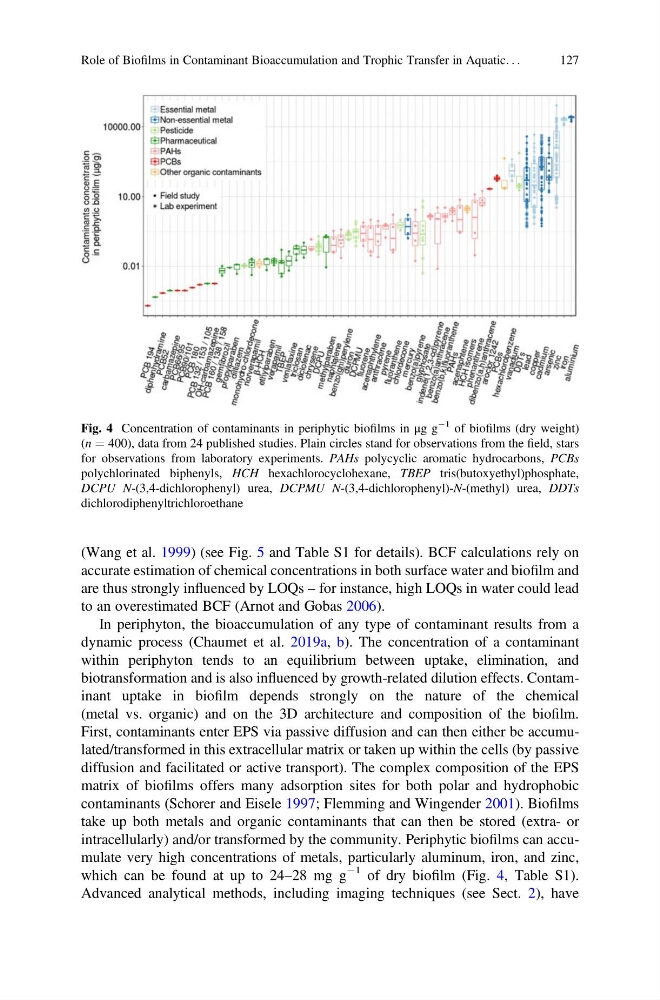
intracellularly) and/or transformed by the community. Periphytic biofilms can accumulate very high concentrations of metals, particularly aluminum, iron, and zinc,
which can be found at up to 24–28 mg g
À1 of dry biofilm (Fig. 4, Table S1).
Advanced analytical methods, including imaging techniques (see Sect. 2), have
Fig. 4 Concentration of contaminants in periphytic biofilms in μg g
À1 of biofilms (dry weight)
(n ¼ 400), data from 24 published studies. Plain circles stand for observations from the field, stars
for observations from laboratory experiments. PAHs polycyclic aromatic hydrocarbons, PCBs
polychlorinated biphenyls, HCH hexachlorocyclohexane, TBEP tris(butoxyethyl)phosphate,
DCPU N-(3,4-dichlorophenyl) urea, DCPMU N-(3,4-dichlorophenyl)-N-(methyl) urea, DDTs
dichlorodiphenyltrichloroethane
Role of Biofilms in Contaminant Bioaccumulation and Trophic Transfer in Aquatic. . .
127
accurate estimation of chemical concentrations in both surface water and biofilm and
are thus strongly influenced by LOQs – for instance, high LOQs in water could lead
to an overestimated BCF (Arnot and Gobas 2006).
In periphyton, the bioaccumulation of any type of contaminant results from a
dynamic process (Chaumet et al. 2019a, b). The concentration of a contaminant
within periphyton tends to an equilibrium between uptake, elimination, and
biotransformation and is also influenced by growth-related dilution effects. Contaminant uptake in biofilm depends strongly on the nature of the chemical
(metal vs. organic) and on the 3D architecture and composition of the biofilm.
First, contaminants enter EPS via passive diffusion and can then either be accumulated/transformed in this extracellular matrix or taken up within the cells (by passive
diffusion and facilitated or active transport). The complex composition of the EPS
matrix of biofilms offers many adsorption sites for both polar and hydrophobic
contaminants (Schorer and Eisele 1997; Flemming and Wingender 2001). Biofilms
take up both metals and organic contaminants that can then be stored (extra- or
intracellularly) and/or transformed by the community. Periphytic biofilms can accumulate very high concentrations of metals, particularly aluminum, iron, and zinc,
which can be found at up to 24–28 mg g
À1 of dry biofilm (Fig. 4, Table S1).
Advanced analytical methods, including imaging techniques (see Sect. 2), have
Fig. 4 Concentration of contaminants in periphytic biofilms in μg g
À1 of biofilms (dry weight)
(n ¼ 400), data from 24 published studies. Plain circles stand for observations from the field, stars
for observations from laboratory experiments. PAHs polycyclic aromatic hydrocarbons, PCBs
polychlorinated biphenyls, HCH hexachlorocyclohexane, TBEP tris(butoxyethyl)phosphate,
DCPU N-(3,4-dichlorophenyl) urea, DCPMU N-(3,4-dichlorophenyl)-N-(methyl) urea, DDTs
dichlorodiphenyltrichloroethane
Role of Biofilms in Contaminant Bioaccumulation and Trophic Transfer in Aquatic. . .
127