

77
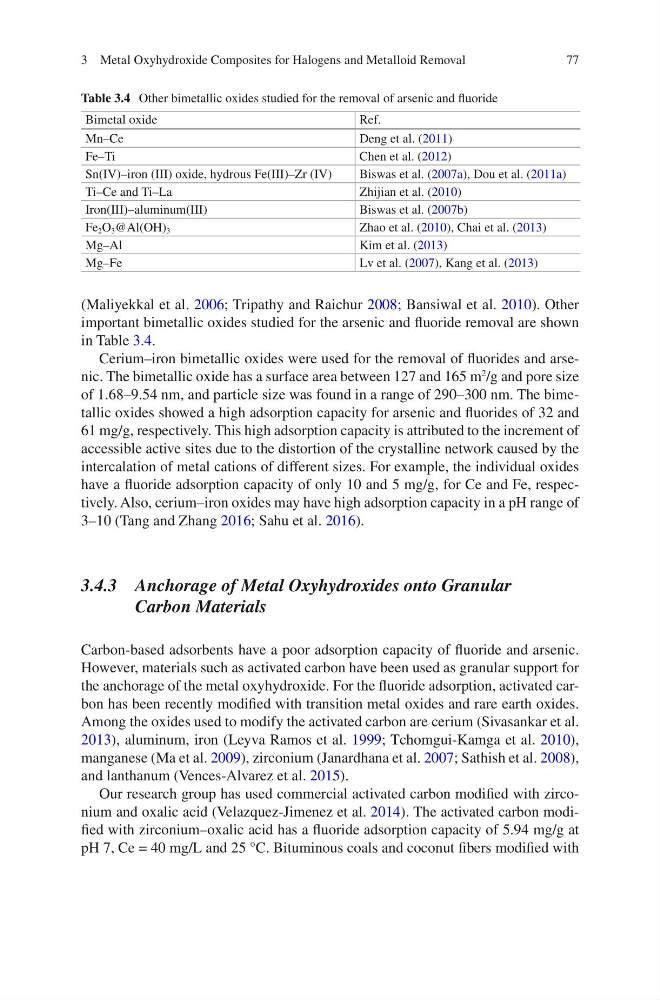
(Maliyekkal et al. 2006; Tripathy and Raichur 2008; Bansiwal et al. 2010). Other
important bimetallic oxides studied for the arsenic and fluoride removal are shown
in Table 3.4.
Cerium–iron bimetallic oxides were used for the removal of fluorides and arsenic. The bimetallic oxide has a surface area between 127 and 165 m
2
/g and pore size
of 1.68–9.54 nm, and particle size was found in a range of 290–300 nm. The bimetallic oxides showed a high adsorption capacity for arsenic and fluorides of 32 and
61 mg/g, respectively. This high adsorption capacity is attributed to the increment of
accessible active sites due to the distortion of the crystalline network caused by the
intercalation of metal cations of different sizes. For example, the individual oxides
have a fluoride adsorption capacity of only 10 and 5 mg/g, for Ce and Fe, respectively. Also, cerium–iron oxides may have high adsorption capacity in a pH range of
3–10 (Tang and Zhang 2016; Sahu et al. 2016).
3.4.3 Anchorage of Metal Oxyhydroxides onto Granular
Carbon Materials
Carbon-based adsorbents have a poor adsorption capacity of fluoride and arsenic.
However, materials such as activated carbon have been used as granular support for
the anchorage of the metal oxyhydroxide. For the fluoride adsorption, activated carbon has been recently modified with transition metal oxides and rare earth oxides.
Among the oxides used to modify the activated carbon are cerium (Sivasankar et al.
2013), aluminum, iron (Leyva Ramos et al. 1999; Tchomgui-Kamga et al. 2010),
manganese (Ma et al. 2009), zirconium (Janardhana et al. 2007; Sathish et al. 2008),
and lanthanum (Vences-Alvarez et al. 2015).
Our research group has used commercial activated carbon modified with zirconium and oxalic acid (Velazquez-Jimenez et al. 2014). The activated carbon modified with zirconium–oxalic acid has a fluoride adsorption capacity of 5.94 mg/g at
pH 7, Ce = 40 mg/L and 25 °C. Bituminous coals and coconut fibers modified with
Table 3.4 Other bimetallic oxides studied for the removal of arsenic and fluoride
Bimetal oxide
Ref.
Mn–Ce
Deng et al. (2011)
Fe–Ti
Chen et al. (2012)
Sn(IV)–iron (III) oxide, hydrous Fe(III)–Zr (IV)
Biswas et al. (2007a), Dou et al. (2011a)
Ti–Ce and Ti–La
Zhijian et al. (2010)
Iron(III)–aluminum(III)
Biswas et al. (2007b)
Fe 2 O 3 @Al(OH) 3
Zhao et al. (2010), Chai et al. (2013)
Mg–Al
Kim et al. (2013)
Mg–Fe
Lv et al. (2007), Kang et al. (2013)
3 Metal Oxyhydroxide Composites for Halogens and Metalloid Removal
(Maliyekkal et al. 2006; Tripathy and Raichur 2008; Bansiwal et al. 2010). Other
important bimetallic oxides studied for the arsenic and fluoride removal are shown
in Table 3.4.
Cerium–iron bimetallic oxides were used for the removal of fluorides and arsenic. The bimetallic oxide has a surface area between 127 and 165 m
2
/g and pore size
of 1.68–9.54 nm, and particle size was found in a range of 290–300 nm. The bimetallic oxides showed a high adsorption capacity for arsenic and fluorides of 32 and
61 mg/g, respectively. This high adsorption capacity is attributed to the increment of
accessible active sites due to the distortion of the crystalline network caused by the
intercalation of metal cations of different sizes. For example, the individual oxides
have a fluoride adsorption capacity of only 10 and 5 mg/g, for Ce and Fe, respectively. Also, cerium–iron oxides may have high adsorption capacity in a pH range of
3–10 (Tang and Zhang 2016; Sahu et al. 2016).
3.4.3 Anchorage of Metal Oxyhydroxides onto Granular
Carbon Materials
Carbon-based adsorbents have a poor adsorption capacity of fluoride and arsenic.
However, materials such as activated carbon have been used as granular support for
the anchorage of the metal oxyhydroxide. For the fluoride adsorption, activated carbon has been recently modified with transition metal oxides and rare earth oxides.
Among the oxides used to modify the activated carbon are cerium (Sivasankar et al.
2013), aluminum, iron (Leyva Ramos et al. 1999; Tchomgui-Kamga et al. 2010),
manganese (Ma et al. 2009), zirconium (Janardhana et al. 2007; Sathish et al. 2008),
and lanthanum (Vences-Alvarez et al. 2015).
Our research group has used commercial activated carbon modified with zirconium and oxalic acid (Velazquez-Jimenez et al. 2014). The activated carbon modified with zirconium–oxalic acid has a fluoride adsorption capacity of 5.94 mg/g at
pH 7, Ce = 40 mg/L and 25 °C. Bituminous coals and coconut fibers modified with
Table 3.4 Other bimetallic oxides studied for the removal of arsenic and fluoride
Bimetal oxide
Ref.
Mn–Ce
Deng et al. (2011)
Fe–Ti
Chen et al. (2012)
Sn(IV)–iron (III) oxide, hydrous Fe(III)–Zr (IV)
Biswas et al. (2007a), Dou et al. (2011a)
Ti–Ce and Ti–La
Zhijian et al. (2010)
Iron(III)–aluminum(III)
Biswas et al. (2007b)
Fe 2 O 3 @Al(OH) 3
Zhao et al. (2010), Chai et al. (2013)
Mg–Al
Kim et al. (2013)
Mg–Fe
Lv et al. (2007), Kang et al. (2013)
3 Metal Oxyhydroxide Composites for Halogens and Metalloid Removal