

62
particles are unestablished or neutralized, the particles start to agglomerate under
gentle stirring. The addition of chemicals promotes the collection of particles, until
reaching a mass high enough to settle or to be removed during filtration.
The most common chemicals used during coagulation are hydrolyzed metals,
including ferric sulfate (Fe 2 (SO 4 ) 3 xH 2 O), aluminum sulfate (Al 2 (SO 4 ) 3 14H 2 O), and
ferric chloride (FeCl 3 xH 2 O) (Edzwald 2010). These metals hydrolyze in water, to
form iron and aluminum hydroxo/aquo complexes with positive charges (e.g.,
Al(H 2 O) 6
3+
) that neutralize the negative charge of the colloids in water. Polymers
can achieve the same task, including biopolymers such as chitin, among others
(Kartinen and Martin 1995).
In this way, the clarification process which includes coagulation, flocculation, and
sedimentation is a specific operation for the removal of colloidal particles from
water. However, these processes can also remove arsenic and fluorine indirectly.
According to the chemical speciation of arsenic (arsenate) and fluorine, the predominant chemical form is a negatively charged ion, also known as anion (see Figs. 3.1
and 3.2). Since coagulant bears a positive charge, arsenic and fluorine can be attracted
to coagulant chemicals by electrostatic interaction and removed from the solution as
adsorbed anions in the sludge. A study of the arsenic removal during conventional
water treatment at a full scale with aluminum-based coagulants confirmed that most
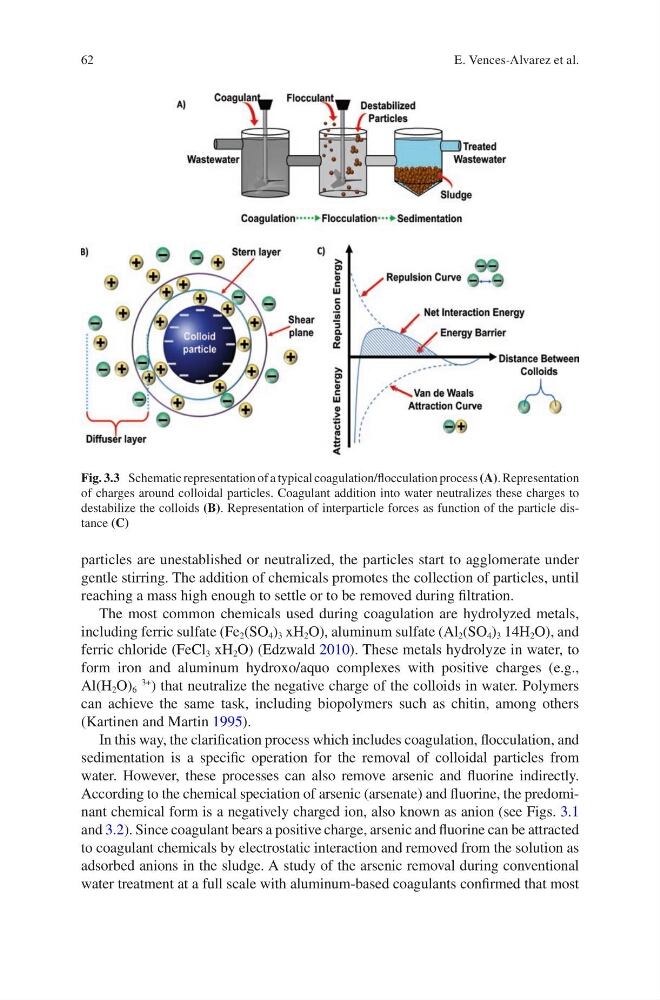
Fig. 3.3 Schematic representation of a typical coagulation/flocculation process (A). Representation
of charges around colloidal particles. Coagulant addition into water neutralizes these charges to
destabilize the colloids (B). Representation of interparticle forces as function of the particle distance (C)
E. Vences-Alvarez et al.
particles are unestablished or neutralized, the particles start to agglomerate under
gentle stirring. The addition of chemicals promotes the collection of particles, until
reaching a mass high enough to settle or to be removed during filtration.
The most common chemicals used during coagulation are hydrolyzed metals,
including ferric sulfate (Fe 2 (SO 4 ) 3 xH 2 O), aluminum sulfate (Al 2 (SO 4 ) 3 14H 2 O), and
ferric chloride (FeCl 3 xH 2 O) (Edzwald 2010). These metals hydrolyze in water, to
form iron and aluminum hydroxo/aquo complexes with positive charges (e.g.,
Al(H 2 O) 6
3+
) that neutralize the negative charge of the colloids in water. Polymers
can achieve the same task, including biopolymers such as chitin, among others
(Kartinen and Martin 1995).
In this way, the clarification process which includes coagulation, flocculation, and
sedimentation is a specific operation for the removal of colloidal particles from
water. However, these processes can also remove arsenic and fluorine indirectly.
According to the chemical speciation of arsenic (arsenate) and fluorine, the predominant chemical form is a negatively charged ion, also known as anion (see Figs. 3.1
and 3.2). Since coagulant bears a positive charge, arsenic and fluorine can be attracted
to coagulant chemicals by electrostatic interaction and removed from the solution as
adsorbed anions in the sludge. A study of the arsenic removal during conventional
water treatment at a full scale with aluminum-based coagulants confirmed that most
Fig. 3.3 Schematic representation of a typical coagulation/flocculation process (A). Representation
of charges around colloidal particles. Coagulant addition into water neutralizes these charges to
destabilize the colloids (B). Representation of interparticle forces as function of the particle distance (C)
E. Vences-Alvarez et al.