

50
carried out. These compounds can be produced either directly by their precursor
polymerization response (or by grafting suitable organic groups on main chain created by sol–gel methods such as silica gel) (Samiey et al. 2014).
2.12 Polymer/Clay Nanocomposite as Heavy
Metal Adsorbent
Polymer/clay nanocomposites have drawn significant attention from scholarly scientists as a very promising option to expanding industrial and economic operations
and satisfying progressively stringent circumstances. Polymer/clay nanocomposites
are now becoming an evolving research and growth area. They are actually multiphase materials in which ultrafine clay in the range of 1–100 nm is dispersed into
polymer matrix. They simultaneously demonstrate both inorganic and organic properties that assist the investigator study their apparent potential or technological
material that also provides a comfortable macroscopic environment for studying
main science phenomena, such as zeta potential (electrokinetic potential in colloidal
systems), rheology, and young modulus. After discovering the outcomes of such
different tests of these materials, it was well defined that they demonstrate enhanced
characteristics such as tensile strength, traction modulus, reduced coefficient of heat
expansion, enhanced solvent resistance, enhanced gas barrier characteristics, and
enhanced sorption capability (Jin et al. 2011). Following are some of the materials
applied for heavy metal adsorption;
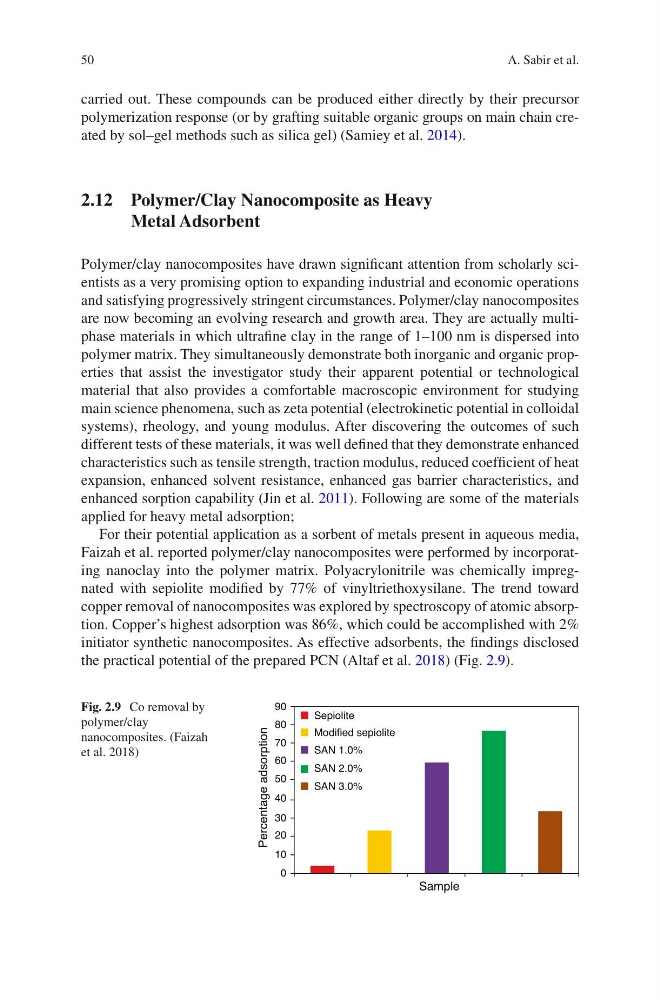
For their potential application as a sorbent of metals present in aqueous media,
Faizah et al. reported polymer/clay nanocomposites were performed by incorporating nanoclay into the polymer matrix. Polyacrylonitrile was chemically impregnated with sepiolite modified by 77% of vinyltriethoxysilane. The trend toward
copper removal of nanocomposites was explored by spectroscopy of atomic absorption. Copper’s highest adsorption was 86%, which could be accomplished with 2%
initiator synthetic nanocomposites. As effective adsorbents, the findings disclosed
the practical potential of the prepared PCN (Altaf et al. 2018) (Fig. 2.9).
Sepiolite
Modified sepiolite
SAN 1.0%
SAN 2.0%
SAN 3.0%
Sample
Percentage adsorption
90
80
70
60
50
40
30
20
10
0
Fig. 2.9 Co removal by
polymer/clay
nanocomposites. (Faizah
et al. 2018)
A. Sabir et al.
carried out. These compounds can be produced either directly by their precursor
polymerization response (or by grafting suitable organic groups on main chain created by sol–gel methods such as silica gel) (Samiey et al. 2014).
2.12 Polymer/Clay Nanocomposite as Heavy
Metal Adsorbent
Polymer/clay nanocomposites have drawn significant attention from scholarly scientists as a very promising option to expanding industrial and economic operations
and satisfying progressively stringent circumstances. Polymer/clay nanocomposites
are now becoming an evolving research and growth area. They are actually multiphase materials in which ultrafine clay in the range of 1–100 nm is dispersed into
polymer matrix. They simultaneously demonstrate both inorganic and organic properties that assist the investigator study their apparent potential or technological
material that also provides a comfortable macroscopic environment for studying
main science phenomena, such as zeta potential (electrokinetic potential in colloidal
systems), rheology, and young modulus. After discovering the outcomes of such
different tests of these materials, it was well defined that they demonstrate enhanced
characteristics such as tensile strength, traction modulus, reduced coefficient of heat
expansion, enhanced solvent resistance, enhanced gas barrier characteristics, and
enhanced sorption capability (Jin et al. 2011). Following are some of the materials
applied for heavy metal adsorption;
For their potential application as a sorbent of metals present in aqueous media,
Faizah et al. reported polymer/clay nanocomposites were performed by incorporating nanoclay into the polymer matrix. Polyacrylonitrile was chemically impregnated with sepiolite modified by 77% of vinyltriethoxysilane. The trend toward
copper removal of nanocomposites was explored by spectroscopy of atomic absorption. Copper’s highest adsorption was 86%, which could be accomplished with 2%
initiator synthetic nanocomposites. As effective adsorbents, the findings disclosed
the practical potential of the prepared PCN (Altaf et al. 2018) (Fig. 2.9).
Sepiolite
Modified sepiolite
SAN 1.0%
SAN 2.0%
SAN 3.0%
Sample
Percentage adsorption
90
80
70
60
50
40
30
20
10
0
Fig. 2.9 Co removal by
polymer/clay
nanocomposites. (Faizah
et al. 2018)
A. Sabir et al.