

37
2.6 Choice of Adsorbent
However, selecting novel kinds of adsorbents is the biggest issue in this sector.
Several adsorbents are used to culminate ions of heavy metal, e.g., activated carbon
(Brigatti et al. 2000), zeolites (Chuang et al. 2007), clays (Carrado et al. 2001), and
agricultural residues (Hettige et al. 2000). The significant drawbacks of such sorbents include small adsorption capacity, their comparatively poor bonding with
heavy metal ions, and problems in some of them separating and regenerating from
wastewater. Metal ions can be significantly removed by ion-exchange resins, but
they have weak ion discernment and elevated swelling in combination with bad
mechanical stamina (Koo 2006).
2.6.1 Conventional Sorbents
Adsorption is regarded to be the most environmentally friendly method for particular removal of such pollutants. The ion-exchange resins, chelating agents (ligands),
and hybrid composite materials with carrier matrix (such as inorganic materials)
and organic enhancers (such as polymers) are different sorbents in use (Say
et al. 2006).
The activated carbon has been regarded as one of the most commonly used
adsorbents in the last century. The toxic pollutants in industrial waste aqueous
medium that has benzenols, pigments, and inorganic toxicants must be adsorbed
strongly by charged charcoal produced from distinct fields of operations. But it is a
reality that the heat charged use of charcoal in pollutant removal has faced costly
reproduction in the long run as a result of adsorbent toxicity potential. In addition,
it adsorbs separate chemicals unsystematically, minimizing their likelihood of being
used again, making it more hard to regenerate the adsorbent. Meanwhile, for aqueous cleaning, many inexpensive adsorbing substrates are synthesized. Such
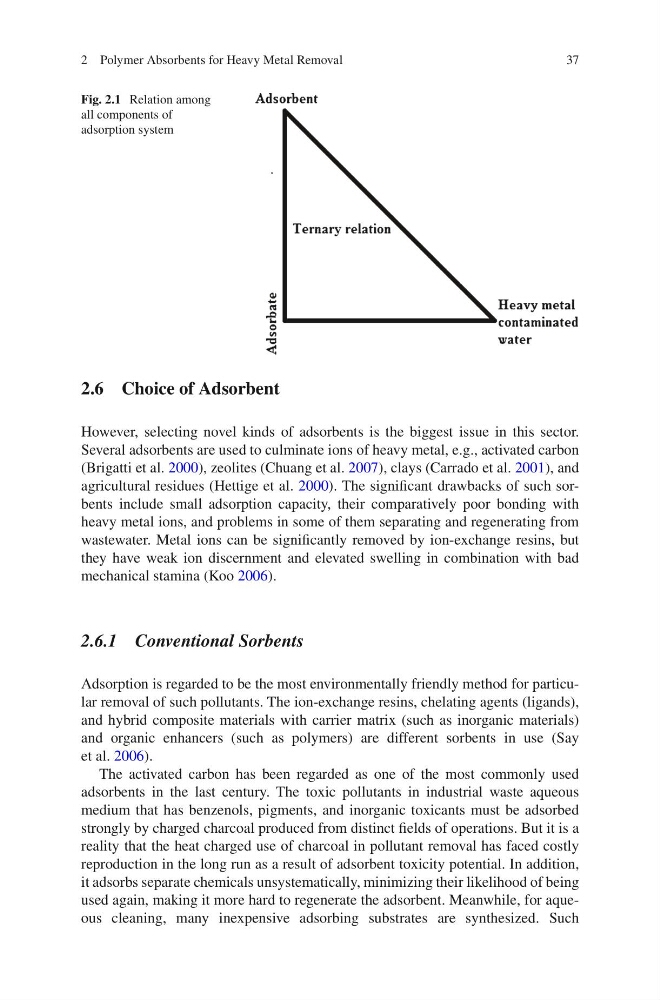
Fig. 2.1 Relation among
all components of
adsorption system
2 Polymer Absorbents for Heavy Metal Removal
2.6 Choice of Adsorbent
However, selecting novel kinds of adsorbents is the biggest issue in this sector.
Several adsorbents are used to culminate ions of heavy metal, e.g., activated carbon
(Brigatti et al. 2000), zeolites (Chuang et al. 2007), clays (Carrado et al. 2001), and
agricultural residues (Hettige et al. 2000). The significant drawbacks of such sorbents include small adsorption capacity, their comparatively poor bonding with
heavy metal ions, and problems in some of them separating and regenerating from
wastewater. Metal ions can be significantly removed by ion-exchange resins, but
they have weak ion discernment and elevated swelling in combination with bad
mechanical stamina (Koo 2006).
2.6.1 Conventional Sorbents
Adsorption is regarded to be the most environmentally friendly method for particular removal of such pollutants. The ion-exchange resins, chelating agents (ligands),
and hybrid composite materials with carrier matrix (such as inorganic materials)
and organic enhancers (such as polymers) are different sorbents in use (Say
et al. 2006).
The activated carbon has been regarded as one of the most commonly used
adsorbents in the last century. The toxic pollutants in industrial waste aqueous
medium that has benzenols, pigments, and inorganic toxicants must be adsorbed
strongly by charged charcoal produced from distinct fields of operations. But it is a
reality that the heat charged use of charcoal in pollutant removal has faced costly
reproduction in the long run as a result of adsorbent toxicity potential. In addition,
it adsorbs separate chemicals unsystematically, minimizing their likelihood of being
used again, making it more hard to regenerate the adsorbent. Meanwhile, for aqueous cleaning, many inexpensive adsorbing substrates are synthesized. Such
Fig. 2.1 Relation among
all components of
adsorption system
2 Polymer Absorbents for Heavy Metal Removal