

433
capacity, two main challenges require further investigation: first, the mass production of layered double hydroxide-based hybrids requires appropriate continuous
process to obtain high-quality product. Secondly, there are multi-pollutants in the
real wastewater. Thus, it is essential to examine the adsorption/removal performance
of these layered double hydroxide-based hybrids for real wastewaters (Daud
et al. 2019).
Organic–Inorganic Adsorbents
Organic–inorganic materials are not clearly defined, since substances that contain
both organic and inorganic compounds do not necessarily fall into the group. The
requirement for a substance to be considered as an organic–inorganic compound is
a molecular-level combination of the two fractions. Therefore, some hybrid materials such as commercial mineral-charged polymers and metal alkoxides should not
be considered as organic–inorganic materials (Gómez-Romero and Sanchez 2006).
An initial categorization of the most conventional types of organic–inorganic materials typically comprises (1) intercalation compounds (e.g., transition metal dichalcogenides), (2) organic derivatives of inorganic solids, and (3) sol–gel composites
(e.g., organic-functionalized silica) (Aguado et al. 2009).
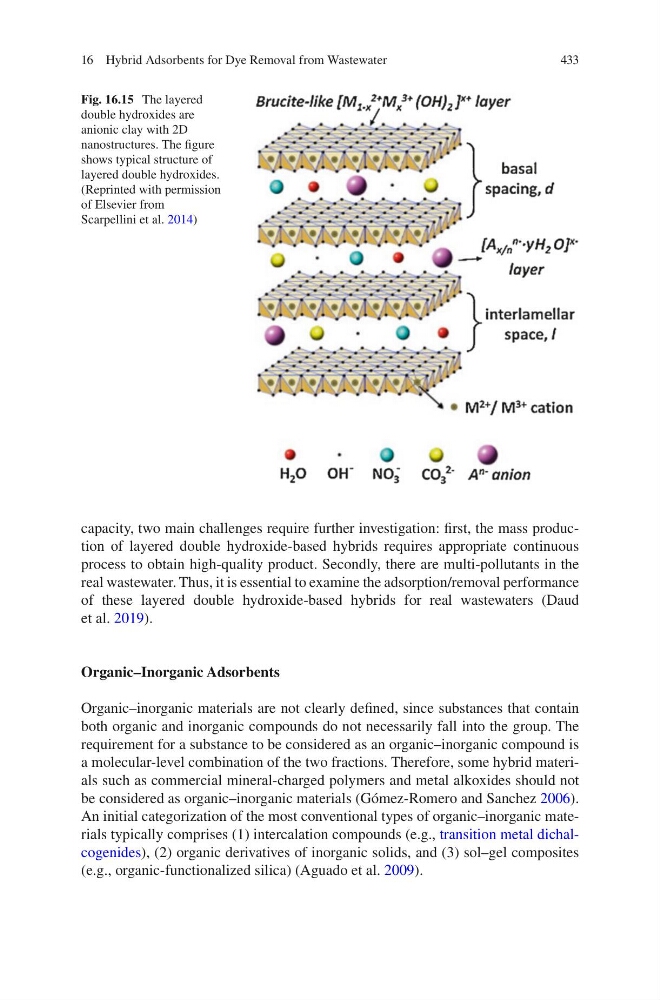
Fig. 16.15 The layered
double hydroxides are
anionic clay with 2D
nanostructures. The figure
shows typical structure of
layered double hydroxides.
(Reprinted with permission
of Elsevier from
Scarpellini et al. 2014)
16 Hybrid Adsorbents for Dye Removal from Wastewater
capacity, two main challenges require further investigation: first, the mass production of layered double hydroxide-based hybrids requires appropriate continuous
process to obtain high-quality product. Secondly, there are multi-pollutants in the
real wastewater. Thus, it is essential to examine the adsorption/removal performance
of these layered double hydroxide-based hybrids for real wastewaters (Daud
et al. 2019).
Organic–Inorganic Adsorbents
Organic–inorganic materials are not clearly defined, since substances that contain
both organic and inorganic compounds do not necessarily fall into the group. The
requirement for a substance to be considered as an organic–inorganic compound is
a molecular-level combination of the two fractions. Therefore, some hybrid materials such as commercial mineral-charged polymers and metal alkoxides should not
be considered as organic–inorganic materials (Gómez-Romero and Sanchez 2006).
An initial categorization of the most conventional types of organic–inorganic materials typically comprises (1) intercalation compounds (e.g., transition metal dichalcogenides), (2) organic derivatives of inorganic solids, and (3) sol–gel composites
(e.g., organic-functionalized silica) (Aguado et al. 2009).
Fig. 16.15 The layered
double hydroxides are
anionic clay with 2D
nanostructures. The figure
shows typical structure of
layered double hydroxides.
(Reprinted with permission
of Elsevier from
Scarpellini et al. 2014)
16 Hybrid Adsorbents for Dye Removal from Wastewater