

430
Bimetals
Bimetals have an undeniable role and a promising future in pollutant removal.
Monometal and metal oxide have limitations such as slow contaminant removal
efficiency and facile deactivation (Wang et al. 2015; Hong et al. 2010). Also, the
removal process is easily influenced by pH. To tailor the monometal and metal
oxide reactivity, the bimetallic particles were prepared by coating small quantities
of noble metals (Pt, Ag, or Pd) or other metals (Cu, Mn, or Ni) onto a fresh metal
surface. In the last few years, there has been a great deal of interest in the utilization
of bimetallic particles for the disposal of pollutants (Fang et al. 2015; Zhao
et al. 2015).
The application of bimetal nanoparticles in the removal of azo dyes and nitro
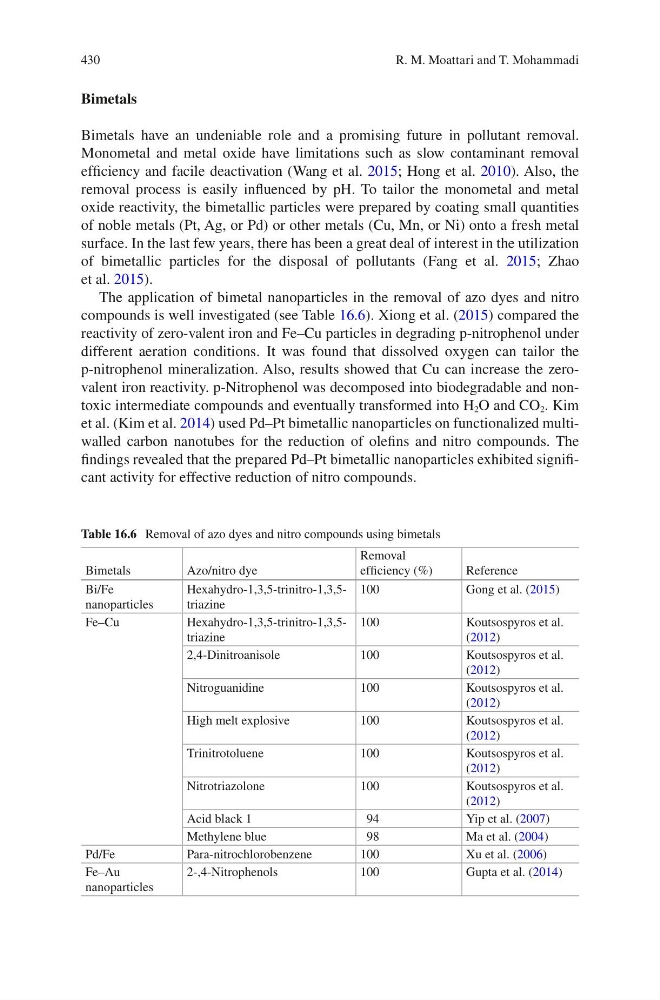
compounds is well investigated (see Table 16.6). Xiong et al. (2015) compared the
reactivity of zero-valent iron and Fe–Cu particles in degrading p-nitrophenol under
different aeration conditions. It was found that dissolved oxygen can tailor the
p-nitrophenol mineralization. Also, results showed that Cu can increase the zerovalent iron reactivity. p-Nitrophenol was decomposed into biodegradable and nontoxic intermediate compounds and eventually transformed into H 2 O and CO 2 . Kim
et al. (Kim et al. 2014) used Pd–Pt bimetallic nanoparticles on functionalized multiwalled carbon nanotubes for the reduction of olefins and nitro compounds. The
findings revealed that the prepared Pd–Pt bimetallic nanoparticles exhibited significant activity for effective reduction of nitro compounds.
Table 16.6 Removal of azo dyes and nitro compounds using bimetals
Bimetals
Azo/nitro dye
Removal
efficiency (%)
Reference
Bi/Fe
nanoparticles
Hexahydro-1,3,5-trinitro-1,3,5triazine
100
Gong et al. (2015)
Fe–Cu
Hexahydro-1,3,5-trinitro-1,3,5triazine
100
Koutsospyros et al.
(2012)
2,4-Dinitroanisole
100
Koutsospyros et al.
(2012)
Nitroguanidine
100
Koutsospyros et al.
(2012)
High melt explosive
100
Koutsospyros et al.
(2012)
Trinitrotoluene
100
Koutsospyros et al.
(2012)
Nitrotriazolone
100
Koutsospyros et al.
(2012)
Acid black 1
94
Yip et al. (2007)
Methylene blue
98
Ma et al. (2004)
Pd/Fe
Para-nitrochlorobenzene
100
Xu et al. (2006)
Fe–Au
nanoparticles
2-,4-Nitrophenols
100
Gupta et al. (2014)
R. M. Moattari and T. Mohammadi
Bimetals
Bimetals have an undeniable role and a promising future in pollutant removal.
Monometal and metal oxide have limitations such as slow contaminant removal
efficiency and facile deactivation (Wang et al. 2015; Hong et al. 2010). Also, the
removal process is easily influenced by pH. To tailor the monometal and metal
oxide reactivity, the bimetallic particles were prepared by coating small quantities
of noble metals (Pt, Ag, or Pd) or other metals (Cu, Mn, or Ni) onto a fresh metal
surface. In the last few years, there has been a great deal of interest in the utilization
of bimetallic particles for the disposal of pollutants (Fang et al. 2015; Zhao
et al. 2015).
The application of bimetal nanoparticles in the removal of azo dyes and nitro
compounds is well investigated (see Table 16.6). Xiong et al. (2015) compared the
reactivity of zero-valent iron and Fe–Cu particles in degrading p-nitrophenol under
different aeration conditions. It was found that dissolved oxygen can tailor the
p-nitrophenol mineralization. Also, results showed that Cu can increase the zerovalent iron reactivity. p-Nitrophenol was decomposed into biodegradable and nontoxic intermediate compounds and eventually transformed into H 2 O and CO 2 . Kim
et al. (Kim et al. 2014) used Pd–Pt bimetallic nanoparticles on functionalized multiwalled carbon nanotubes for the reduction of olefins and nitro compounds. The
findings revealed that the prepared Pd–Pt bimetallic nanoparticles exhibited significant activity for effective reduction of nitro compounds.
Table 16.6 Removal of azo dyes and nitro compounds using bimetals
Bimetals
Azo/nitro dye
Removal
efficiency (%)
Reference
Bi/Fe
nanoparticles
Hexahydro-1,3,5-trinitro-1,3,5triazine
100
Gong et al. (2015)
Fe–Cu
Hexahydro-1,3,5-trinitro-1,3,5triazine
100
Koutsospyros et al.
(2012)
2,4-Dinitroanisole
100
Koutsospyros et al.
(2012)
Nitroguanidine
100
Koutsospyros et al.
(2012)
High melt explosive
100
Koutsospyros et al.
(2012)
Trinitrotoluene
100
Koutsospyros et al.
(2012)
Nitrotriazolone
100
Koutsospyros et al.
(2012)
Acid black 1
94
Yip et al. (2007)
Methylene blue
98
Ma et al. (2004)
Pd/Fe
Para-nitrochlorobenzene
100
Xu et al. (2006)
Fe–Au
nanoparticles
2-,4-Nitrophenols
100
Gupta et al. (2014)
R. M. Moattari and T. Mohammadi