

390
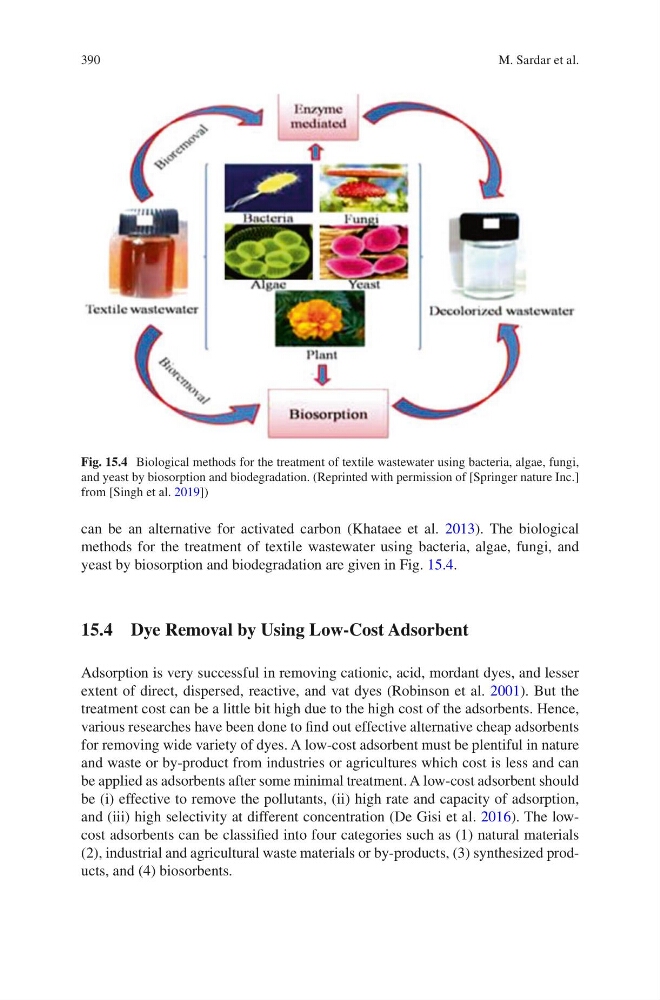
can be an alternative for activated carbon (Khataee et al. 2013). The biological
methods for the treatment of textile wastewater using bacteria, algae, fungi, and
yeast by biosorption and biodegradation are given in Fig. 15.4.
15.4 Dye Removal by Using Low-Cost Adsorbent
Adsorption is very successful in removing cationic, acid, mordant dyes, and lesser
extent of direct, dispersed, reactive, and vat dyes (Robinson et al. 2001). But the
treatment cost can be a little bit high due to the high cost of the adsorbents. Hence,
various researches have been done to find out effective alternative cheap adsorbents
for removing wide variety of dyes. A low-cost adsorbent must be plentiful in nature
and waste or by-product from industries or agricultures which cost is less and can
be applied as adsorbents after some minimal treatment. A low-cost adsorbent should
be (i) effective to remove the pollutants, (ii) high rate and capacity of adsorption,
and (iii) high selectivity at different concentration (De Gisi et al. 2016). The lowcost adsorbents can be classified into four categories such as (1) natural materials
(2), industrial and agricultural waste materials or by-products, (3) synthesized products, and (4) biosorbents.
Fig. 15.4 Biological methods for the treatment of textile wastewater using bacteria, algae, fungi,
and yeast by biosorption and biodegradation. (Reprinted with permission of [Springer nature Inc.]
from [Singh et al. 2019])
M. Sardar et al.
can be an alternative for activated carbon (Khataee et al. 2013). The biological
methods for the treatment of textile wastewater using bacteria, algae, fungi, and
yeast by biosorption and biodegradation are given in Fig. 15.4.
15.4 Dye Removal by Using Low-Cost Adsorbent
Adsorption is very successful in removing cationic, acid, mordant dyes, and lesser
extent of direct, dispersed, reactive, and vat dyes (Robinson et al. 2001). But the
treatment cost can be a little bit high due to the high cost of the adsorbents. Hence,
various researches have been done to find out effective alternative cheap adsorbents
for removing wide variety of dyes. A low-cost adsorbent must be plentiful in nature
and waste or by-product from industries or agricultures which cost is less and can
be applied as adsorbents after some minimal treatment. A low-cost adsorbent should
be (i) effective to remove the pollutants, (ii) high rate and capacity of adsorption,
and (iii) high selectivity at different concentration (De Gisi et al. 2016). The lowcost adsorbents can be classified into four categories such as (1) natural materials
(2), industrial and agricultural waste materials or by-products, (3) synthesized products, and (4) biosorbents.
Fig. 15.4 Biological methods for the treatment of textile wastewater using bacteria, algae, fungi,
and yeast by biosorption and biodegradation. (Reprinted with permission of [Springer nature Inc.]
from [Singh et al. 2019])
M. Sardar et al.