

381
sulfur group, carbon with nitrogen group, nitro, nitroso, or chinoid groups (Rai et al.
2005). On the other hand, auxochrome, i.e., donor of electrons, which can not only
supplement the chromophore but also intensify the casting of chromophore by modifying the overall strength of the electronic system and providing the solubility and the
adhesion of the dye to the fiber by means of stable chemical bonds (Rai et al. 2005;
Gupta and Suhas 2009). The most common auxochrome are carboxyl, sulfonate,
amino, and hydroxyl group. The chemical bonds are organized by basic or acidic
groups in nature (Rai et al. 2005).
15.2.2 Classification of Dyes
Dye can be arranged in a number of ways like basic chemistry, source of materials,
industrial application, nuclear structure, nature of chromophores, Colour Index, and
specific way of bonding (e.g., physical forces or robust bonds). Dyes are also
arranged depending on their dissolution of particle charge in solution like cationic,
anionic, and non-ionic. Dye can be classified based on their solubility. For example,
soluble dyes include acid, basic, direct, mordant, metal complex, and reactive dyes;
and insoluble dyes include sulfur, azoic, vat, and disperse dyes (Yagub et al. 2014).
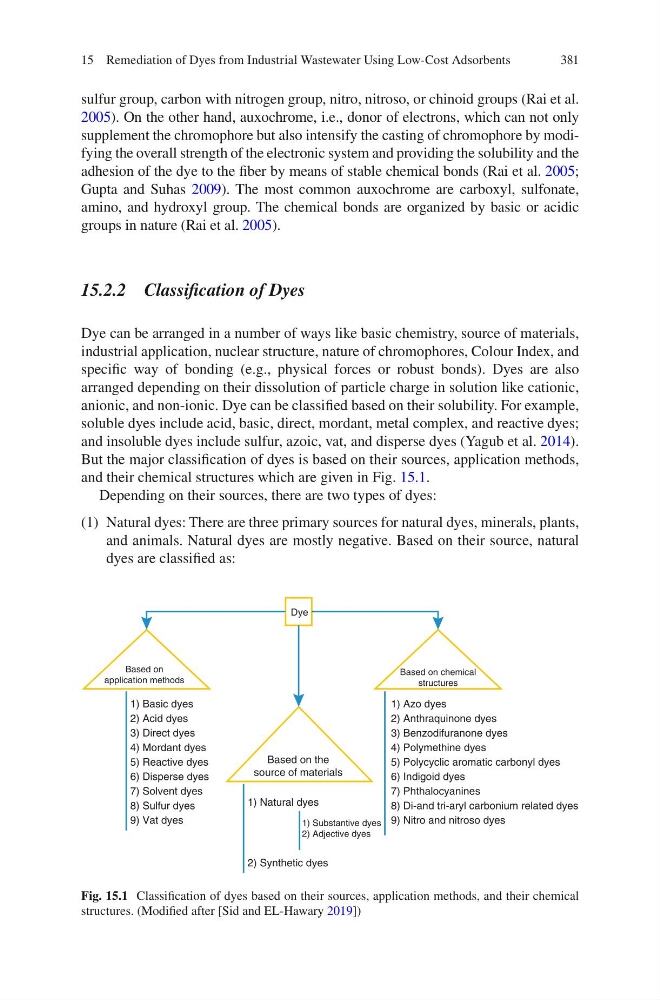
But the major classification of dyes is based on their sources, application methods,
and their chemical structures which are given in Fig. 15.1.
Depending on their sources, there are two types of dyes:
(1) Natural dyes: There are three primary sources for natural dyes, minerals, plants,
and animals. Natural dyes are mostly negative. Based on their source, natural
dyes are classified as:
Based on
application methods
Dye
Based on the
source of materials
1) Natural dyes
2) Synthetic dyes
1) Substantive dyes
2) Adjective dyes
Based on chemical
structures
1) Basic dyes
2) Acid dyes
3) Direct dyes
4) Mordant dyes
5) Reactive dyes
6) Disperse dyes
7) Solvent dyes
8) Sulfur dyes
9) Vat dyes
1) Azo dyes
2) Anthraquinone dyes
3) Benzodifuranone dyes
4) Polymethine dyes
5) Polycyclic aromatic carbonyl dyes
6) Indigoid dyes
7) Phthalocyanines
8) Di-and tri-aryl carbonium related dyes
9) Nitro and nitroso dyes
Fig. 15.1 Classification of dyes based on their sources, application methods, and their chemical
structures. (Modified after [Sid and EL-Hawary 2019])
15 Remediation of Dyes from Industrial Wastewater Using Low-Cost Adsorbents
sulfur group, carbon with nitrogen group, nitro, nitroso, or chinoid groups (Rai et al.
2005). On the other hand, auxochrome, i.e., donor of electrons, which can not only
supplement the chromophore but also intensify the casting of chromophore by modifying the overall strength of the electronic system and providing the solubility and the
adhesion of the dye to the fiber by means of stable chemical bonds (Rai et al. 2005;
Gupta and Suhas 2009). The most common auxochrome are carboxyl, sulfonate,
amino, and hydroxyl group. The chemical bonds are organized by basic or acidic
groups in nature (Rai et al. 2005).
15.2.2 Classification of Dyes
Dye can be arranged in a number of ways like basic chemistry, source of materials,
industrial application, nuclear structure, nature of chromophores, Colour Index, and
specific way of bonding (e.g., physical forces or robust bonds). Dyes are also
arranged depending on their dissolution of particle charge in solution like cationic,
anionic, and non-ionic. Dye can be classified based on their solubility. For example,
soluble dyes include acid, basic, direct, mordant, metal complex, and reactive dyes;
and insoluble dyes include sulfur, azoic, vat, and disperse dyes (Yagub et al. 2014).
But the major classification of dyes is based on their sources, application methods,
and their chemical structures which are given in Fig. 15.1.
Depending on their sources, there are two types of dyes:
(1) Natural dyes: There are three primary sources for natural dyes, minerals, plants,
and animals. Natural dyes are mostly negative. Based on their source, natural
dyes are classified as:
Based on
application methods
Dye
Based on the
source of materials
1) Natural dyes
2) Synthetic dyes
1) Substantive dyes
2) Adjective dyes
Based on chemical
structures
1) Basic dyes
2) Acid dyes
3) Direct dyes
4) Mordant dyes
5) Reactive dyes
6) Disperse dyes
7) Solvent dyes
8) Sulfur dyes
9) Vat dyes
1) Azo dyes
2) Anthraquinone dyes
3) Benzodifuranone dyes
4) Polymethine dyes
5) Polycyclic aromatic carbonyl dyes
6) Indigoid dyes
7) Phthalocyanines
8) Di-and tri-aryl carbonium related dyes
9) Nitro and nitroso dyes
Fig. 15.1 Classification of dyes based on their sources, application methods, and their chemical
structures. (Modified after [Sid and EL-Hawary 2019])
15 Remediation of Dyes from Industrial Wastewater Using Low-Cost Adsorbents