

355
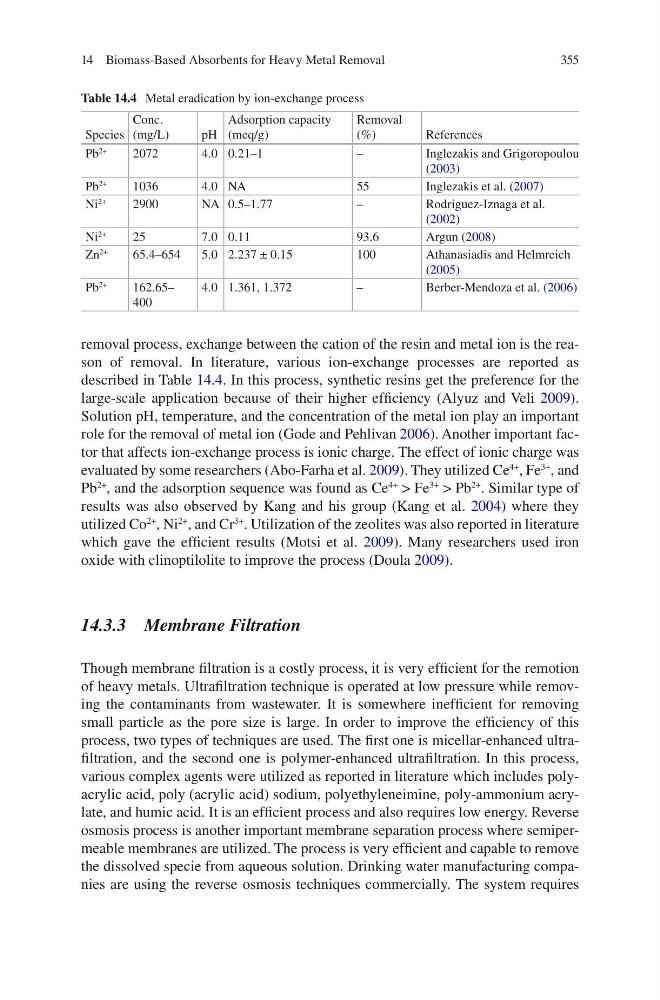
removal process, exchange between the cation of the resin and metal ion is the reason of removal. In literature, various ion-exchange processes are reported as
described in Table 14.4. In this process, synthetic resins get the preference for the
large-scale application because of their higher efficiency (Alyuz and Veli 2009).
Solution pH, temperature, and the concentration of the metal ion play an important
role for the removal of metal ion (Gode and Pehlivan 2006). Another important factor that affects ion-exchange process is ionic charge. The effect of ionic charge was
evaluated by some researchers (Abo-Farha et al. 2009). They utilized Ce
4+
, Fe
3+
, and
Pb
2+
, and the adsorption sequence was found as Ce
4+
> Fe
3+
> Pb
2+
. Similar type of
results was also observed by Kang and his group (Kang et al. 2004) where they
utilized Co
2+
, Ni
2+
, and Cr
3+
. Utilization of the zeolites was also reported in literature
which gave the efficient results (Motsi et al. 2009). Many researchers used iron
oxide with clinoptilolite to improve the process (Doula 2009).
14.3.3 Membrane Filtration
Though membrane filtration is a costly process, it is very efficient for the remotion
of heavy metals. Ultrafiltration technique is operated at low pressure while removing the contaminants from wastewater. It is somewhere inefficient for removing
small particle as the pore size is large. In order to improve the efficiency of this
process, two types of techniques are used. The first one is micellar-enhanced ultrafiltration, and the second one is polymer-enhanced ultrafiltration. In this process,
various complex agents were utilized as reported in literature which includes polyacrylic acid, poly (acrylic acid) sodium, polyethyleneimine, poly-ammonium acrylate, and humic acid. It is an efficient process and also requires low energy. Reverse
osmosis process is another important membrane separation process where semipermeable membranes are utilized. The process is very efficient and capable to remove
the dissolved specie from aqueous solution. Drinking water manufacturing companies are using the reverse osmosis techniques commercially. The system requires
Table 14.4 Metal eradication by ion-exchange process
Species
Conc.
(mg/L)
pH
Adsorption capacity
(meq/g)
Removal
(%)
References
Pb
2+
2072
4.0 0.21–1
–
Inglezakis and Grigoropoulou
(2003)
Pb
2+
1036
4.0 NA
55
Inglezakis et al. (2007)
Ni
2+
2900
NA 0.5–1.77
–
Rodriguez-Iznaga et al.
(2002)
Ni
2+
25
7.0 0.11
93.6
Argun (2008)
Zn
2+
65.4–654
5.0 2.237 ± 0.15
100
Athanasiadis and Helmreich
(2005)
Pb
2+
162.65–
400
4.0 1.361, 1.372
–
Berber-Mendoza et al. (2006)
14 Biomass-Based Absorbents for Heavy Metal Removal
removal process, exchange between the cation of the resin and metal ion is the reason of removal. In literature, various ion-exchange processes are reported as
described in Table 14.4. In this process, synthetic resins get the preference for the
large-scale application because of their higher efficiency (Alyuz and Veli 2009).
Solution pH, temperature, and the concentration of the metal ion play an important
role for the removal of metal ion (Gode and Pehlivan 2006). Another important factor that affects ion-exchange process is ionic charge. The effect of ionic charge was
evaluated by some researchers (Abo-Farha et al. 2009). They utilized Ce
4+
, Fe
3+
, and
Pb
2+
, and the adsorption sequence was found as Ce
4+
> Fe
3+
> Pb
2+
. Similar type of
results was also observed by Kang and his group (Kang et al. 2004) where they
utilized Co
2+
, Ni
2+
, and Cr
3+
. Utilization of the zeolites was also reported in literature
which gave the efficient results (Motsi et al. 2009). Many researchers used iron
oxide with clinoptilolite to improve the process (Doula 2009).
14.3.3 Membrane Filtration
Though membrane filtration is a costly process, it is very efficient for the remotion
of heavy metals. Ultrafiltration technique is operated at low pressure while removing the contaminants from wastewater. It is somewhere inefficient for removing
small particle as the pore size is large. In order to improve the efficiency of this
process, two types of techniques are used. The first one is micellar-enhanced ultrafiltration, and the second one is polymer-enhanced ultrafiltration. In this process,
various complex agents were utilized as reported in literature which includes polyacrylic acid, poly (acrylic acid) sodium, polyethyleneimine, poly-ammonium acrylate, and humic acid. It is an efficient process and also requires low energy. Reverse
osmosis process is another important membrane separation process where semipermeable membranes are utilized. The process is very efficient and capable to remove
the dissolved specie from aqueous solution. Drinking water manufacturing companies are using the reverse osmosis techniques commercially. The system requires
Table 14.4 Metal eradication by ion-exchange process
Species
Conc.
(mg/L)
pH
Adsorption capacity
(meq/g)
Removal
(%)
References
Pb
2+
2072
4.0 0.21–1
–
Inglezakis and Grigoropoulou
(2003)
Pb
2+
1036
4.0 NA
55
Inglezakis et al. (2007)
Ni
2+
2900
NA 0.5–1.77
–
Rodriguez-Iznaga et al.
(2002)
Ni
2+
25
7.0 0.11
93.6
Argun (2008)
Zn
2+
65.4–654
5.0 2.237 ± 0.15
100
Athanasiadis and Helmreich
(2005)
Pb
2+
162.65–
400
4.0 1.361, 1.372
–
Berber-Mendoza et al. (2006)
14 Biomass-Based Absorbents for Heavy Metal Removal