

315
nature in various allotropic forms. Crystalline boron is substantially lightweight,
hard, scratch-resistant, and heat-stable. Boron is a good conductor at high temperatures. Chemical properties of boron element depend on its morphology and grain
size. Micron-size amorphous boron reacts easily and sometimes violently, while
boron crystal does not react easily. Boron reacts with water at high temperatures to
form boric acid and some other products (Holleman and Wilberg 2001).
Boric acid is a weak Lewis acid, which has a pK a value 9.24 at 25 °C (Delazare
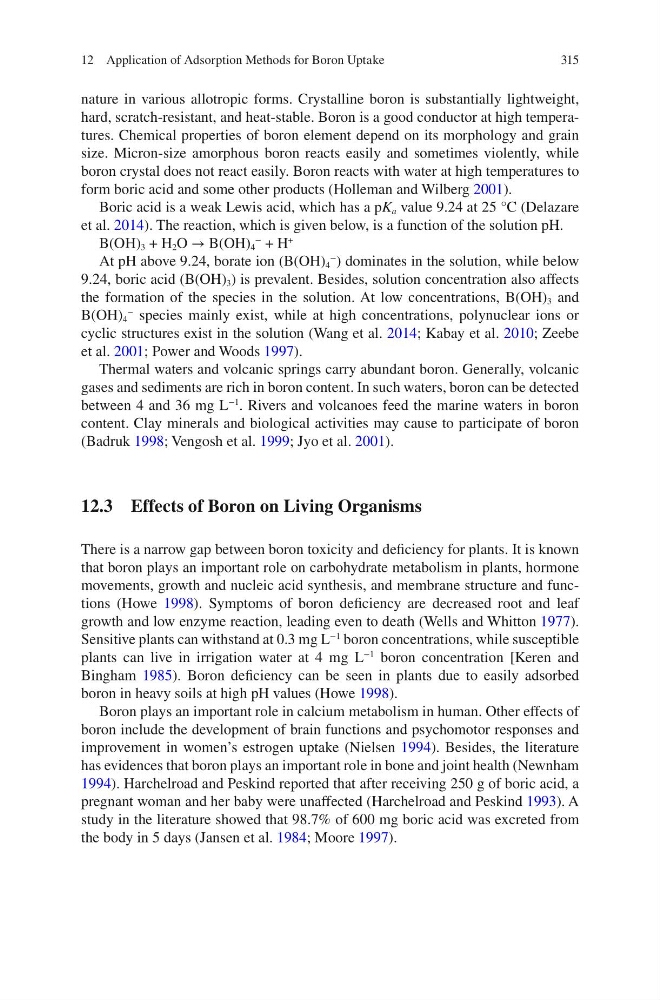
et al. 2014). The reaction, which is given below, is a function of the solution pH.
B(OH) 3 + H 2 O → B(OH) 4
−
+ H
+
At pH above 9.24, borate ion (B(OH) 4
−
) dominates in the solution, while below
9.24, boric acid (B(OH) 3 ) is prevalent. Besides, solution concentration also affects
the formation of the species in the solution. At low concentrations, B(OH) 3 and
B(OH) 4
−
species mainly exist, while at high concentrations, polynuclear ions or
cyclic structures exist in the solution (Wang et al. 2014; Kabay et al. 2010; Zeebe
et al. 2001; Power and Woods 1997).
Thermal waters and volcanic springs carry abundant boron. Generally, volcanic
gases and sediments are rich in boron content. In such waters, boron can be detected
between 4 and 36 mg L
−1
. Rivers and volcanoes feed the marine waters in boron
content. Clay minerals and biological activities may cause to participate of boron
(Badruk 1998; Vengosh et al. 1999; Jyo et al. 2001).
12.3 Effects of Boron on Living Organisms
There is a narrow gap between boron toxicity and deficiency for plants. It is known
that boron plays an important role on carbohydrate metabolism in plants, hormone
movements, growth and nucleic acid synthesis, and membrane structure and functions (Howe 1998). Symptoms of boron deficiency are decreased root and leaf
growth and low enzyme reaction, leading even to death (Wells and Whitton 1977).
Sensitive plants can withstand at 0.3 mg L
−1
boron concentrations, while susceptible
plants can live in irrigation water at 4 mg L
−1
boron concentration [Keren and
Bingham 1985). Boron deficiency can be seen in plants due to easily adsorbed
boron in heavy soils at high pH values (Howe 1998).
Boron plays an important role in calcium metabolism in human. Other effects of
boron include the development of brain functions and psychomotor responses and
improvement in women’s estrogen uptake (Nielsen 1994). Besides, the literature
has evidences that boron plays an important role in bone and joint health (Newnham
1994). Harchelroad and Peskind reported that after receiving 250 g of boric acid, a
pregnant woman and her baby were unaffected (Harchelroad and Peskind 1993). A
study in the literature showed that 98.7% of 600 mg boric acid was excreted from
the body in 5 days (Jansen et al. 1984; Moore 1997).
12 Application of Adsorption Methods for Boron Uptake
nature in various allotropic forms. Crystalline boron is substantially lightweight,
hard, scratch-resistant, and heat-stable. Boron is a good conductor at high temperatures. Chemical properties of boron element depend on its morphology and grain
size. Micron-size amorphous boron reacts easily and sometimes violently, while
boron crystal does not react easily. Boron reacts with water at high temperatures to
form boric acid and some other products (Holleman and Wilberg 2001).
Boric acid is a weak Lewis acid, which has a pK a value 9.24 at 25 °C (Delazare
et al. 2014). The reaction, which is given below, is a function of the solution pH.
B(OH) 3 + H 2 O → B(OH) 4
−
+ H
+
At pH above 9.24, borate ion (B(OH) 4
−
) dominates in the solution, while below
9.24, boric acid (B(OH) 3 ) is prevalent. Besides, solution concentration also affects
the formation of the species in the solution. At low concentrations, B(OH) 3 and
B(OH) 4
−
species mainly exist, while at high concentrations, polynuclear ions or
cyclic structures exist in the solution (Wang et al. 2014; Kabay et al. 2010; Zeebe
et al. 2001; Power and Woods 1997).
Thermal waters and volcanic springs carry abundant boron. Generally, volcanic
gases and sediments are rich in boron content. In such waters, boron can be detected
between 4 and 36 mg L
−1
. Rivers and volcanoes feed the marine waters in boron
content. Clay minerals and biological activities may cause to participate of boron
(Badruk 1998; Vengosh et al. 1999; Jyo et al. 2001).
12.3 Effects of Boron on Living Organisms
There is a narrow gap between boron toxicity and deficiency for plants. It is known
that boron plays an important role on carbohydrate metabolism in plants, hormone
movements, growth and nucleic acid synthesis, and membrane structure and functions (Howe 1998). Symptoms of boron deficiency are decreased root and leaf
growth and low enzyme reaction, leading even to death (Wells and Whitton 1977).
Sensitive plants can withstand at 0.3 mg L
−1
boron concentrations, while susceptible
plants can live in irrigation water at 4 mg L
−1
boron concentration [Keren and
Bingham 1985). Boron deficiency can be seen in plants due to easily adsorbed
boron in heavy soils at high pH values (Howe 1998).
Boron plays an important role in calcium metabolism in human. Other effects of
boron include the development of brain functions and psychomotor responses and
improvement in women’s estrogen uptake (Nielsen 1994). Besides, the literature
has evidences that boron plays an important role in bone and joint health (Newnham
1994). Harchelroad and Peskind reported that after receiving 250 g of boric acid, a
pregnant woman and her baby were unaffected (Harchelroad and Peskind 1993). A
study in the literature showed that 98.7% of 600 mg boric acid was excreted from
the body in 5 days (Jansen et al. 1984; Moore 1997).
12 Application of Adsorption Methods for Boron Uptake