

18
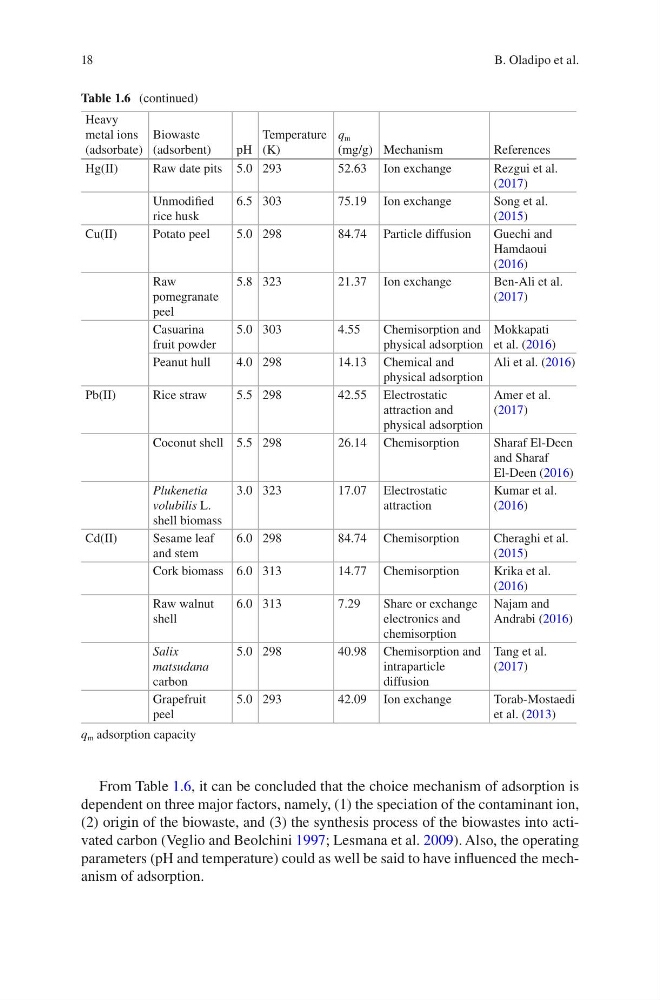
From Table 1.6, it can be concluded that the choice mechanism of adsorption is
dependent on three major factors, namely, (1) the speciation of the contaminant ion,
(2) origin of the biowaste, and (3) the synthesis process of the biowastes into activated carbon (Veglio and Beolchini 1997; Lesmana et al. 2009). Also, the operating
parameters (pH and temperature) could as well be said to have influenced the mechanism of adsorption.
Table 1.6 (continued)
Heavy
metal ions
(adsorbate)
Biowaste
(adsorbent)
pH
Temperature
(K)
q m
(mg/g) Mechanism
References
Hg(II)
Raw date pits 5.0 293
52.63 Ion exchange
Rezgui et al.
(2017)
Unmodified
rice husk
6.5 303
75.19 Ion exchange
Song et al.
(2015)
Cu(II)
Potato peel
5.0 298
84.74 Particle diffusion
Guechi and
Hamdaoui
(2016)
Raw
pomegranate
peel
5.8 323
21.37 Ion exchange
Ben-Ali et al.
(2017)
Casuarina
fruit powder
5.0 303
4.55
Chemisorption and
physical adsorption
Mokkapati
et al. (2016)
Peanut hull
4.0 298
14.13 Chemical and
physical adsorption
Ali et al. (2016)
Pb(II)
Rice straw
5.5 298
42.55 Electrostatic
attraction and
physical adsorption
Amer et al.
(2017)
Coconut shell 5.5 298
26.14 Chemisorption
Sharaf El-Deen
and Sharaf
El-Deen (2016)
Plukenetia
volubilis L.
shell biomass
3.0 323
17.07 Electrostatic
attraction
Kumar et al.
(2016)
Cd(II)
Sesame leaf
and stem
6.0 298
84.74 Chemisorption
Cheraghi et al.
(2015)
Cork biomass 6.0 313
14.77 Chemisorption
Krika et al.
(2016)
Raw walnut
shell
6.0 313
7.29
Share or exchange
electronics and
chemisorption
Najam and
Andrabi (2016)
Salix
matsudana
carbon
5.0 298
40.98 Chemisorption and
intraparticle
diffusion
Tang et al.
(2017)
Grapefruit
peel
5.0 293
42.09 Ion exchange
Torab- Mostaedi
et al. (2013)
q m adsorption capacity
B. Oladipo et al.
From Table 1.6, it can be concluded that the choice mechanism of adsorption is
dependent on three major factors, namely, (1) the speciation of the contaminant ion,
(2) origin of the biowaste, and (3) the synthesis process of the biowastes into activated carbon (Veglio and Beolchini 1997; Lesmana et al. 2009). Also, the operating
parameters (pH and temperature) could as well be said to have influenced the mechanism of adsorption.
Table 1.6 (continued)
Heavy
metal ions
(adsorbate)
Biowaste
(adsorbent)
pH
Temperature
(K)
q m
(mg/g) Mechanism
References
Hg(II)
Raw date pits 5.0 293
52.63 Ion exchange
Rezgui et al.
(2017)
Unmodified
rice husk
6.5 303
75.19 Ion exchange
Song et al.
(2015)
Cu(II)
Potato peel
5.0 298
84.74 Particle diffusion
Guechi and
Hamdaoui
(2016)
Raw
pomegranate
peel
5.8 323
21.37 Ion exchange
Ben-Ali et al.
(2017)
Casuarina
fruit powder
5.0 303
4.55
Chemisorption and
physical adsorption
Mokkapati
et al. (2016)
Peanut hull
4.0 298
14.13 Chemical and
physical adsorption
Ali et al. (2016)
Pb(II)
Rice straw
5.5 298
42.55 Electrostatic
attraction and
physical adsorption
Amer et al.
(2017)
Coconut shell 5.5 298
26.14 Chemisorption
Sharaf El-Deen
and Sharaf
El-Deen (2016)
Plukenetia
volubilis L.
shell biomass
3.0 323
17.07 Electrostatic
attraction
Kumar et al.
(2016)
Cd(II)
Sesame leaf
and stem
6.0 298
84.74 Chemisorption
Cheraghi et al.
(2015)
Cork biomass 6.0 313
14.77 Chemisorption
Krika et al.
(2016)
Raw walnut
shell
6.0 313
7.29
Share or exchange
electronics and
chemisorption
Najam and
Andrabi (2016)
Salix
matsudana
carbon
5.0 298
40.98 Chemisorption and
intraparticle
diffusion
Tang et al.
(2017)
Grapefruit
peel
5.0 293
42.09 Ion exchange
Torab- Mostaedi
et al. (2013)
q m adsorption capacity
B. Oladipo et al.