

282
removal and observed changes of saturated adsorption amounts of dyes with pH of
solutions and changes of saturated adsorption amounts with zeta potentials. Methyl
green possesses the quaternary ammonium halide group and methyl violet the amine
group whereas anionic dyes the sulfuric group. The saturated adsorption amount for
anionic dyes reduction was observed with the increase of pH. Moreover, the zeta
potential of commercial activated carbons surface showed three distinct states: zeta
potential is nearly zero – neutral potential state, dispersion forces are the adsorption
forces whereas the electrostatic interactions between commercial activated carbon
surface – dyes are negligible (no effect of pH); zeta potential is negative or positive,
attractive or repulsive interactions between commercial activated carbon surface
and dyes occurred.
Congo red was removed by activated carbon (mass of adsorbent 1 g/L, pH at
zero-point charge = 6.6). Efficiency of dye removal was above 90% (initial dye
concentration 50–100 mg/L) and close to 80% at pH 7.0. At pH 2 the maximum
adsorption (quantitative removal) of dye was observed. Kinetic and equilibrium
studies proved that pseudo second-order kinetic model, and Freundlich model fit the
experimental results more adequately. Desorption of Congo red was carried out
using the surfactant enhanced carbon regeneration method with the anionic and
cationic surfactants (Purkait et al. 2007).
Reactive black 5 was removed using grain and powder commercial activated
carbons (powders after chopping obtained from the granular form) using three Norit
materials such as Norit R008, Norit Darco 12 × 20, and Norit PK 1–3 (used as fine
powders of the size from 75 to 125 μm). The effect of pH (2–12) (1 g/L of adsorbent, 20 mL of dye solution, the concentration before sorption C 0 = 500 mg/L)
shows that the optimum pH was alkaline and equal to 10. Moreover, the ionic
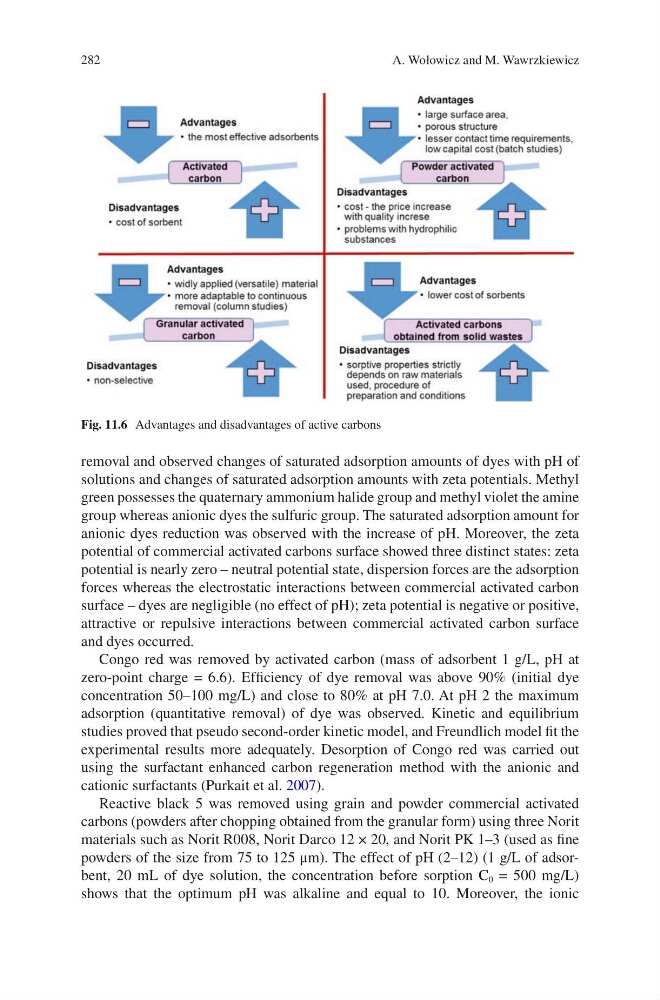
Fig. 11.6 Advantages and disadvantages of active carbons
A. Wołowicz and M. Wawrzkiewicz
removal and observed changes of saturated adsorption amounts of dyes with pH of
solutions and changes of saturated adsorption amounts with zeta potentials. Methyl
green possesses the quaternary ammonium halide group and methyl violet the amine
group whereas anionic dyes the sulfuric group. The saturated adsorption amount for
anionic dyes reduction was observed with the increase of pH. Moreover, the zeta
potential of commercial activated carbons surface showed three distinct states: zeta
potential is nearly zero – neutral potential state, dispersion forces are the adsorption
forces whereas the electrostatic interactions between commercial activated carbon
surface – dyes are negligible (no effect of pH); zeta potential is negative or positive,
attractive or repulsive interactions between commercial activated carbon surface
and dyes occurred.
Congo red was removed by activated carbon (mass of adsorbent 1 g/L, pH at
zero-point charge = 6.6). Efficiency of dye removal was above 90% (initial dye
concentration 50–100 mg/L) and close to 80% at pH 7.0. At pH 2 the maximum
adsorption (quantitative removal) of dye was observed. Kinetic and equilibrium
studies proved that pseudo second-order kinetic model, and Freundlich model fit the
experimental results more adequately. Desorption of Congo red was carried out
using the surfactant enhanced carbon regeneration method with the anionic and
cationic surfactants (Purkait et al. 2007).
Reactive black 5 was removed using grain and powder commercial activated
carbons (powders after chopping obtained from the granular form) using three Norit
materials such as Norit R008, Norit Darco 12 × 20, and Norit PK 1–3 (used as fine
powders of the size from 75 to 125 μm). The effect of pH (2–12) (1 g/L of adsorbent, 20 mL of dye solution, the concentration before sorption C 0 = 500 mg/L)
shows that the optimum pH was alkaline and equal to 10. Moreover, the ionic
Fig. 11.6 Advantages and disadvantages of active carbons
A. Wołowicz and M. Wawrzkiewicz