

279
11.3 Adsorption and Sorbents Classification
Adsorption is useful technic for separation, purification, catalysis, and pollution
control processes (Rouquerol et al. 1999). Taking into account its advantages, it can
be also applied in textile wastewater treatment (Yagub et al. 2014; Seow and Lim
2016; Pavithra et al. 2019). The use of traditional methods of synthetic dyes removal
from water and wastewater and thus effective decolorization of wastewater is not
always possible, whereas the use of adsorption processes seems to be a beneficial
solution.
The term adsorption was coined in 1881 by the German physicist named Heinrich
Kayser. Adsorption is defined as the interaction of chemical species such as atoms,
ions, or molecules onto the surface of particles and taking place on solid’s surface
in contact with liquid or gas. In the other words, adsorption is material enrichment
or fluid density increase in the vicinity of an interface. Most often adsorption refers
to the process of liquid substance binding on the solid surface or gaseous substance
binding on the solid or liquid surface (Rouquerol et al. 1999).
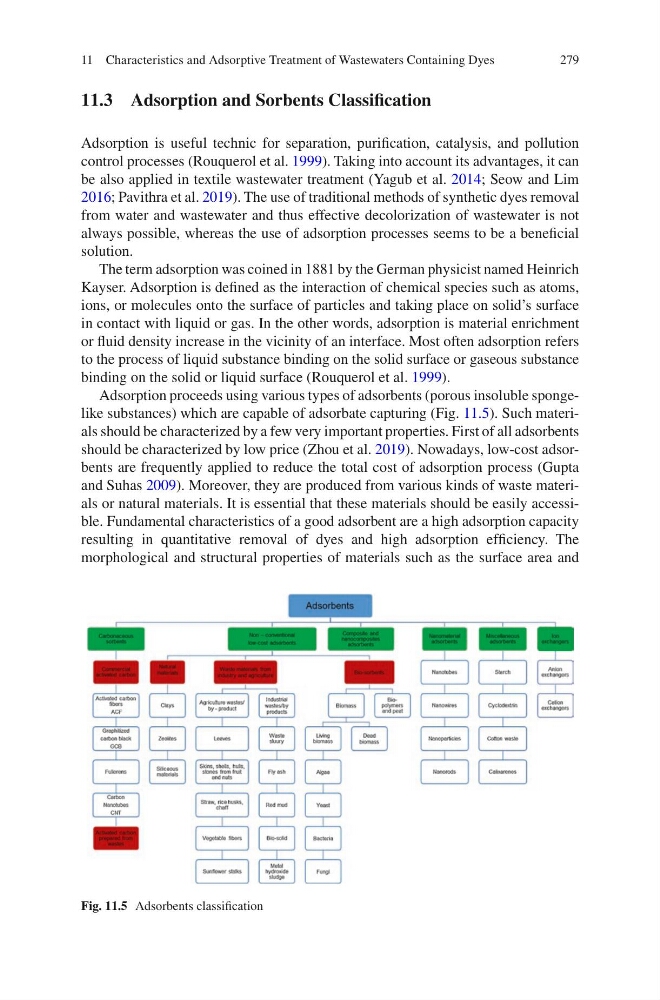
Adsorption proceeds using various types of adsorbents (porous insoluble spongelike substances) which are capable of adsorbate capturing (Fig. 11.5). Such materials should be characterized by a few very important properties. First of all adsorbents
should be characterized by low price (Zhou et al. 2019). Nowadays, low-cost adsorbents are frequently applied to reduce the total cost of adsorption process (Gupta
and Suhas 2009). Moreover, they are produced from various kinds of waste materials or natural materials. It is essential that these materials should be easily accessible. Fundamental characteristics of a good adsorbent are a high adsorption capacity
resulting in quantitative removal of dyes and high adsorption efficiency. The
morphological and structural properties of materials such as the surface area and
Fig. 11.5 Adsorbents classification
11 Characteristics and Adsorptive Treatment of Wastewaters Containing Dyes
11.3 Adsorption and Sorbents Classification
Adsorption is useful technic for separation, purification, catalysis, and pollution
control processes (Rouquerol et al. 1999). Taking into account its advantages, it can
be also applied in textile wastewater treatment (Yagub et al. 2014; Seow and Lim
2016; Pavithra et al. 2019). The use of traditional methods of synthetic dyes removal
from water and wastewater and thus effective decolorization of wastewater is not
always possible, whereas the use of adsorption processes seems to be a beneficial
solution.
The term adsorption was coined in 1881 by the German physicist named Heinrich
Kayser. Adsorption is defined as the interaction of chemical species such as atoms,
ions, or molecules onto the surface of particles and taking place on solid’s surface
in contact with liquid or gas. In the other words, adsorption is material enrichment
or fluid density increase in the vicinity of an interface. Most often adsorption refers
to the process of liquid substance binding on the solid surface or gaseous substance
binding on the solid or liquid surface (Rouquerol et al. 1999).
Adsorption proceeds using various types of adsorbents (porous insoluble spongelike substances) which are capable of adsorbate capturing (Fig. 11.5). Such materials should be characterized by a few very important properties. First of all adsorbents
should be characterized by low price (Zhou et al. 2019). Nowadays, low-cost adsorbents are frequently applied to reduce the total cost of adsorption process (Gupta
and Suhas 2009). Moreover, they are produced from various kinds of waste materials or natural materials. It is essential that these materials should be easily accessible. Fundamental characteristics of a good adsorbent are a high adsorption capacity
resulting in quantitative removal of dyes and high adsorption efficiency. The
morphological and structural properties of materials such as the surface area and
Fig. 11.5 Adsorbents classification
11 Characteristics and Adsorptive Treatment of Wastewaters Containing Dyes