

257
experimented to evaluate the effect of temperature, ionic strength, and surface acidity of goethite in aqueous medium (Mamindy-Pajany et al. 2009; Kersten and
Vlasova 2009). The result leads to the conclusion that adsorption of arsenate on
goethite is an exothermic process and thereby weaken with increase in the temperature (Kersten and Vlasova 2009). The adsorption behavior of different microstructure of goethite with addition of multiple metal ions, e.g., Pb
+2
, Cr
+3
, Zn
+2
, and Cd
+2
,
was investigated (Kaur et al. 2009). It was very evident from the result that Cr
+3
and
Cd
+2
are significantly removed mutually and incorporation of Pb
+2
also gives positive result in the goethite structure but for Zn
+2
, it was not the same. Therefore critical results conclude that goethite might not be right choice to the circumstances
where multiple metal ions are present (Kaur et al. 2009).
There are loads of research studies on heavy metal removal using clay mineral as
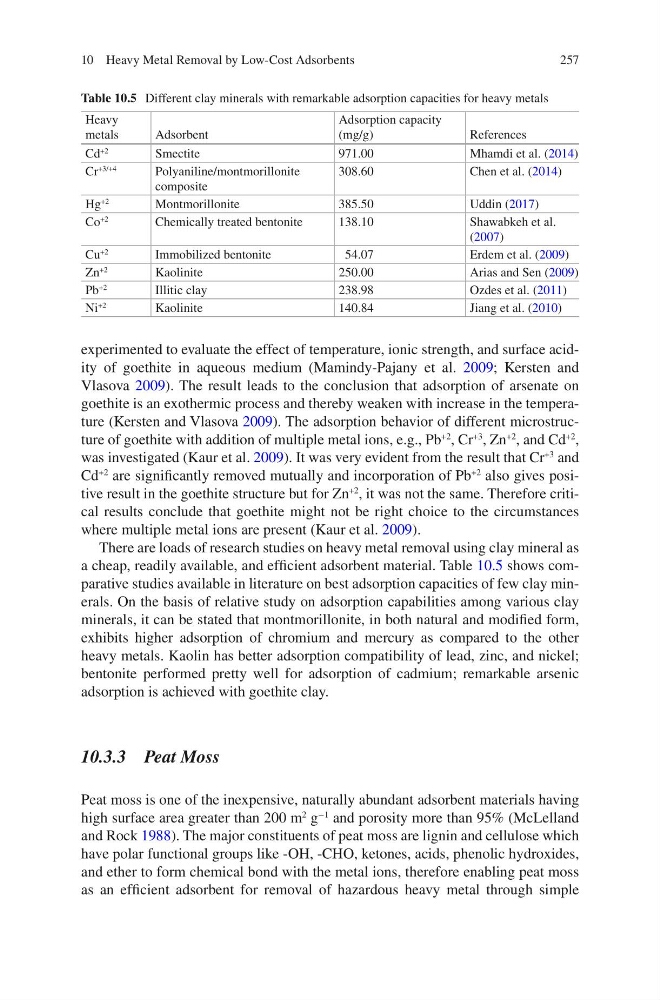
a cheap, readily available, and efficient adsorbent material. Table 10.5 shows comparative studies available in literature on best adsorption capacities of few clay minerals. On the basis of relative study on adsorption capabilities among various clay
minerals, it can be stated that montmorillonite, in both natural and modified form,
exhibits higher adsorption of chromium and mercury as compared to the other
heavy metals. Kaolin has better adsorption compatibility of lead, zinc, and nickel;
bentonite performed pretty well for adsorption of cadmium; remarkable arsenic
adsorption is achieved with goethite clay.
10.3.3 Peat Moss
Peat moss is one of the inexpensive, naturally abundant adsorbent materials having
high surface area greater than 200 m
2
g
−1
and porosity more than 95% (McLelland
and Rock 1988). The major constituents of peat moss are lignin and cellulose which
have polar functional groups like -OH, -CHO, ketones, acids, phenolic hydroxides,
and ether to form chemical bond with the metal ions, therefore enabling peat moss
as an efficient adsorbent for removal of hazardous heavy metal through simple
Table 10.5 Different clay minerals with remarkable adsorption capacities for heavy metals
Heavy
metals
Adsorbent
Adsorption capacity
(mg/g)
References
Cd
+2
Smectite
971.00
Mhamdi et al. (2014)
Cr
+3/+4
Polyaniline/montmorillonite
composite
308.60
Chen et al. (2014)
Hg
+2
Montmorillonite
385.50
Uddin (2017)
Co
+2
Chemically treated bentonite
138.10
Shawabkeh et al.
(2007)
Cu
+2
Immobilized bentonite
54.07
Erdem et al. (2009)
Zn
+2
Kaolinite
250.00
Arias and Sen (2009)
Pb
+2
Illitic clay
238.98
Ozdes et al. (2011)
Ni
+2
Kaolinite
140.84
Jiang et al. (2010)
10 Heavy Metal Removal by Low-Cost Adsorbents
experimented to evaluate the effect of temperature, ionic strength, and surface acidity of goethite in aqueous medium (Mamindy-Pajany et al. 2009; Kersten and
Vlasova 2009). The result leads to the conclusion that adsorption of arsenate on
goethite is an exothermic process and thereby weaken with increase in the temperature (Kersten and Vlasova 2009). The adsorption behavior of different microstructure of goethite with addition of multiple metal ions, e.g., Pb
+2
, Cr
+3
, Zn
+2
, and Cd
+2
,
was investigated (Kaur et al. 2009). It was very evident from the result that Cr
+3
and
Cd
+2
are significantly removed mutually and incorporation of Pb
+2
also gives positive result in the goethite structure but for Zn
+2
, it was not the same. Therefore critical results conclude that goethite might not be right choice to the circumstances
where multiple metal ions are present (Kaur et al. 2009).
There are loads of research studies on heavy metal removal using clay mineral as
a cheap, readily available, and efficient adsorbent material. Table 10.5 shows comparative studies available in literature on best adsorption capacities of few clay minerals. On the basis of relative study on adsorption capabilities among various clay
minerals, it can be stated that montmorillonite, in both natural and modified form,
exhibits higher adsorption of chromium and mercury as compared to the other
heavy metals. Kaolin has better adsorption compatibility of lead, zinc, and nickel;
bentonite performed pretty well for adsorption of cadmium; remarkable arsenic
adsorption is achieved with goethite clay.
10.3.3 Peat Moss
Peat moss is one of the inexpensive, naturally abundant adsorbent materials having
high surface area greater than 200 m
2
g
−1
and porosity more than 95% (McLelland
and Rock 1988). The major constituents of peat moss are lignin and cellulose which
have polar functional groups like -OH, -CHO, ketones, acids, phenolic hydroxides,
and ether to form chemical bond with the metal ions, therefore enabling peat moss
as an efficient adsorbent for removal of hazardous heavy metal through simple
Table 10.5 Different clay minerals with remarkable adsorption capacities for heavy metals
Heavy
metals
Adsorbent
Adsorption capacity
(mg/g)
References
Cd
+2
Smectite
971.00
Mhamdi et al. (2014)
Cr
+3/+4
Polyaniline/montmorillonite
composite
308.60
Chen et al. (2014)
Hg
+2
Montmorillonite
385.50
Uddin (2017)
Co
+2
Chemically treated bentonite
138.10
Shawabkeh et al.
(2007)
Cu
+2
Immobilized bentonite
54.07
Erdem et al. (2009)
Zn
+2
Kaolinite
250.00
Arias and Sen (2009)
Pb
+2
Illitic clay
238.98
Ozdes et al. (2011)
Ni
+2
Kaolinite
140.84
Jiang et al. (2010)
10 Heavy Metal Removal by Low-Cost Adsorbents