

253
reduction reaction and is widely applicable in removal of metal ions as well as
metalloids.
Chromium enters into our body naturally through fruits, vegetables, grains, and
meats in form of Cr
+3
, but in higher oxidation state as Cr
+6
, it becomes very toxic and
demands reduction to lower oxidation state. Several photocatalysts are used for degradation of Cr
+6
such as TiO 2 , ZnO, WO 3 , ZnS, CdS, and SnIn 4 S 8 . Degradation of
Cr
+6
under ultraviolet radiation depends greatly on pH. In a photodeposition method,
the platinum precursor [Pt
+4
Cl 6 ]
2−
was reduced by the photogenerated electron at the
valance band of TiO 2 , and the sacrificial organic reagent acts as hole scavenger
(Chowdhury et al. 2013). The Pt–TiO 2 photocatalysts have extensive applications in
water treatment as well as in photocatalytic hydrogen generation. Photoreduction of
Cd
+2
in the presence of formate ion was much faster compared with Zn
+2
photoreduction (Chenthamarakshan et al. 2000). It was reported that photoreduction of
Hg
+2
is significantly improved by 45% with TiO 2 in absence of oxygen (Khalil et al.
2002). Photocatalytic conversion of As
+3
to As
+5
can be achieved both by the mechanism with a superoxide anion such as HO 2 ˙or O 2
−
, and via a valance band hole or
HO (Fei et al. 2011). The cost-effective photoreactor development is the key issue
involved with photocatalysis system. It also takes long duration for
photoremediation.
10.2.8 Adsorption
Adsorption process is an efficient and environment-friendly process for effluent
treatment. It is a mass transfer process in which a substance is carried from a liquid
phase to the surface of a solid and bounds with the solid surface by physical and/or
chemical interactions. In addition, regeneration of adsorbents is possible as it is
sometimes reversible using suitable desorption process. Depending on intermolecular forces, adsorption is of two types which are described in the following.
Physical adsorption: It is one such process in which adsorbate binds on adsorbent
surface by van der Waals attractive force. It can only be observed in low temperature
for solid–liquid or solid–gas system, and under appropriate conditions, gas phase
molecules can form multilayer adsorption.
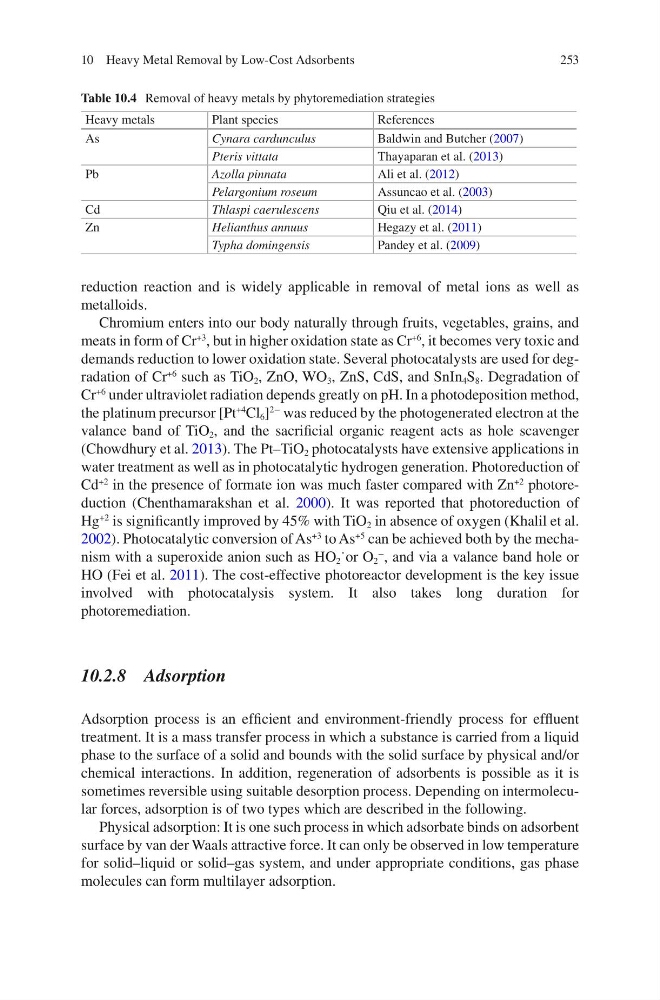
Table 10.4 Removal of heavy metals by phytoremediation strategies
Heavy metals
Plant species
References
As
Cynara cardunculus
Baldwin and Butcher (2007)
Pteris vittata
Thayaparan et al. (2013)
Pb
Azolla pinnata
Ali et al. (2012)
Pelargonium roseum
Assuncao et al. (2003)
Cd
Thlaspi caerulescens
Qiu et al. (2014)
Zn
Helianthus annuus
Hegazy et al. (2011)
Typha domingensis
Pandey et al. (2009)
10 Heavy Metal Removal by Low-Cost Adsorbents
reduction reaction and is widely applicable in removal of metal ions as well as
metalloids.
Chromium enters into our body naturally through fruits, vegetables, grains, and
meats in form of Cr
+3
, but in higher oxidation state as Cr
+6
, it becomes very toxic and
demands reduction to lower oxidation state. Several photocatalysts are used for degradation of Cr
+6
such as TiO 2 , ZnO, WO 3 , ZnS, CdS, and SnIn 4 S 8 . Degradation of
Cr
+6
under ultraviolet radiation depends greatly on pH. In a photodeposition method,
the platinum precursor [Pt
+4
Cl 6 ]
2−
was reduced by the photogenerated electron at the
valance band of TiO 2 , and the sacrificial organic reagent acts as hole scavenger
(Chowdhury et al. 2013). The Pt–TiO 2 photocatalysts have extensive applications in
water treatment as well as in photocatalytic hydrogen generation. Photoreduction of
Cd
+2
in the presence of formate ion was much faster compared with Zn
+2
photoreduction (Chenthamarakshan et al. 2000). It was reported that photoreduction of
Hg
+2
is significantly improved by 45% with TiO 2 in absence of oxygen (Khalil et al.
2002). Photocatalytic conversion of As
+3
to As
+5
can be achieved both by the mechanism with a superoxide anion such as HO 2 ˙or O 2
−
, and via a valance band hole or
HO (Fei et al. 2011). The cost-effective photoreactor development is the key issue
involved with photocatalysis system. It also takes long duration for
photoremediation.
10.2.8 Adsorption
Adsorption process is an efficient and environment-friendly process for effluent
treatment. It is a mass transfer process in which a substance is carried from a liquid
phase to the surface of a solid and bounds with the solid surface by physical and/or
chemical interactions. In addition, regeneration of adsorbents is possible as it is
sometimes reversible using suitable desorption process. Depending on intermolecular forces, adsorption is of two types which are described in the following.
Physical adsorption: It is one such process in which adsorbate binds on adsorbent
surface by van der Waals attractive force. It can only be observed in low temperature
for solid–liquid or solid–gas system, and under appropriate conditions, gas phase
molecules can form multilayer adsorption.
Table 10.4 Removal of heavy metals by phytoremediation strategies
Heavy metals
Plant species
References
As
Cynara cardunculus
Baldwin and Butcher (2007)
Pteris vittata
Thayaparan et al. (2013)
Pb
Azolla pinnata
Ali et al. (2012)
Pelargonium roseum
Assuncao et al. (2003)
Cd
Thlaspi caerulescens
Qiu et al. (2014)
Zn
Helianthus annuus
Hegazy et al. (2011)
Typha domingensis
Pandey et al. (2009)
10 Heavy Metal Removal by Low-Cost Adsorbents