

208
molecular weight, and ionic radius. Solubility is a very important parameter
influencing the adsorption capacity.
• The size and the polarity of adsorbate also influence adsorption both positively
and negatively.
• pH is also a major factor affecting adsorption capacity of an adsorbent. This factor is more influencing in case of heavy metal adsorption from aqueous media.
• Efficient sorbents should be harmless and possess high sorption efficiency and
sensitivity to lower the amount of toxicant.
• The desorption of sorbent should be easily possible and finally recycled able.
• It should have fast rate of adsorption.
8.3.12 Various Adsorbents Used in Adsorption Processes
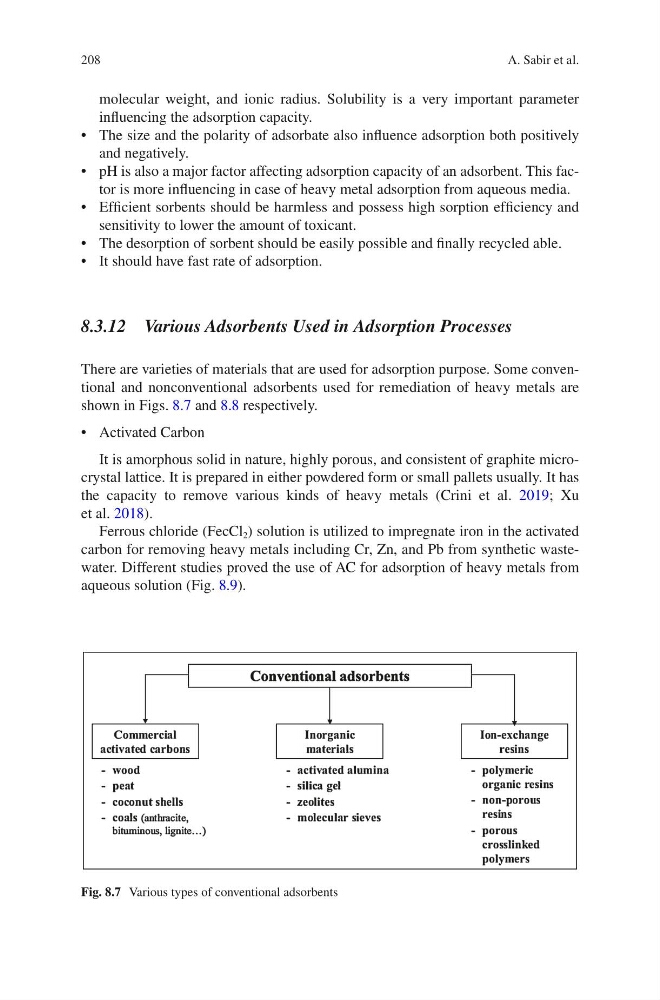
There are varieties of materials that are used for adsorption purpose. Some conventional and nonconventional adsorbents used for remediation of heavy metals are
shown in Figs. 8.7 and 8.8 respectively.
• Activated Carbon
It is amorphous solid in nature, highly porous, and consistent of graphite microcrystal lattice. It is prepared in either powdered form or small pallets usually. It has
the capacity to remove various kinds of heavy metals (Crini et al. 2019; Xu
et al. 2018).
Ferrous chloride (FecCl 2 ) solution is utilized to impregnate iron in the activated
carbon for removing heavy metals including Cr, Zn, and Pb from synthetic wastewater. Different studies proved the use of AC for adsorption of heavy metals from
aqueous solution (Fig. 8.9).
Fig. 8.7 Various types of conventional adsorbents
A. Sabir et al.
molecular weight, and ionic radius. Solubility is a very important parameter
influencing the adsorption capacity.
• The size and the polarity of adsorbate also influence adsorption both positively
and negatively.
• pH is also a major factor affecting adsorption capacity of an adsorbent. This factor is more influencing in case of heavy metal adsorption from aqueous media.
• Efficient sorbents should be harmless and possess high sorption efficiency and
sensitivity to lower the amount of toxicant.
• The desorption of sorbent should be easily possible and finally recycled able.
• It should have fast rate of adsorption.
8.3.12 Various Adsorbents Used in Adsorption Processes
There are varieties of materials that are used for adsorption purpose. Some conventional and nonconventional adsorbents used for remediation of heavy metals are
shown in Figs. 8.7 and 8.8 respectively.
• Activated Carbon
It is amorphous solid in nature, highly porous, and consistent of graphite microcrystal lattice. It is prepared in either powdered form or small pallets usually. It has
the capacity to remove various kinds of heavy metals (Crini et al. 2019; Xu
et al. 2018).
Ferrous chloride (FecCl 2 ) solution is utilized to impregnate iron in the activated
carbon for removing heavy metals including Cr, Zn, and Pb from synthetic wastewater. Different studies proved the use of AC for adsorption of heavy metals from
aqueous solution (Fig. 8.9).
Fig. 8.7 Various types of conventional adsorbents
A. Sabir et al.