

206
adsorbents such as activated charcoal, activated carbon, etc. for purification of water
(Burakov et al. 2018).
Adsorption processes for removal of pollutants in aqueous media are done either
in a discontinuous way by batch reactors or in a continuous manner by fixed-bed
reactors or columns (Gong et al. 2018). The Fixed bed systems are mostly used for
industrial scale, while batch is utilized on laboratory purpose as, due to their easiness and easy handling they are restricted for treating of small concentration of
solution (Crini et al. 2019).
8.3.9 Kinds of Adsorption
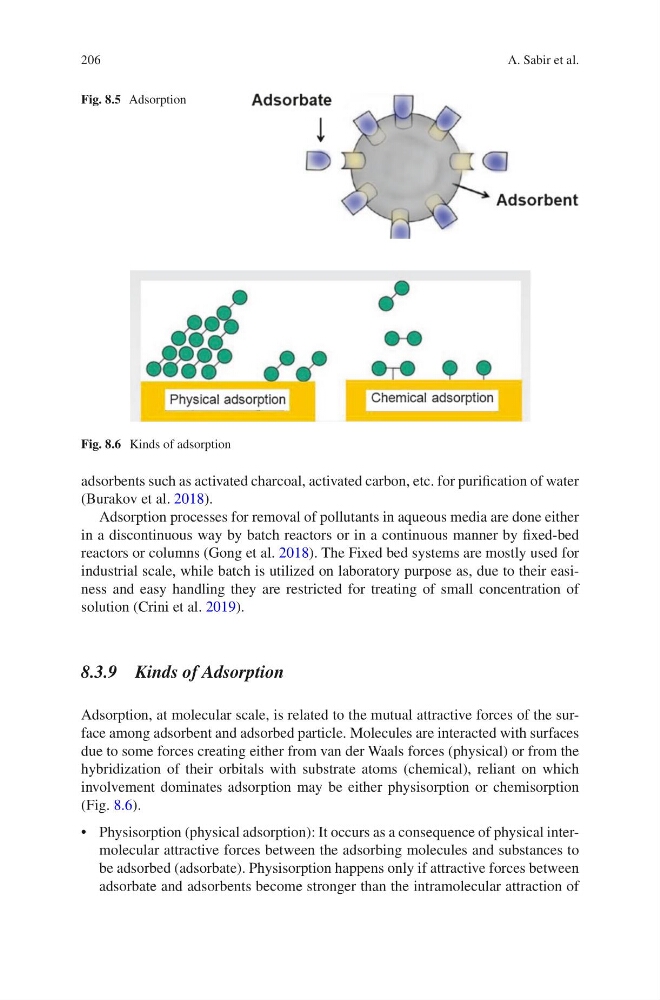
Adsorption, at molecular scale, is related to the mutual attractive forces of the surface among adsorbent and adsorbed particle. Molecules are interacted with surfaces
due to some forces creating either from van der Waals forces (physical) or from the
hybridization of their orbitals with substrate atoms (chemical), reliant on which
involvement dominates adsorption may be either physisorption or chemisorption
(Fig. 8.6).
• Physisorption (physical adsorption): It occurs as a consequence of physical intermolecular attractive forces between the adsorbing molecules and substances to
be adsorbed (adsorbate). Physisorption happens only if attractive forces between
adsorbate and adsorbents become stronger than the intramolecular attraction of
Fig. 8.5 Adsorption
Fig. 8.6 Kinds of adsorption
A. Sabir et al.
adsorbents such as activated charcoal, activated carbon, etc. for purification of water
(Burakov et al. 2018).
Adsorption processes for removal of pollutants in aqueous media are done either
in a discontinuous way by batch reactors or in a continuous manner by fixed-bed
reactors or columns (Gong et al. 2018). The Fixed bed systems are mostly used for
industrial scale, while batch is utilized on laboratory purpose as, due to their easiness and easy handling they are restricted for treating of small concentration of
solution (Crini et al. 2019).
8.3.9 Kinds of Adsorption
Adsorption, at molecular scale, is related to the mutual attractive forces of the surface among adsorbent and adsorbed particle. Molecules are interacted with surfaces
due to some forces creating either from van der Waals forces (physical) or from the
hybridization of their orbitals with substrate atoms (chemical), reliant on which
involvement dominates adsorption may be either physisorption or chemisorption
(Fig. 8.6).
• Physisorption (physical adsorption): It occurs as a consequence of physical intermolecular attractive forces between the adsorbing molecules and substances to
be adsorbed (adsorbate). Physisorption happens only if attractive forces between
adsorbate and adsorbents become stronger than the intramolecular attraction of
Fig. 8.5 Adsorption
Fig. 8.6 Kinds of adsorption
A. Sabir et al.