

185
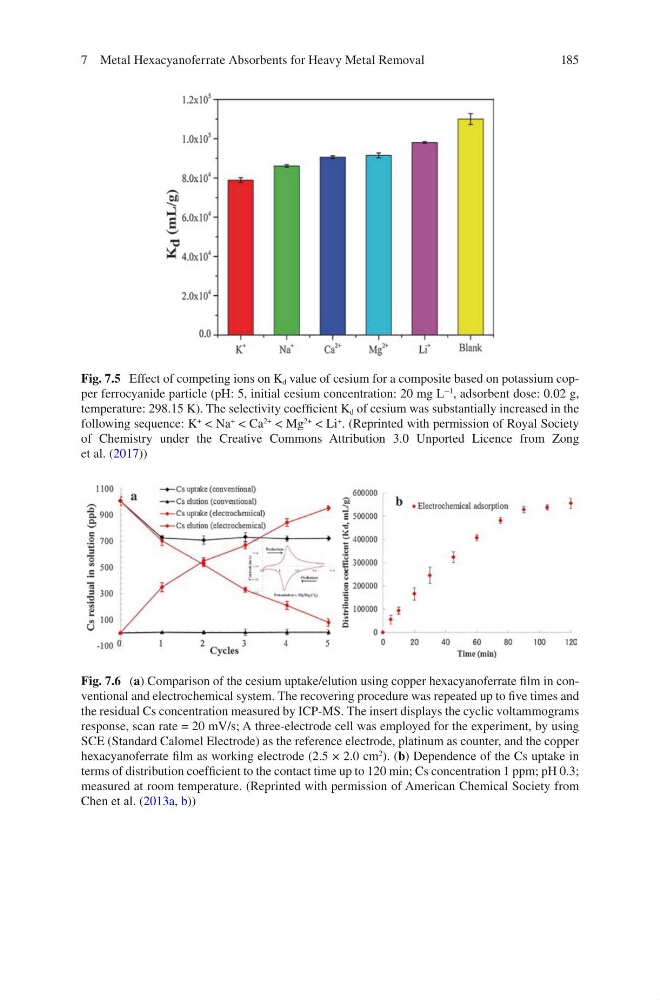
Fig. 7.5 Effect of competing ions on K d value of cesium for a composite based on potassium copper ferrocyanide particle (pH: 5, initial cesium concentration: 20 mg L
−1
, adsorbent dose: 0.02 g,
temperature: 298.15 K). The selectivity coefficient K d of cesium was substantially increased in the
following sequence: K
+ < Na
+ < Ca
2+
< Mg
2+
< Li
+
. (Reprinted with permission of Royal Society
of Chemistry under the Creative Commons Attribution 3.0 Unported Licence from Zong
et al. (2017))
Fig. 7.6 (a) Comparison of the cesium uptake/elution using copper hexacyanoferrate film in conventional and electrochemical system. The recovering procedure was repeated up to five times and
the residual Cs concentration measured by ICP-MS. The insert displays the cyclic voltammograms
response, scan rate = 20 mV/s; A three-electrode cell was employed for the experiment, by using
SCE (Standard Calomel Electrode) as the reference electrode, platinum as counter, and the copper
hexacyanoferrate film as working electrode (2.5 × 2.0 cm
2 ). (b) Dependence of the Cs uptake in
terms of distribution coefficient to the contact time up to 120 min; Cs concentration 1 ppm; pH 0.3;
measured at room temperature. (Reprinted with permission of American Chemical Society from
Chen et al. (2013a, b))
7 Metal Hexacyanoferrate Absorbents for Heavy Metal Removal
Fig. 7.5 Effect of competing ions on K d value of cesium for a composite based on potassium copper ferrocyanide particle (pH: 5, initial cesium concentration: 20 mg L
−1
, adsorbent dose: 0.02 g,
temperature: 298.15 K). The selectivity coefficient K d of cesium was substantially increased in the
following sequence: K
+ < Na
+ < Ca
2+
< Mg
2+
< Li
+
. (Reprinted with permission of Royal Society
of Chemistry under the Creative Commons Attribution 3.0 Unported Licence from Zong
et al. (2017))
Fig. 7.6 (a) Comparison of the cesium uptake/elution using copper hexacyanoferrate film in conventional and electrochemical system. The recovering procedure was repeated up to five times and
the residual Cs concentration measured by ICP-MS. The insert displays the cyclic voltammograms
response, scan rate = 20 mV/s; A three-electrode cell was employed for the experiment, by using
SCE (Standard Calomel Electrode) as the reference electrode, platinum as counter, and the copper
hexacyanoferrate film as working electrode (2.5 × 2.0 cm
2 ). (b) Dependence of the Cs uptake in
terms of distribution coefficient to the contact time up to 120 min; Cs concentration 1 ppm; pH 0.3;
measured at room temperature. (Reprinted with permission of American Chemical Society from
Chen et al. (2013a, b))
7 Metal Hexacyanoferrate Absorbents for Heavy Metal Removal