

174
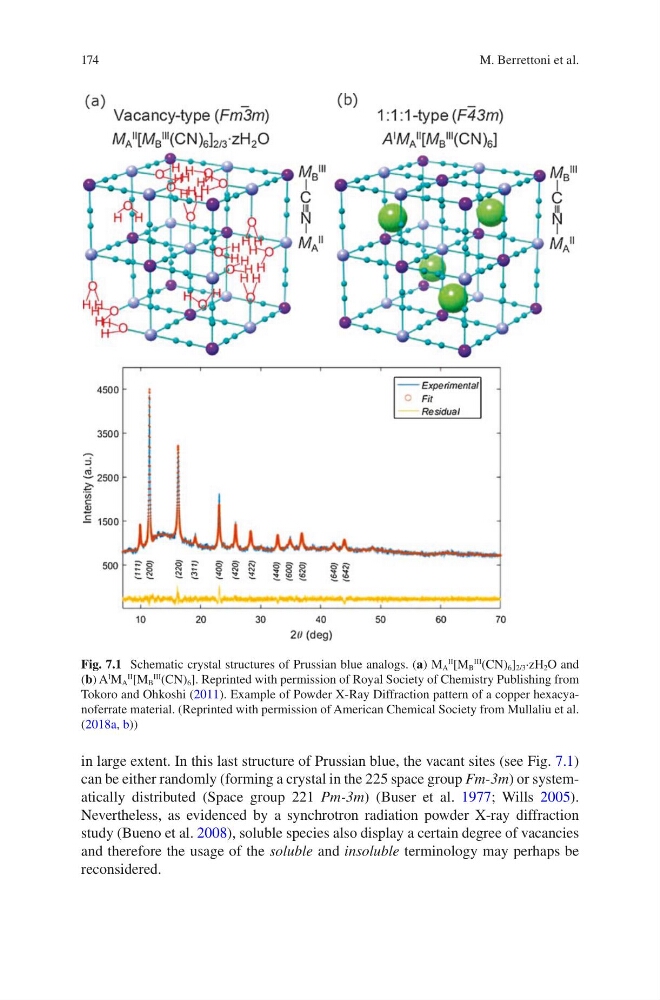
in large extent. In this last structure of Prussian blue, the vacant sites (see Fig. 7.1)
can be either randomly (forming a crystal in the 225 space group Fm-3m) or systematically distributed (Space group 221 Pm-3m) (Buser et al. 1977; Wills 2005).
Nevertheless, as evidenced by a synchrotron radiation powder X-ray diffraction
study (Bueno et al. 2008), soluble species also display a certain degree of vacancies
and therefore the usage of the soluble and insoluble terminology may perhaps be
reconsidered.
Fig. 7.1 Schematic crystal structures of Prussian blue analogs. (a) M A
II
[M B
III
(CN) 6 ] 2/3 ·zH 2 O and
(b) A
I M A
II
[M B
III
(CN) 6 ]. Reprinted with permission of Royal Society of Chemistry Publishing from
Tokoro and Ohkoshi (2011). Example of Powder X-Ray Diffraction pattern of a copper hexacyanoferrate material. (Reprinted with permission of American Chemical Society from Mullaliu et al.
(2018a, b))
M. Berrettoni et al.
in large extent. In this last structure of Prussian blue, the vacant sites (see Fig. 7.1)
can be either randomly (forming a crystal in the 225 space group Fm-3m) or systematically distributed (Space group 221 Pm-3m) (Buser et al. 1977; Wills 2005).
Nevertheless, as evidenced by a synchrotron radiation powder X-ray diffraction
study (Bueno et al. 2008), soluble species also display a certain degree of vacancies
and therefore the usage of the soluble and insoluble terminology may perhaps be
reconsidered.
Fig. 7.1 Schematic crystal structures of Prussian blue analogs. (a) M A
II
[M B
III
(CN) 6 ] 2/3 ·zH 2 O and
(b) A
I M A
II
[M B
III
(CN) 6 ]. Reprinted with permission of Royal Society of Chemistry Publishing from
Tokoro and Ohkoshi (2011). Example of Powder X-Ray Diffraction pattern of a copper hexacyanoferrate material. (Reprinted with permission of American Chemical Society from Mullaliu et al.
(2018a, b))
M. Berrettoni et al.