

151
from 15.92 to 21.31 mL/m
2
.h.mmHg when the amount of zeolite nanoparticles was
increased from 0.01 to 0.05 wt%. Further increase of zeolite loading decreased the
water permeability. However, the molecular weight cutoff of the composite membrane showed a steady increase from 9500 to 54,000 Da. with the increase in loading concentration. Those behaviors have been explained by the authors based on the
variations of the number of pores and pore sizes, which are directly related to the
zeolite nanoparticle loadings. The mechanism of the membrane formation during
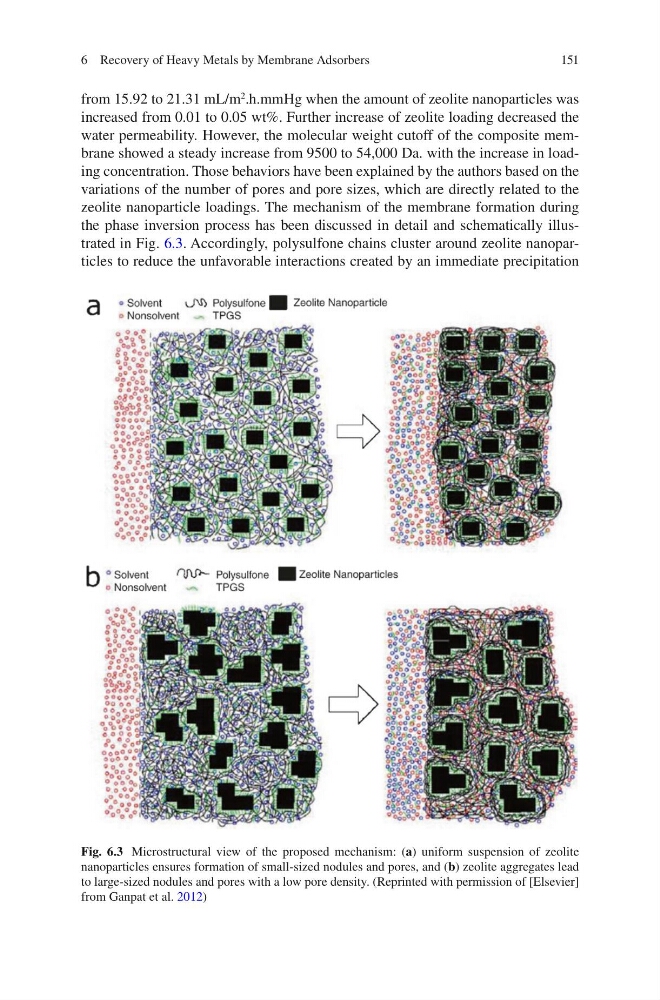
the phase inversion process has been discussed in detail and schematically illustrated in Fig. 6.3. Accordingly, polysulfone chains cluster around zeolite nanoparticles to reduce the unfavorable interactions created by an immediate precipitation
Fig. 6.3 Microstructural view of the proposed mechanism: (a) uniform suspension of zeolite
nanoparticles ensures formation of small-sized nodules and pores, and (b) zeolite aggregates lead
to large-sized nodules and pores with a low pore density. (Reprinted with permission of [Elsevier]
from Ganpat et al. 2012)
6 Recovery of Heavy Metals by Membrane Adsorbers
from 15.92 to 21.31 mL/m
2
.h.mmHg when the amount of zeolite nanoparticles was
increased from 0.01 to 0.05 wt%. Further increase of zeolite loading decreased the
water permeability. However, the molecular weight cutoff of the composite membrane showed a steady increase from 9500 to 54,000 Da. with the increase in loading concentration. Those behaviors have been explained by the authors based on the
variations of the number of pores and pore sizes, which are directly related to the
zeolite nanoparticle loadings. The mechanism of the membrane formation during
the phase inversion process has been discussed in detail and schematically illustrated in Fig. 6.3. Accordingly, polysulfone chains cluster around zeolite nanoparticles to reduce the unfavorable interactions created by an immediate precipitation
Fig. 6.3 Microstructural view of the proposed mechanism: (a) uniform suspension of zeolite
nanoparticles ensures formation of small-sized nodules and pores, and (b) zeolite aggregates lead
to large-sized nodules and pores with a low pore density. (Reprinted with permission of [Elsevier]
from Ganpat et al. 2012)
6 Recovery of Heavy Metals by Membrane Adsorbers