

147
6.2 Membrane Fabrication
Membrane technology provides a reliable and efficient separation through a range
of membrane materials (polymeric, e.g., polysulfone, polyethersulfone, polyamide,
polyvinylidene difluoride; ceramic, e.g., alumina, silica, titania; and metallic, e.g.,
silver, palladium) and pore sizes (reverse osmosis, nanofiltration, ultrafiltration, and
microfiltration) (Yasuda and Tsai 1974; Meng et al. 2009; Pendergast and Hoek
2011; Hofs et al. 2011). Polymeric membranes have been mostly preferred due to
their relatively low costs, wide ranges of pore sizes, flexibilities in configuration,
and easy scalability. Functional nanomaterial inclusion into membranes is believed
to overcome the natural limitations between permeability and selectivities of the
membrane, reduce the membrane fouling, and provide adsorptivity. However, during material development, care must be taken to balance between the potential
defect formation in the membrane and improved properties ensured by the embedded nanomaterial in order to derive positive benefits without compromising the
integrity of these composites.
Synthesis of membrane adsorbers is similar to regular polymer membrane fabrication. Two procedures are more appropriate for dispersing inorganic nanoparticles
in the suspension: first, dispersion of nanoparticles in the solvent followed by the
addition of polymer, and, second, preparation of polymer solution and nanoparticle
suspension separately followed by the addition of latter into the former (Lin et al.
2018; Cong et al. 2007). Those two techniques form low viscosity of the initial
filler/solvent suspension; hence, particle agglomerations can be precluded by high
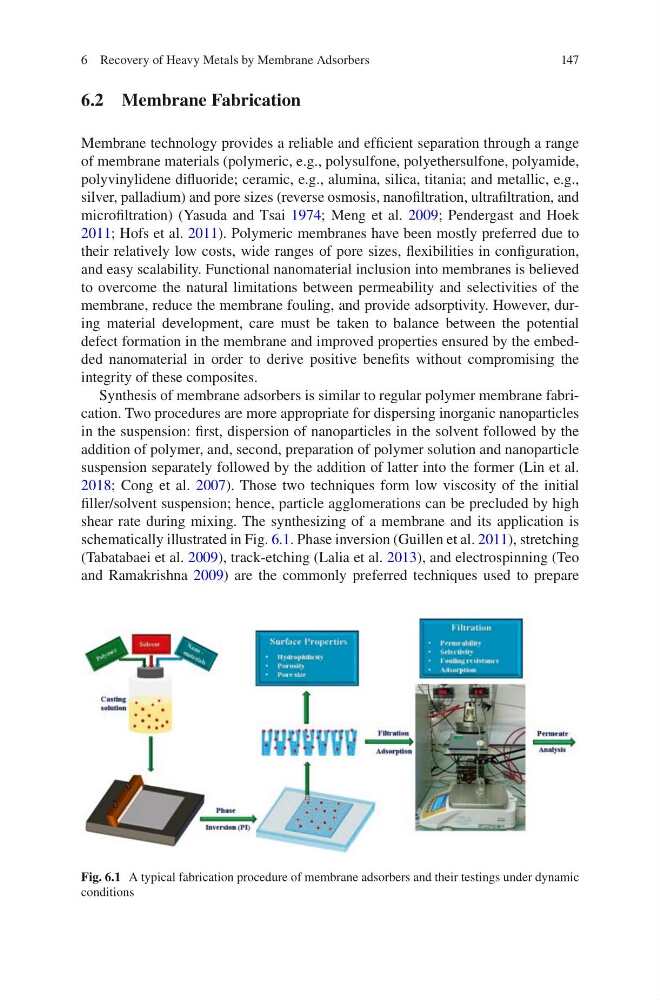
shear rate during mixing. The synthesizing of a membrane and its application is
schematically illustrated in Fig. 6.1. Phase inversion (Guillen et al. 2011), stretching
(Tabatabaei et al. 2009), track-etching (Lalia et al. 2013), and electrospinning (Teo
and Ramakrishna 2009) are the commonly preferred techniques used to prepare
Fig. 6.1 A typical fabrication procedure of membrane adsorbers and their testings under dynamic
conditions
6 Recovery of Heavy Metals by Membrane Adsorbers
6.2 Membrane Fabrication
Membrane technology provides a reliable and efficient separation through a range
of membrane materials (polymeric, e.g., polysulfone, polyethersulfone, polyamide,
polyvinylidene difluoride; ceramic, e.g., alumina, silica, titania; and metallic, e.g.,
silver, palladium) and pore sizes (reverse osmosis, nanofiltration, ultrafiltration, and
microfiltration) (Yasuda and Tsai 1974; Meng et al. 2009; Pendergast and Hoek
2011; Hofs et al. 2011). Polymeric membranes have been mostly preferred due to
their relatively low costs, wide ranges of pore sizes, flexibilities in configuration,
and easy scalability. Functional nanomaterial inclusion into membranes is believed
to overcome the natural limitations between permeability and selectivities of the
membrane, reduce the membrane fouling, and provide adsorptivity. However, during material development, care must be taken to balance between the potential
defect formation in the membrane and improved properties ensured by the embedded nanomaterial in order to derive positive benefits without compromising the
integrity of these composites.
Synthesis of membrane adsorbers is similar to regular polymer membrane fabrication. Two procedures are more appropriate for dispersing inorganic nanoparticles
in the suspension: first, dispersion of nanoparticles in the solvent followed by the
addition of polymer, and, second, preparation of polymer solution and nanoparticle
suspension separately followed by the addition of latter into the former (Lin et al.
2018; Cong et al. 2007). Those two techniques form low viscosity of the initial
filler/solvent suspension; hence, particle agglomerations can be precluded by high
shear rate during mixing. The synthesizing of a membrane and its application is
schematically illustrated in Fig. 6.1. Phase inversion (Guillen et al. 2011), stretching
(Tabatabaei et al. 2009), track-etching (Lalia et al. 2013), and electrospinning (Teo
and Ramakrishna 2009) are the commonly preferred techniques used to prepare
Fig. 6.1 A typical fabrication procedure of membrane adsorbers and their testings under dynamic
conditions
6 Recovery of Heavy Metals by Membrane Adsorbers