

collected in relation to the first DNC conference
explored how a Nexus Approach may help to
cope with them (Hettiarachchi and Ardakanian
2016b). Obviously, the challenges of global
change are interrelated, in particular urbanization
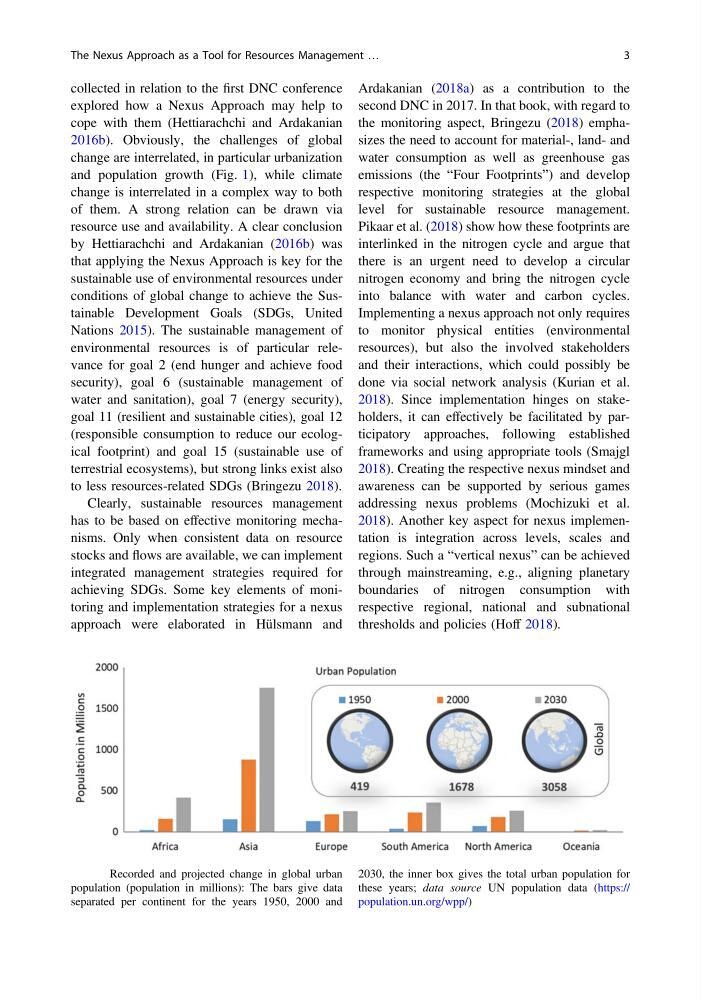
and population growth (Fig. 1), while climate
change is interrelated in a complex way to both
of them. A strong relation can be drawn via
resource use and availability. A clear conclusion
by Hettiarachchi and Ardakanian (2016b) was
that applying the Nexus Approach is key for the
sustainable use of environmental resources under
conditions of global change to achieve the Sustainable Development Goals (SDGs, United
Nations 2015). The sustainable management of
environmental resources is of particular relevance for goal 2 (end hunger and achieve food
security), goal 6 (sustainable management of
water and sanitation), goal 7 (energy security),
goal 11 (resilient and sustainable cities), goal 12
(responsible consumption to reduce our ecological footprint) and goal 15 (sustainable use of
terrestrial ecosystems), but strong links exist also
to less resources-related SDGs (Bringezu 2018).
Clearly, sustainable resources management
has to be based on effective monitoring mechanisms. Only when consistent data on resource
stocks and flows are available, we can implement
integrated management strategies required for
achieving SDGs. Some key elements of monitoring and implementation strategies for a nexus
approach were elaborated in Hülsmann and
Ardakanian (2018a) as a contribution to the
second DNC in 2017. In that book, with regard to
the monitoring aspect, Bringezu (2018) emphasizes the need to account for material-, land- and
water consumption as well as greenhouse gas
emissions (the “Four Footprints”) and develop
respective monitoring strategies at the global
level for sustainable resource management.
Pikaar et al. (2018) show how these footprints are
interlinked in the nitrogen cycle and argue that
there is an urgent need to develop a circular
nitrogen economy and bring the nitrogen cycle
into balance with water and carbon cycles.
Implementing a nexus approach not only requires
to monitor physical entities (environmental
resources), but also the involved stakeholders
and their interactions, which could possibly be
done via social network analysis (Kurian et al.
2018). Since implementation hinges on stakeholders, it can effectively be facilitated by participatory approaches, following established
frameworks and using appropriate tools (Smajgl
2018). Creating the respective nexus mindset and
awareness can be supported by serious games
addressing nexus problems (Mochizuki et al.
2018). Another key aspect for nexus implementation is integration across levels, scales and
regions. Such a “vertical nexus” can be achieved
through mainstreaming, e.g., aligning planetary
boundaries of nitrogen consumption with
respective regional, national and subnational
thresholds and policies (Hoff 2018).
Fig. 1 Recorded and projected change in global urban
population (population in millions): The bars give data
separated per continent for the years 1950, 2000 and
2030, the inner box gives the total urban population for
these years; data source UN population data (https://
population.un.org/wpp/)
The Nexus Approach as a Tool for Resources Management …
3
explored how a Nexus Approach may help to
cope with them (Hettiarachchi and Ardakanian
2016b). Obviously, the challenges of global
change are interrelated, in particular urbanization
and population growth (Fig. 1), while climate
change is interrelated in a complex way to both
of them. A strong relation can be drawn via
resource use and availability. A clear conclusion
by Hettiarachchi and Ardakanian (2016b) was
that applying the Nexus Approach is key for the
sustainable use of environmental resources under
conditions of global change to achieve the Sustainable Development Goals (SDGs, United
Nations 2015). The sustainable management of
environmental resources is of particular relevance for goal 2 (end hunger and achieve food
security), goal 6 (sustainable management of
water and sanitation), goal 7 (energy security),
goal 11 (resilient and sustainable cities), goal 12
(responsible consumption to reduce our ecological footprint) and goal 15 (sustainable use of
terrestrial ecosystems), but strong links exist also
to less resources-related SDGs (Bringezu 2018).
Clearly, sustainable resources management
has to be based on effective monitoring mechanisms. Only when consistent data on resource
stocks and flows are available, we can implement
integrated management strategies required for
achieving SDGs. Some key elements of monitoring and implementation strategies for a nexus
approach were elaborated in Hülsmann and
Ardakanian (2018a) as a contribution to the
second DNC in 2017. In that book, with regard to
the monitoring aspect, Bringezu (2018) emphasizes the need to account for material-, land- and
water consumption as well as greenhouse gas
emissions (the “Four Footprints”) and develop
respective monitoring strategies at the global
level for sustainable resource management.
Pikaar et al. (2018) show how these footprints are
interlinked in the nitrogen cycle and argue that
there is an urgent need to develop a circular
nitrogen economy and bring the nitrogen cycle
into balance with water and carbon cycles.
Implementing a nexus approach not only requires
to monitor physical entities (environmental
resources), but also the involved stakeholders
and their interactions, which could possibly be
done via social network analysis (Kurian et al.
2018). Since implementation hinges on stakeholders, it can effectively be facilitated by participatory approaches, following established
frameworks and using appropriate tools (Smajgl
2018). Creating the respective nexus mindset and
awareness can be supported by serious games
addressing nexus problems (Mochizuki et al.
2018). Another key aspect for nexus implementation is integration across levels, scales and
regions. Such a “vertical nexus” can be achieved
through mainstreaming, e.g., aligning planetary
boundaries of nitrogen consumption with
respective regional, national and subnational
thresholds and policies (Hoff 2018).
Fig. 1 Recorded and projected change in global urban
population (population in millions): The bars give data
separated per continent for the years 1950, 2000 and
2030, the inner box gives the total urban population for
these years; data source UN population data (https://
population.un.org/wpp/)
The Nexus Approach as a Tool for Resources Management …
3