

municipality and the size of the steering committee cannot be identified.
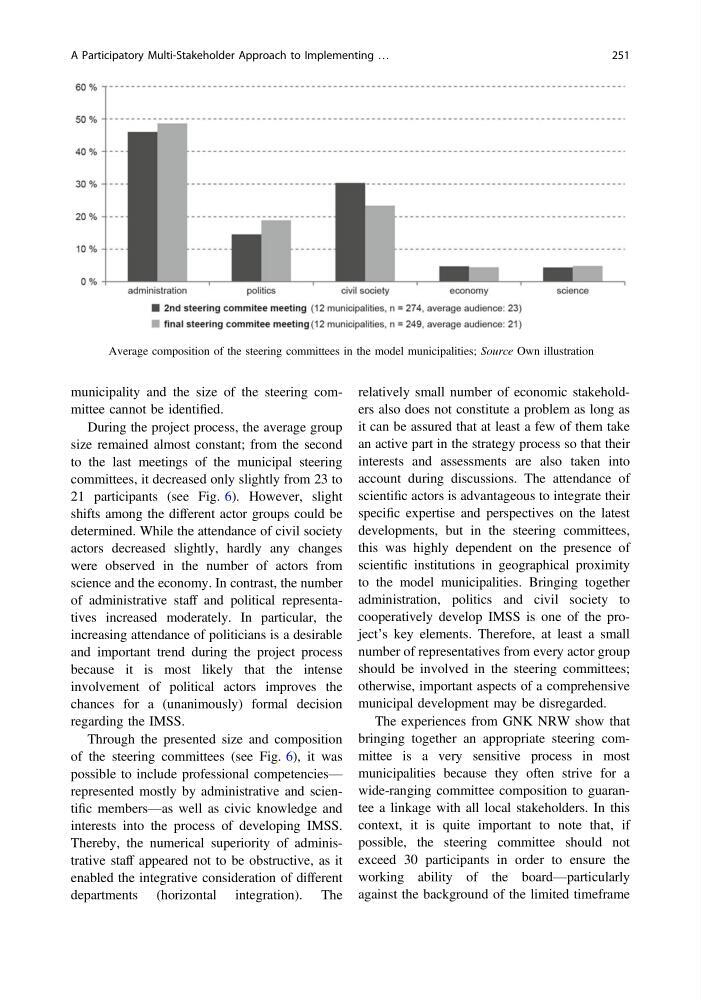
During the project process, the average group
size remained almost constant; from the second
to the last meetings of the municipal steering
committees, it decreased only slightly from 23 to
21 participants (see Fig. 6). However, slight
shifts among the different actor groups could be
determined. While the attendance of civil society
actors decreased slightly, hardly any changes
were observed in the number of actors from
science and the economy. In contrast, the number
of administrative staff and political representatives increased moderately. In particular, the
increasing attendance of politicians is a desirable
and important trend during the project process
because it is most likely that the intense
involvement of political actors improves the
chances for a (unanimously) formal decision
regarding the IMSS.
Through the presented size and composition
of the steering committees (see Fig. 6), it was
possible to include professional competencies—
represented mostly by administrative and scientific members—as well as civic knowledge and
interests into the process of developing IMSS.
Thereby, the numerical superiority of administrative staff appeared not to be obstructive, as it
enabled the integrative consideration of different
departments (horizontal integration). The
relatively small number of economic stakeholders also does not constitute a problem as long as
it can be assured that at least a few of them take
an active part in the strategy process so that their
interests and assessments are also taken into
account during discussions. The attendance of
scientific actors is advantageous to integrate their
specific expertise and perspectives on the latest
developments, but in the steering committees,
this was highly dependent on the presence of
scientific institutions in geographical proximity
to the model municipalities. Bringing together
administration, politics and civil society to
cooperatively develop IMSS is one of the project’s key elements. Therefore, at least a small
number of representatives from every actor group
should be involved in the steering committees;
otherwise, important aspects of a comprehensive
municipal development may be disregarded.
The experiences from GNK NRW show that
bringing together an appropriate steering committee is a very sensitive process in most
municipalities because they often strive for a
wide-ranging committee composition to guarantee a linkage with all local stakeholders. In this
context, it is quite important to note that, if
possible, the steering committee should not
exceed 30 participants in order to ensure the
working ability of the board—particularly
against the background of the limited timeframe
Fig. 6 Average composition of the steering committees in the model municipalities; Source Own illustration
A Participatory Multi-Stakeholder Approach to Implementing …
251
During the project process, the average group
size remained almost constant; from the second
to the last meetings of the municipal steering
committees, it decreased only slightly from 23 to
21 participants (see Fig. 6). However, slight
shifts among the different actor groups could be
determined. While the attendance of civil society
actors decreased slightly, hardly any changes
were observed in the number of actors from
science and the economy. In contrast, the number
of administrative staff and political representatives increased moderately. In particular, the
increasing attendance of politicians is a desirable
and important trend during the project process
because it is most likely that the intense
involvement of political actors improves the
chances for a (unanimously) formal decision
regarding the IMSS.
Through the presented size and composition
of the steering committees (see Fig. 6), it was
possible to include professional competencies—
represented mostly by administrative and scientific members—as well as civic knowledge and
interests into the process of developing IMSS.
Thereby, the numerical superiority of administrative staff appeared not to be obstructive, as it
enabled the integrative consideration of different
departments (horizontal integration). The
relatively small number of economic stakeholders also does not constitute a problem as long as
it can be assured that at least a few of them take
an active part in the strategy process so that their
interests and assessments are also taken into
account during discussions. The attendance of
scientific actors is advantageous to integrate their
specific expertise and perspectives on the latest
developments, but in the steering committees,
this was highly dependent on the presence of
scientific institutions in geographical proximity
to the model municipalities. Bringing together
administration, politics and civil society to
cooperatively develop IMSS is one of the project’s key elements. Therefore, at least a small
number of representatives from every actor group
should be involved in the steering committees;
otherwise, important aspects of a comprehensive
municipal development may be disregarded.
The experiences from GNK NRW show that
bringing together an appropriate steering committee is a very sensitive process in most
municipalities because they often strive for a
wide-ranging committee composition to guarantee a linkage with all local stakeholders. In this
context, it is quite important to note that, if
possible, the steering committee should not
exceed 30 participants in order to ensure the
working ability of the board—particularly
against the background of the limited timeframe
Fig. 6 Average composition of the steering committees in the model municipalities; Source Own illustration
A Participatory Multi-Stakeholder Approach to Implementing …
251