

communities into working groups to coordinate
planning and implementation of possible technologies, and (iii) formulation of community
bylaws (regulations) with clear enforcement
guidelines starting from implementation to post
implementation (Field observations; Mekonnen
and Fekadu 2015).
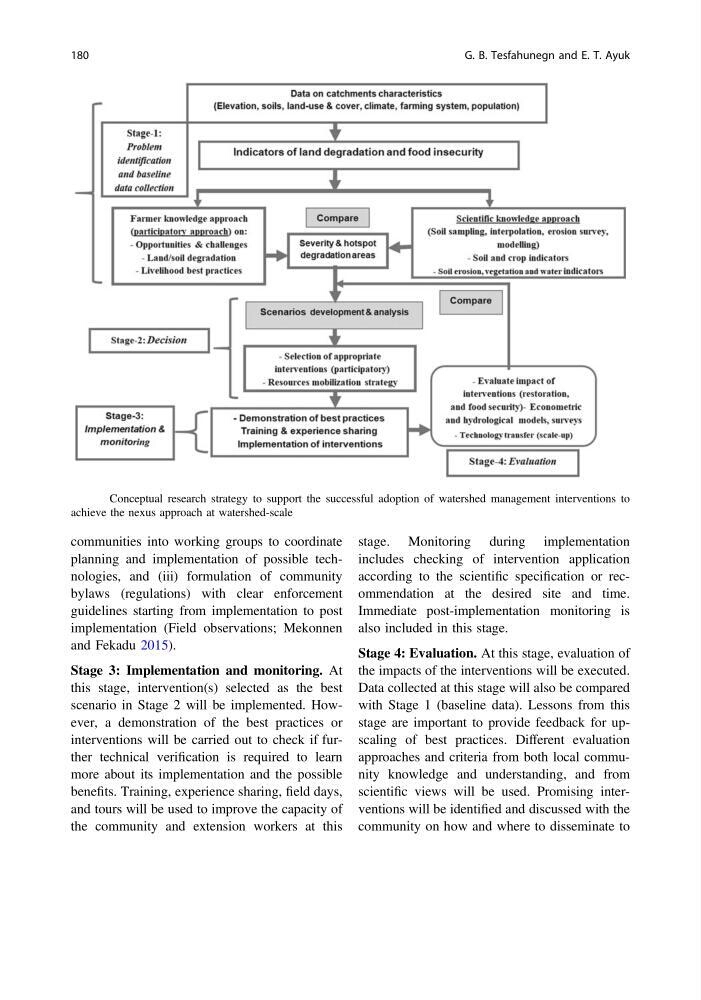
Stage 3: Implementation and monitoring. At
this stage, intervention(s) selected as the best
scenario in Stage 2 will be implemented. However, a demonstration of the best practices or
interventions will be carried out to check if further technical verification is required to learn
more about its implementation and the possible
benefits. Training, experience sharing, field days,
and tours will be used to improve the capacity of
the community and extension workers at this
stage. Monitoring during implementation
includes checking of intervention application
according to the scientific specification or recommendation at the desired site and time.
Immediate post-implementation monitoring is
also included in this stage.
Stage 4: Evaluation. At this stage, evaluation of
the impacts of the interventions will be executed.
Data collected at this stage will also be compared
with Stage 1 (baseline data). Lessons from this
stage are important to provide feedback for upscaling of best practices. Different evaluation
approaches and criteria from both local community knowledge and understanding, and from
scientific views will be used. Promising interventions will be identified and discussed with the
community on how and where to disseminate to
Fig. 9 Conceptual research strategy to support the successful adoption of watershed management interventions to
achieve the nexus approach at watershed-scale
180
G. B. Tesfahunegn and E. T. Ayuk
planning and implementation of possible technologies, and (iii) formulation of community
bylaws (regulations) with clear enforcement
guidelines starting from implementation to post
implementation (Field observations; Mekonnen
and Fekadu 2015).
Stage 3: Implementation and monitoring. At
this stage, intervention(s) selected as the best
scenario in Stage 2 will be implemented. However, a demonstration of the best practices or
interventions will be carried out to check if further technical verification is required to learn
more about its implementation and the possible
benefits. Training, experience sharing, field days,
and tours will be used to improve the capacity of
the community and extension workers at this
stage. Monitoring during implementation
includes checking of intervention application
according to the scientific specification or recommendation at the desired site and time.
Immediate post-implementation monitoring is
also included in this stage.
Stage 4: Evaluation. At this stage, evaluation of
the impacts of the interventions will be executed.
Data collected at this stage will also be compared
with Stage 1 (baseline data). Lessons from this
stage are important to provide feedback for upscaling of best practices. Different evaluation
approaches and criteria from both local community knowledge and understanding, and from
scientific views will be used. Promising interventions will be identified and discussed with the
community on how and where to disseminate to
Fig. 9 Conceptual research strategy to support the successful adoption of watershed management interventions to
achieve the nexus approach at watershed-scale
180
G. B. Tesfahunegn and E. T. Ayuk