

represent bottlenecks to the successful adoption
of watershed management interventions. For
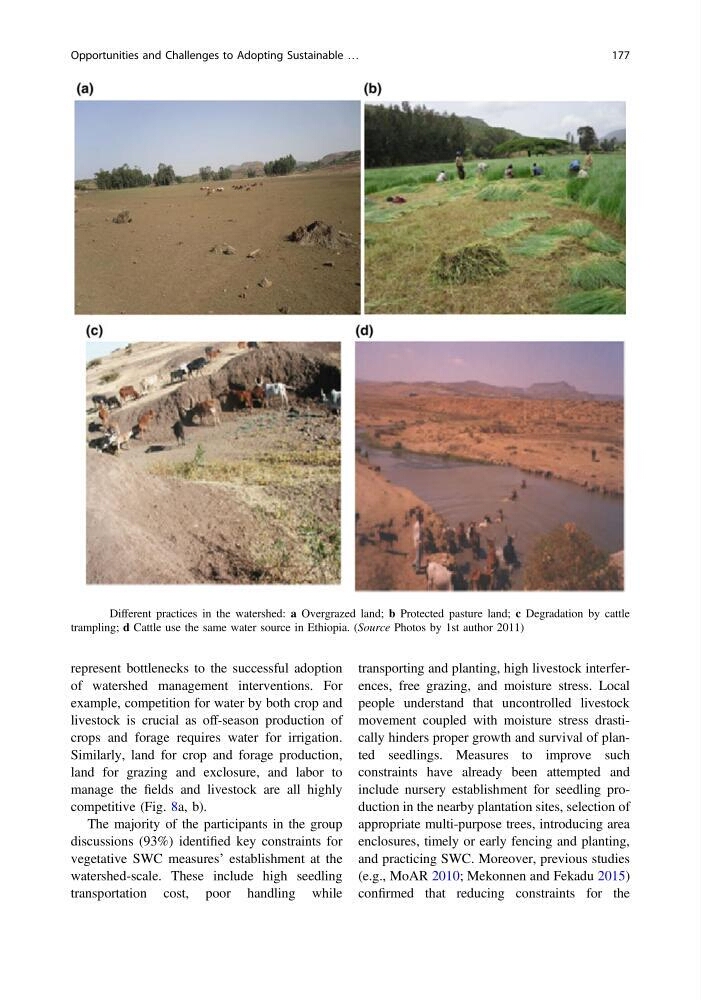
example, competition for water by both crop and
livestock is crucial as off-season production of
crops and forage requires water for irrigation.
Similarly, land for crop and forage production,
land for grazing and exclosure, and labor to
manage the fields and livestock are all highly
competitive (Fig. 8a, b).
The majority of the participants in the group
discussions (93%) identified key constraints for
vegetative SWC measures’ establishment at the
watershed-scale. These include high seedling
transportation cost, poor handling while
transporting and planting, high livestock interferences, free grazing, and moisture stress. Local
people understand that uncontrolled livestock
movement coupled with moisture stress drastically hinders proper growth and survival of planted seedlings. Measures to improve such
constraints have already been attempted and
include nursery establishment for seedling production in the nearby plantation sites, selection of
appropriate multi-purpose trees, introducing area
enclosures, timely or early fencing and planting,
and practicing SWC. Moreover, previous studies
(e.g., MoAR 2010; Mekonnen and Fekadu 2015)
confirmed that reducing constraints for the
Fig. 6 Different practices in the watershed: a Overgrazed land; b Protected pasture land; c Degradation by cattle
trampling; d Cattle use the same water source in Ethiopia. (Source Photos by 1st author 2011)
Opportunities and Challenges to Adopting Sustainable …
177
of watershed management interventions. For
example, competition for water by both crop and
livestock is crucial as off-season production of
crops and forage requires water for irrigation.
Similarly, land for crop and forage production,
land for grazing and exclosure, and labor to
manage the fields and livestock are all highly
competitive (Fig. 8a, b).
The majority of the participants in the group
discussions (93%) identified key constraints for
vegetative SWC measures’ establishment at the
watershed-scale. These include high seedling
transportation cost, poor handling while
transporting and planting, high livestock interferences, free grazing, and moisture stress. Local
people understand that uncontrolled livestock
movement coupled with moisture stress drastically hinders proper growth and survival of planted seedlings. Measures to improve such
constraints have already been attempted and
include nursery establishment for seedling production in the nearby plantation sites, selection of
appropriate multi-purpose trees, introducing area
enclosures, timely or early fencing and planting,
and practicing SWC. Moreover, previous studies
(e.g., MoAR 2010; Mekonnen and Fekadu 2015)
confirmed that reducing constraints for the
Fig. 6 Different practices in the watershed: a Overgrazed land; b Protected pasture land; c Degradation by cattle
trampling; d Cattle use the same water source in Ethiopia. (Source Photos by 1st author 2011)
Opportunities and Challenges to Adopting Sustainable …
177