

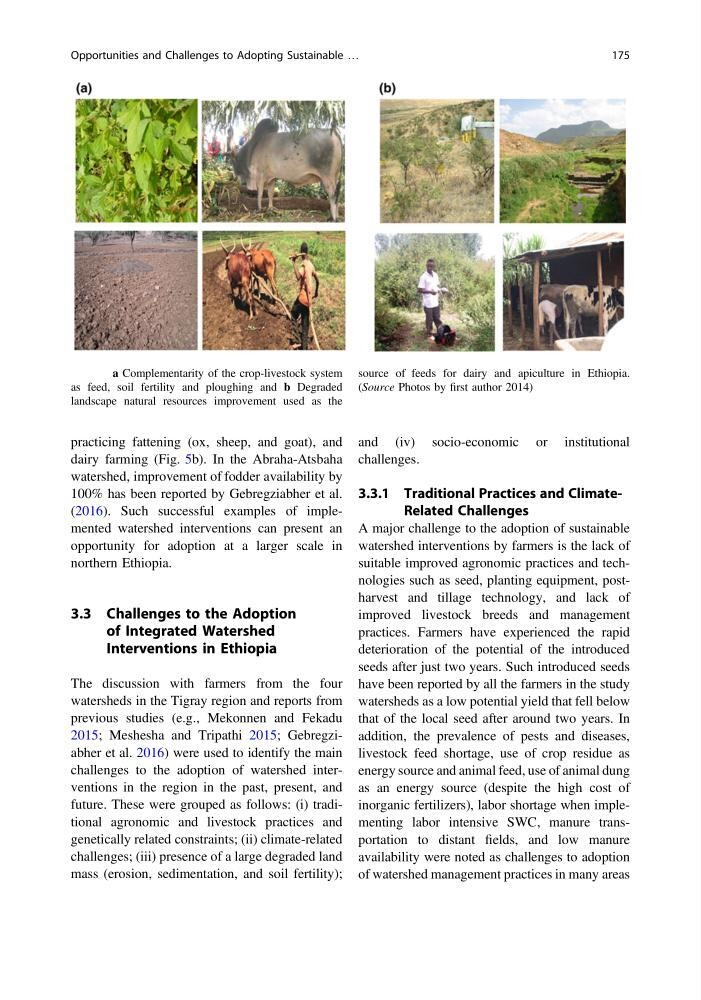
practicing fattening (ox, sheep, and goat), and
dairy farming (Fig. 5b). In the Abraha-Atsbaha
watershed, improvement of fodder availability by
100% has been reported by Gebregziabher et al.
(2016). Such successful examples of implemented watershed interventions can present an
opportunity for adoption at a larger scale in
northern Ethiopia.
3.3 Challenges to the Adoption
of Integrated Watershed
Interventions in Ethiopia
The discussion with farmers from the four
watersheds in the Tigray region and reports from
previous studies (e.g., Mekonnen and Fekadu
2015; Meshesha and Tripathi 2015; Gebregziabher et al. 2016) were used to identify the main
challenges to the adoption of watershed interventions in the region in the past, present, and
future. These were grouped as follows: (i) traditional agronomic and livestock practices and
genetically related constraints; (ii) climate-related
challenges; (iii) presence of a large degraded land
mass (erosion, sedimentation, and soil fertility);
and (iv) socio-economic or institutional
challenges.
3.3.1 Traditional Practices and ClimateRelated Challenges
A major challenge to the adoption of sustainable
watershed interventions by farmers is the lack of
suitable improved agronomic practices and technologies such as seed, planting equipment, postharvest and tillage technology, and lack of
improved livestock breeds and management
practices. Farmers have experienced the rapid
deterioration of the potential of the introduced
seeds after just two years. Such introduced seeds
have been reported by all the farmers in the study
watersheds as a low potential yield that fell below
that of the local seed after around two years. In
addition, the prevalence of pests and diseases,
livestock feed shortage, use of crop residue as
energy source and animal feed, use of animal dung
as an energy source (despite the high cost of
inorganic fertilizers), labor shortage when implementing labor intensive SWC, manure transportation to distant fields, and low manure
availability were noted as challenges to adoption
of watershed management practices in many areas
Fig. 5 a Complementarity of the crop-livestock system
as feed, soil fertility and ploughing and b Degraded
landscape natural resources improvement used as the
source of feeds for dairy and apiculture in Ethiopia.
(Source Photos by first author 2014)
Opportunities and Challenges to Adopting Sustainable …
175
dairy farming (Fig. 5b). In the Abraha-Atsbaha
watershed, improvement of fodder availability by
100% has been reported by Gebregziabher et al.
(2016). Such successful examples of implemented watershed interventions can present an
opportunity for adoption at a larger scale in
northern Ethiopia.
3.3 Challenges to the Adoption
of Integrated Watershed
Interventions in Ethiopia
The discussion with farmers from the four
watersheds in the Tigray region and reports from
previous studies (e.g., Mekonnen and Fekadu
2015; Meshesha and Tripathi 2015; Gebregziabher et al. 2016) were used to identify the main
challenges to the adoption of watershed interventions in the region in the past, present, and
future. These were grouped as follows: (i) traditional agronomic and livestock practices and
genetically related constraints; (ii) climate-related
challenges; (iii) presence of a large degraded land
mass (erosion, sedimentation, and soil fertility);
and (iv) socio-economic or institutional
challenges.
3.3.1 Traditional Practices and ClimateRelated Challenges
A major challenge to the adoption of sustainable
watershed interventions by farmers is the lack of
suitable improved agronomic practices and technologies such as seed, planting equipment, postharvest and tillage technology, and lack of
improved livestock breeds and management
practices. Farmers have experienced the rapid
deterioration of the potential of the introduced
seeds after just two years. Such introduced seeds
have been reported by all the farmers in the study
watersheds as a low potential yield that fell below
that of the local seed after around two years. In
addition, the prevalence of pests and diseases,
livestock feed shortage, use of crop residue as
energy source and animal feed, use of animal dung
as an energy source (despite the high cost of
inorganic fertilizers), labor shortage when implementing labor intensive SWC, manure transportation to distant fields, and low manure
availability were noted as challenges to adoption
of watershed management practices in many areas
Fig. 5 a Complementarity of the crop-livestock system
as feed, soil fertility and ploughing and b Degraded
landscape natural resources improvement used as the
source of feeds for dairy and apiculture in Ethiopia.
(Source Photos by first author 2014)
Opportunities and Challenges to Adopting Sustainable …
175