

77
the proteinuria. The water-related hazards or legacies from the activities of uranium
mining, milling and tailing management potentially damage the kidney. Hence, the
containment failure due to the erosion from heavy rain resulting in the release of
hazardous or toxic contaminants would be significant for water supplies in the
region, leading to 10–20 times greater radioactivity concentrations in the river/reservoir system than what is allowed.
The mining process has a direct impact to the environment (Beheshti 2011),
whereas the hydrological cycle is also getting disturbed and contaminated due to the
disposal of tailing materials (Dhaoui et al. 2016). Other than the aqueous stream, the
solid waste generated by the mining and milling activities contains radiotoxic substances like radon, selenium, uranium and thorium, sometimes along with the heavy
metals like molybdenum, copper and arsenic as well. Radon released from the environment poses a risk of lung cancer to both miners and the surrounding population
(Meena et al. 2010; Beheshti 2011). Moreover, a significant amount of uranium and
thorium was found in plants due to deposition of aerosol emitted from uranium
conversion facility area in France. In addition, Vachaspati et al. (2018) have studied
aerosol optical properties in the mining zone in Kadapa, India. The elevated level of
mining dust increases the mortality rates from non-malignant respiratory diseases,
like emphysema. On the other hand, the noise and air pollution by the heavy vehicle
used at the mine sites can aggravate the levels of respiratory disease, stress, sleep
disruption and blood pressure in the surrounding peoples. In nutshell, it can be
stated that mining and milling operations give proximal impacts initially wherein
environmental impacts are an intermediate outcome. The final consequences lead to
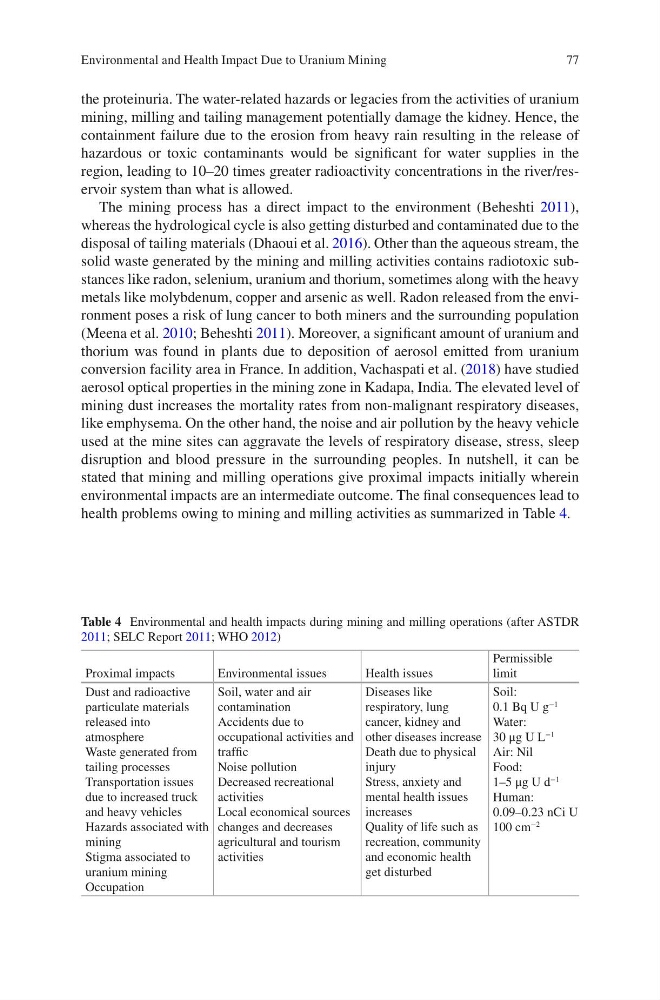
health problems owing to mining and milling activities as summarized in Table 4.
Table 4 Environmental and health impacts during mining and milling operations (after ASTDR
2011; SELC Report 2011; WHO 2012)
Proximal impacts
Environmental issues
Health issues
Permissible
limit
Dust and radioactive
particulate materials
released into
atmosphere
Waste generated from
tailing processes
Transportation issues
due to increased truck
and heavy vehicles
Hazards associated with
mining
Stigma associated to
uranium mining
Occupation
Soil, water and air
contamination
Accidents due to
occupational activities and
traffic
Noise pollution
Decreased recreational
activities
Local economical sources
changes and decreases
agricultural and tourism
activities
Diseases like
respiratory, lung
cancer, kidney and
other diseases increase
Death due to physical
injury
Stress, anxiety and
mental health issues
increases
Quality of life such as
recreation, community
and economic health
get disturbed
Soil:
0.1 Bq U g
−1
Water:
30 μg U L
−1
Air: Nil
Food:
1–5 μg U d
−1
Human:
0.09–0.23 nCi U
100 cm
−2
Environmental and Health Impact Due to Uranium Mining
the proteinuria. The water-related hazards or legacies from the activities of uranium
mining, milling and tailing management potentially damage the kidney. Hence, the
containment failure due to the erosion from heavy rain resulting in the release of
hazardous or toxic contaminants would be significant for water supplies in the
region, leading to 10–20 times greater radioactivity concentrations in the river/reservoir system than what is allowed.
The mining process has a direct impact to the environment (Beheshti 2011),
whereas the hydrological cycle is also getting disturbed and contaminated due to the
disposal of tailing materials (Dhaoui et al. 2016). Other than the aqueous stream, the
solid waste generated by the mining and milling activities contains radiotoxic substances like radon, selenium, uranium and thorium, sometimes along with the heavy
metals like molybdenum, copper and arsenic as well. Radon released from the environment poses a risk of lung cancer to both miners and the surrounding population
(Meena et al. 2010; Beheshti 2011). Moreover, a significant amount of uranium and
thorium was found in plants due to deposition of aerosol emitted from uranium
conversion facility area in France. In addition, Vachaspati et al. (2018) have studied
aerosol optical properties in the mining zone in Kadapa, India. The elevated level of
mining dust increases the mortality rates from non-malignant respiratory diseases,
like emphysema. On the other hand, the noise and air pollution by the heavy vehicle
used at the mine sites can aggravate the levels of respiratory disease, stress, sleep
disruption and blood pressure in the surrounding peoples. In nutshell, it can be
stated that mining and milling operations give proximal impacts initially wherein
environmental impacts are an intermediate outcome. The final consequences lead to
health problems owing to mining and milling activities as summarized in Table 4.
Table 4 Environmental and health impacts during mining and milling operations (after ASTDR
2011; SELC Report 2011; WHO 2012)
Proximal impacts
Environmental issues
Health issues
Permissible
limit
Dust and radioactive
particulate materials
released into
atmosphere
Waste generated from
tailing processes
Transportation issues
due to increased truck
and heavy vehicles
Hazards associated with
mining
Stigma associated to
uranium mining
Occupation
Soil, water and air
contamination
Accidents due to
occupational activities and
traffic
Noise pollution
Decreased recreational
activities
Local economical sources
changes and decreases
agricultural and tourism
activities
Diseases like
respiratory, lung
cancer, kidney and
other diseases increase
Death due to physical
injury
Stress, anxiety and
mental health issues
increases
Quality of life such as
recreation, community
and economic health
get disturbed
Soil:
0.1 Bq U g
−1
Water:
30 μg U L
−1
Air: Nil
Food:
1–5 μg U d
−1
Human:
0.09–0.23 nCi U
100 cm
−2
Environmental and Health Impact Due to Uranium Mining