

72
dumps slowly spill to pollute the ground/surface water. Such contamination of the
radioactive waste with air and water leads to a gradual decrease in soil fertility
(Bajwa et al. 2017), and exposure of it badly affects the human health (e.g. damaging the kidney, liver, lungs, eyes, skin, brain, etc.). However, the societal expectations and safety regulation of the current days evolved considerably as the outcomes
of the early mining became apparent to drive the changes in regulatory oversight
and mining practices. The reason that is why this industry is directed towards radiation protection, environmental stewardship, health and safety, and the mining methods are changing. In 1990, 55% of the global production of uranium was coming
from the underground mines, which shrunk to 33% in 1999. The in situ leach (ISL)
mining is steadily increasing its share of the total and in 2017 accounted for approximately half of the uranium production worldwide (see Table 2).
A safer and environmentally low-impact mining is not only a matter of interest
to uranium producers, but it is also one of concern to the users of nuclear energy to
establish it as the clean source of energy (Ming et al. 2016; Guo and Ren 2017). This
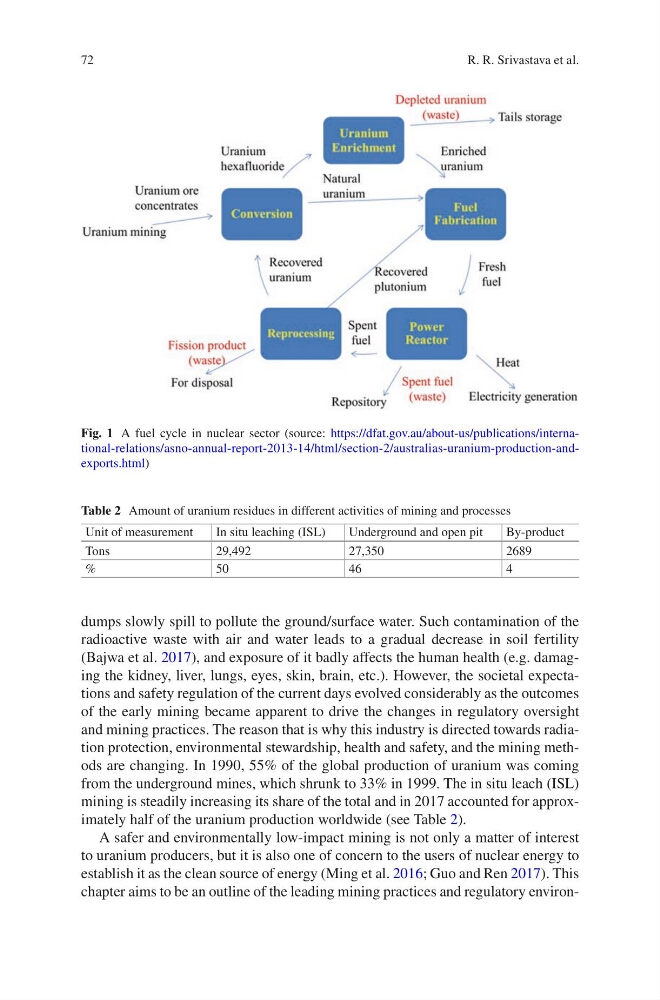
chapter aims to be an outline of the leading mining practices and regulatory environFig.
tional-relations/asno-annual-report-2013-14/html/section-2/australias-uranium-production-andexports.html)
Table 2 Amount of uranium residues in different activities of mining and processes
Unit of measurement
In situ leaching (ISL)
Underground and open pit
By-product
Tons
29,492
27,350
2689
%
50
46
4
R. R. Srivastava et al.
dumps slowly spill to pollute the ground/surface water. Such contamination of the
radioactive waste with air and water leads to a gradual decrease in soil fertility
(Bajwa et al. 2017), and exposure of it badly affects the human health (e.g. damaging the kidney, liver, lungs, eyes, skin, brain, etc.). However, the societal expectations and safety regulation of the current days evolved considerably as the outcomes
of the early mining became apparent to drive the changes in regulatory oversight
and mining practices. The reason that is why this industry is directed towards radiation protection, environmental stewardship, health and safety, and the mining methods are changing. In 1990, 55% of the global production of uranium was coming
from the underground mines, which shrunk to 33% in 1999. The in situ leach (ISL)
mining is steadily increasing its share of the total and in 2017 accounted for approximately half of the uranium production worldwide (see Table 2).
A safer and environmentally low-impact mining is not only a matter of interest
to uranium producers, but it is also one of concern to the users of nuclear energy to
establish it as the clean source of energy (Ming et al. 2016; Guo and Ren 2017). This
chapter aims to be an outline of the leading mining practices and regulatory environFig.
tional-relations/asno-annual-report-2013-14/html/section-2/australias-uranium-production-andexports.html)
Table 2 Amount of uranium residues in different activities of mining and processes
Unit of measurement
In situ leaching (ISL)
Underground and open pit
By-product
Tons
29,492
27,350
2689
%
50
46
4
R. R. Srivastava et al.