

56
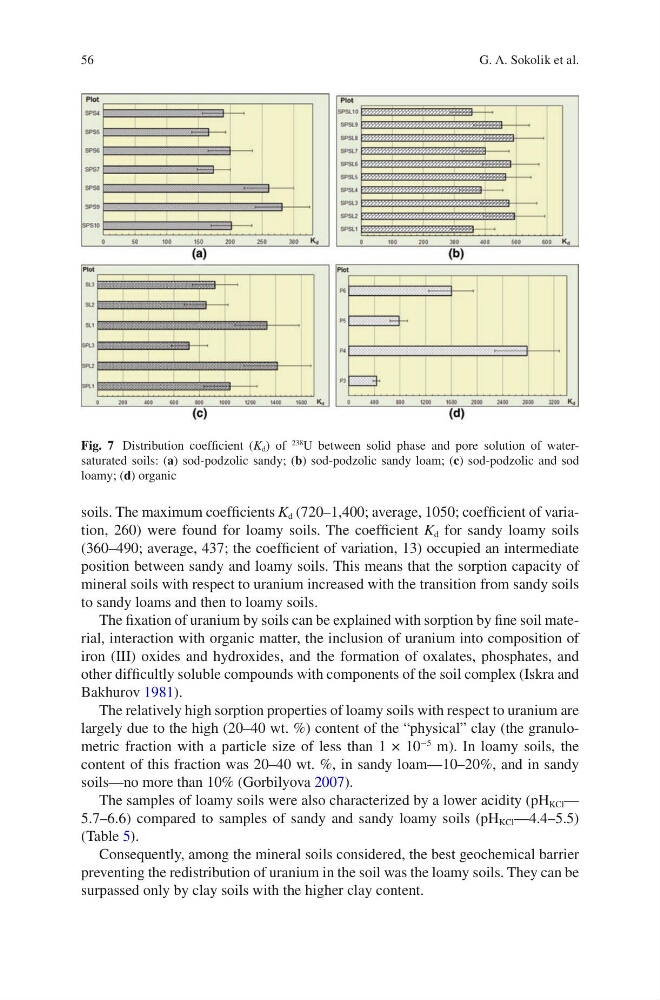
soils. The maximum coefficients K d (720–1,400; average, 1050; coefficient of variation, 260) were found for loamy soils. The coefficient K d for sandy loamy soils
(360–490; average, 437; the coefficient of variation, 13) occupied an intermediate
position between sandy and loamy soils. This means that the sorption capacity of
mineral soils with respect to uranium increased with the transition from sandy soils
to sandy loams and then to loamy soils.
The fixation of uranium by soils can be explained with sorption by fine soil material, interaction with organic matter, the inclusion of uranium into composition of
iron (III) oxides and hydroxides, and the formation of oxalates, phosphates, and
other difficultly soluble compounds with components of the soil complex (Iskra and
Bakhurov 1981).
The relatively high sorption properties of loamy soils with respect to uranium are
largely due to the high (20–40 wt. %) content of the “physical” clay (the granulometric fraction with a particle size of less than 1 × 10
−5
m). In loamy soils, the
content of this fraction was 20–40 wt. %, in sandy loam—10–20%, and in sandy
soils—no more than 10% (Gorbilyova 2007).
The samples of loamy soils were also characterized by a lower acidity (pH KCl —
5.7–6.6) compared to samples of sandy and sandy loamy soils (pH KCl —4.4–5.5)
(Table 5).
Consequently, among the mineral soils considered, the best geochemical barrier
preventing the redistribution of uranium in the soil was the loamy soils. They can be
surpassed only by clay soils with the higher clay content.
Fig. 7 Distribution coefficient (K d ) of
238
U between solid phase and pore solution of watersaturated soils: (a) sod-podzolic sandy; (b) sod-podzolic sandy loam; (c) sod-podzolic and sod
loamy; (d) organic
G. A. Sokolik et al.
soils. The maximum coefficients K d (720–1,400; average, 1050; coefficient of variation, 260) were found for loamy soils. The coefficient K d for sandy loamy soils
(360–490; average, 437; the coefficient of variation, 13) occupied an intermediate
position between sandy and loamy soils. This means that the sorption capacity of
mineral soils with respect to uranium increased with the transition from sandy soils
to sandy loams and then to loamy soils.
The fixation of uranium by soils can be explained with sorption by fine soil material, interaction with organic matter, the inclusion of uranium into composition of
iron (III) oxides and hydroxides, and the formation of oxalates, phosphates, and
other difficultly soluble compounds with components of the soil complex (Iskra and
Bakhurov 1981).
The relatively high sorption properties of loamy soils with respect to uranium are
largely due to the high (20–40 wt. %) content of the “physical” clay (the granulometric fraction with a particle size of less than 1 × 10
−5
m). In loamy soils, the
content of this fraction was 20–40 wt. %, in sandy loam—10–20%, and in sandy
soils—no more than 10% (Gorbilyova 2007).
The samples of loamy soils were also characterized by a lower acidity (pH KCl —
5.7–6.6) compared to samples of sandy and sandy loamy soils (pH KCl —4.4–5.5)
(Table 5).
Consequently, among the mineral soils considered, the best geochemical barrier
preventing the redistribution of uranium in the soil was the loamy soils. They can be
surpassed only by clay soils with the higher clay content.
Fig. 7 Distribution coefficient (K d ) of
238
U between solid phase and pore solution of watersaturated soils: (a) sod-podzolic sandy; (b) sod-podzolic sandy loam; (c) sod-podzolic and sod
loamy; (d) organic
G. A. Sokolik et al.