

49
Differences in the content of uranium in the pore waters of soils were due to the
peculiarities of the structure of the sorption soil complex: different ratios of granulometric fractions and the content and composition of mineral and organic components,
acidity, moisture capacity, and other properties that affect the release of radionuclides
into pore waters. A close correlation was found between the content of uranium
(α U ,%) and organic components (OM sol ,%) in pore solutions of mineral soils (Fig. 3).
Uranium is characterized by a high tendency to complex formation (Sheppard
and Campbell 1980; Katz et al. 1991). In soil solutions and other types of natural
waters, it can be present simultaneously in the form of anionic, cationic, and neutral
(molecular) complex compounds with organic and inorganic ligands (Katz et al.
1991). Under natural conditions, the main part of organic material of soils is in the
solid phase. Even in cases where the fraction of fulvic acids (FA) exceeds the humic
acids (HA) fraction, most of the FA soluble in the free state is associated in soils
with high-molecular-weight poorly soluble HA and with the mineral part of the
absorbing soil complex (Titayeva and Taskayev 1983; Zhang et al. 1997). Only a
small part of relatively low- molecular organic components enters the pore waters
of soils. The presence of a correlation between the content of uranium and organic
components in the porous waters of soils indicates that the entry of uranium into
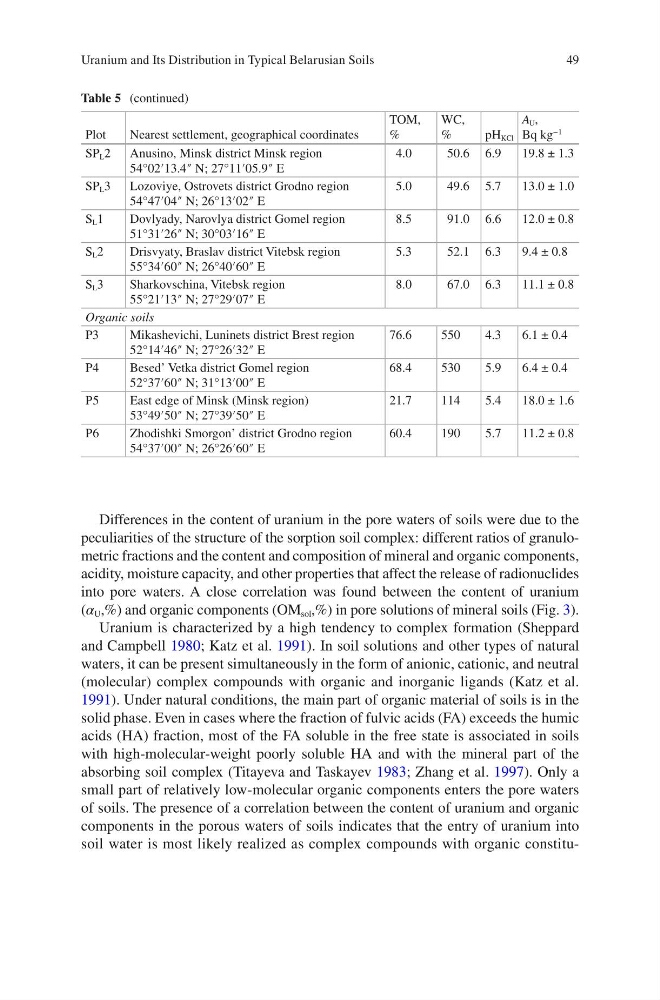
soil water is most likely realized as complex compounds with organic constituTable 5 (continued)
Plot
Nearest settlement, geographical coordinates
TOM,
%
WC,
%
pH KCl
A U ,
Bq kg
−1
SP L 2
Anusino, Minsk district Minsk region
54°02′13.4″ N; 27°11′05.9″ E
4.0
50.6 6.9
19.8 ± 1.3
SP L 3
Lozoviye, Ostrovets district Grodno region
54°47′04″ N; 26°13′02″ E
5.0
49.6 5.7
13.0 ± 1.0
S L 1
Dovlyady, Narovlya district Gomel region
51°31′26″ N; 30°03′16″ E
8.5
91.0 6.6
12.0 ± 0.8
S L 2
Drisvyaty, Braslav district Vitebsk region
55°34′60″ N; 26°40′60″ E
5.3
52.1 6.3
9.4 ± 0.8
S L 3
Sharkovschina, Vitebsk region
55°21′13″ N; 27°29′07″ E
8.0
67.0 6.3
11.1 ± 0.8
Organic soils
P3
Mikashevichi, Luninets district Brest region
52°14′46″ N; 27°26′32″ E
76.6
550
4.3
6.1 ± 0.4
P4
Besed’ Vetka district Gomel region
52°37′60″ N; 31°13′00″ E
68.4
530
5.9
6.4 ± 0.4
Р5
East edge of Minsk (Minsk region)
53°49′50″ N; 27°39′50″ E
21.7
114
5.4
18.0 ± 1.6
Р6
Zhodishki Smorgon’ district Grodno region
54°37′00″ N; 26°26′60″ E
60.4
190
5.7
11.2 ± 0.8
Uranium and Its Distribution in Typical Belarusian Soils
Differences in the content of uranium in the pore waters of soils were due to the
peculiarities of the structure of the sorption soil complex: different ratios of granulometric fractions and the content and composition of mineral and organic components,
acidity, moisture capacity, and other properties that affect the release of radionuclides
into pore waters. A close correlation was found between the content of uranium
(α U ,%) and organic components (OM sol ,%) in pore solutions of mineral soils (Fig. 3).
Uranium is characterized by a high tendency to complex formation (Sheppard
and Campbell 1980; Katz et al. 1991). In soil solutions and other types of natural
waters, it can be present simultaneously in the form of anionic, cationic, and neutral
(molecular) complex compounds with organic and inorganic ligands (Katz et al.
1991). Under natural conditions, the main part of organic material of soils is in the
solid phase. Even in cases where the fraction of fulvic acids (FA) exceeds the humic
acids (HA) fraction, most of the FA soluble in the free state is associated in soils
with high-molecular-weight poorly soluble HA and with the mineral part of the
absorbing soil complex (Titayeva and Taskayev 1983; Zhang et al. 1997). Only a
small part of relatively low- molecular organic components enters the pore waters
of soils. The presence of a correlation between the content of uranium and organic
components in the porous waters of soils indicates that the entry of uranium into
soil water is most likely realized as complex compounds with organic constituTable 5 (continued)
Plot
Nearest settlement, geographical coordinates
TOM,
%
WC,
%
pH KCl
A U ,
Bq kg
−1
SP L 2
Anusino, Minsk district Minsk region
54°02′13.4″ N; 27°11′05.9″ E
4.0
50.6 6.9
19.8 ± 1.3
SP L 3
Lozoviye, Ostrovets district Grodno region
54°47′04″ N; 26°13′02″ E
5.0
49.6 5.7
13.0 ± 1.0
S L 1
Dovlyady, Narovlya district Gomel region
51°31′26″ N; 30°03′16″ E
8.5
91.0 6.6
12.0 ± 0.8
S L 2
Drisvyaty, Braslav district Vitebsk region
55°34′60″ N; 26°40′60″ E
5.3
52.1 6.3
9.4 ± 0.8
S L 3
Sharkovschina, Vitebsk region
55°21′13″ N; 27°29′07″ E
8.0
67.0 6.3
11.1 ± 0.8
Organic soils
P3
Mikashevichi, Luninets district Brest region
52°14′46″ N; 27°26′32″ E
76.6
550
4.3
6.1 ± 0.4
P4
Besed’ Vetka district Gomel region
52°37′60″ N; 31°13′00″ E
68.4
530
5.9
6.4 ± 0.4
Р5
East edge of Minsk (Minsk region)
53°49′50″ N; 27°39′50″ E
21.7
114
5.4
18.0 ± 1.6
Р6
Zhodishki Smorgon’ district Grodno region
54°37′00″ N; 26°26′60″ E
60.4
190
5.7
11.2 ± 0.8
Uranium and Its Distribution in Typical Belarusian Soils