

39
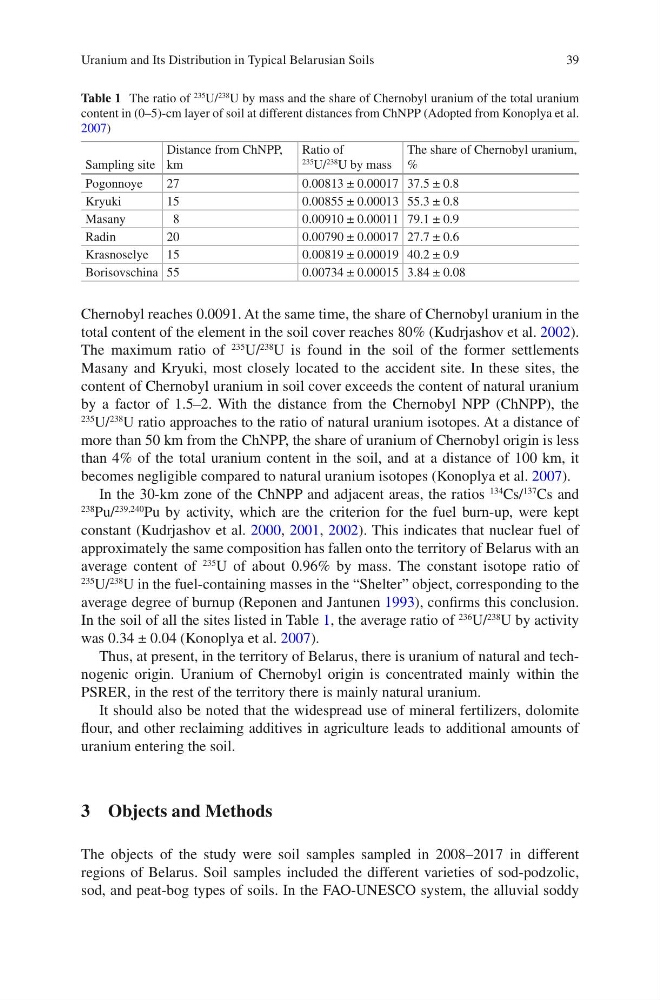
Chernobyl reaches 0.0091. At the same time, the share of Chernobyl uranium in the
total content of the element in the soil cover reaches 80% (Kudrjashov et al. 2002).
The maximum ratio of
235
U/
238
U is found in the soil of the former settlements
Masany and Kryuki, most closely located to the accident site. In these sites, the
content of Chernobyl uranium in soil cover exceeds the content of natural uranium
by a factor of 1.5–2. With the distance from the Chernobyl NPP (ChNPP), the
235
U/
238
U ratio approaches to the ratio of natural uranium isotopes. At a distance of
more than 50 km from the ChNPP, the share of uranium of Chernobyl origin is less
than 4% of the total uranium content in the soil, and at a distance of 100 km, it
becomes negligible compared to natural uranium isotopes (Konoplya et al. 2007).
In the 30-km zone of the ChNPP and adjacent areas, the ratios
134
Cs/
137
Cs and
238
Pu/
239,240
Pu by activity, which are the criterion for the fuel burn-up, were kept
constant (Kudrjashov et al. 2000, 2001, 2002). This indicates that nuclear fuel of
approximately the same composition has fallen onto the territory of Belarus with an
average content of
235
U of about 0.96% by mass. The constant isotope ratio of
235
U/
238
U in the fuel-containing masses in the “Shelter” object, corresponding to the
average degree of burnup (Reponen and Jantunen 1993), confirms this conclusion.
In the soil of all the sites listed in Table 1, the average ratio of
236
U/
238
U by activity
was 0.34 ± 0.04 (Konoplya et al. 2007).
Thus, at present, in the territory of Belarus, there is uranium of natural and technogenic origin. Uranium of Chernobyl origin is concentrated mainly within the
PSRER, in the rest of the territory there is mainly natural uranium.
It should also be noted that the widespread use of mineral fertilizers, dolomite
flour, and other reclaiming additives in agriculture leads to additional amounts of
uranium entering the soil.
3 Objects and Methods
The objects of the study were soil samples sampled in 2008–2017 in different
regions of Belarus. Soil samples included the different varieties of sod-podzolic,
sod, and peat-bog types of soils. In the FAO-UNESCO system, the alluvial soddy
Table 1 The ratio of
235
U/
238
U by mass and the share of Chernobyl uranium of the total uranium
content in (0–5)-cm layer of soil at different distances from ChNPP (Adopted from Konoplya et al.
2007)
Sampling site
Distance from ChNPP,
km
Ratio of
235
U/
238
U by mass
The share of Chernobyl uranium,
%
Pogonnoye
27
0.00813 ± 0.00017 37.5 ± 0.8
Kryuki
15
0.00855 ± 0.00013 55.3 ± 0.8
Masany
8
0.00910 ± 0.00011 79.1 ± 0.9
Radin
20
0.00790 ± 0.00017 27.7 ± 0.6
Krasnoselye 15
0.00819 ± 0.00019 40.2 ± 0.9
Borisovschina 55
0.00734 ± 0.00015 3.84 ± 0.08
Uranium and Its Distribution in Typical Belarusian Soils
Chernobyl reaches 0.0091. At the same time, the share of Chernobyl uranium in the
total content of the element in the soil cover reaches 80% (Kudrjashov et al. 2002).
The maximum ratio of
235
U/
238
U is found in the soil of the former settlements
Masany and Kryuki, most closely located to the accident site. In these sites, the
content of Chernobyl uranium in soil cover exceeds the content of natural uranium
by a factor of 1.5–2. With the distance from the Chernobyl NPP (ChNPP), the
235
U/
238
U ratio approaches to the ratio of natural uranium isotopes. At a distance of
more than 50 km from the ChNPP, the share of uranium of Chernobyl origin is less
than 4% of the total uranium content in the soil, and at a distance of 100 km, it
becomes negligible compared to natural uranium isotopes (Konoplya et al. 2007).
In the 30-km zone of the ChNPP and adjacent areas, the ratios
134
Cs/
137
Cs and
238
Pu/
239,240
Pu by activity, which are the criterion for the fuel burn-up, were kept
constant (Kudrjashov et al. 2000, 2001, 2002). This indicates that nuclear fuel of
approximately the same composition has fallen onto the territory of Belarus with an
average content of
235
U of about 0.96% by mass. The constant isotope ratio of
235
U/
238
U in the fuel-containing masses in the “Shelter” object, corresponding to the
average degree of burnup (Reponen and Jantunen 1993), confirms this conclusion.
In the soil of all the sites listed in Table 1, the average ratio of
236
U/
238
U by activity
was 0.34 ± 0.04 (Konoplya et al. 2007).
Thus, at present, in the territory of Belarus, there is uranium of natural and technogenic origin. Uranium of Chernobyl origin is concentrated mainly within the
PSRER, in the rest of the territory there is mainly natural uranium.
It should also be noted that the widespread use of mineral fertilizers, dolomite
flour, and other reclaiming additives in agriculture leads to additional amounts of
uranium entering the soil.
3 Objects and Methods
The objects of the study were soil samples sampled in 2008–2017 in different
regions of Belarus. Soil samples included the different varieties of sod-podzolic,
sod, and peat-bog types of soils. In the FAO-UNESCO system, the alluvial soddy
Table 1 The ratio of
235
U/
238
U by mass and the share of Chernobyl uranium of the total uranium
content in (0–5)-cm layer of soil at different distances from ChNPP (Adopted from Konoplya et al.
2007)
Sampling site
Distance from ChNPP,
km
Ratio of
235
U/
238
U by mass
The share of Chernobyl uranium,
%
Pogonnoye
27
0.00813 ± 0.00017 37.5 ± 0.8
Kryuki
15
0.00855 ± 0.00013 55.3 ± 0.8
Masany
8
0.00910 ± 0.00011 79.1 ± 0.9
Radin
20
0.00790 ± 0.00017 27.7 ± 0.6
Krasnoselye 15
0.00819 ± 0.00019 40.2 ± 0.9
Borisovschina 55
0.00734 ± 0.00015 3.84 ± 0.08
Uranium and Its Distribution in Typical Belarusian Soils