

235
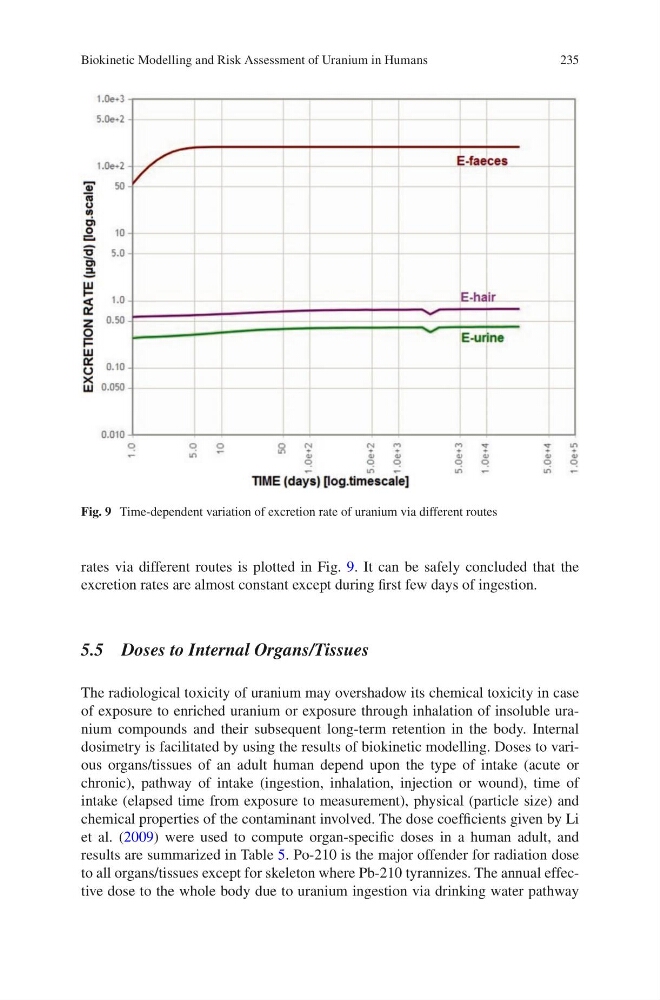
rates via different routes is plotted in Fig. 9. It can be safely concluded that the
excretion rates are almost constant except during first few days of ingestion.
5.5 Doses to Internal Organs/Tissues
The radiological toxicity of uranium may overshadow its chemical toxicity in case
of exposure to enriched uranium or exposure through inhalation of insoluble uranium compounds and their subsequent long-term retention in the body. Internal
dosimetry is facilitated by using the results of biokinetic modelling. Doses to various organs/tissues of an adult human depend upon the type of intake (acute or
chronic), pathway of intake (ingestion, inhalation, injection or wound), time of
intake (elapsed time from exposure to measurement), physical (particle size) and
chemical properties of the contaminant involved. The dose coefficients given by Li
et al. (2009) were used to compute organ-specific doses in a human adult, and
results are summarized in Table 5. Po-210 is the major offender for radiation dose
to all organs/tissues except for skeleton where Pb-210 tyrannizes. The annual effective dose to the whole body due to uranium ingestion via drinking water pathway
Fig. 9 Time-dependent variation of excretion rate of uranium via different routes
Biokinetic Modelling and Risk Assessment of Uranium in Humans
rates via different routes is plotted in Fig. 9. It can be safely concluded that the
excretion rates are almost constant except during first few days of ingestion.
5.5 Doses to Internal Organs/Tissues
The radiological toxicity of uranium may overshadow its chemical toxicity in case
of exposure to enriched uranium or exposure through inhalation of insoluble uranium compounds and their subsequent long-term retention in the body. Internal
dosimetry is facilitated by using the results of biokinetic modelling. Doses to various organs/tissues of an adult human depend upon the type of intake (acute or
chronic), pathway of intake (ingestion, inhalation, injection or wound), time of
intake (elapsed time from exposure to measurement), physical (particle size) and
chemical properties of the contaminant involved. The dose coefficients given by Li
et al. (2009) were used to compute organ-specific doses in a human adult, and
results are summarized in Table 5. Po-210 is the major offender for radiation dose
to all organs/tissues except for skeleton where Pb-210 tyrannizes. The annual effective dose to the whole body due to uranium ingestion via drinking water pathway
Fig. 9 Time-dependent variation of excretion rate of uranium via different routes
Biokinetic Modelling and Risk Assessment of Uranium in Humans