

10
world press referred to them as a total sensation. They were the largest factories of
their kind in the world specializing in such products. By 1898, a total of 108 tonnes
of uranium paints had been produced, of which the clear majority went for export.
The areas of the Ore Mountains, which historically always formed a border
between Saxony in Germany and Bohemia (the Czech Republic), were known to be
rich in various ores. It started especially with silver and then with uranium mining.
Central European uranium deposits were the first industrially mined deposits in the
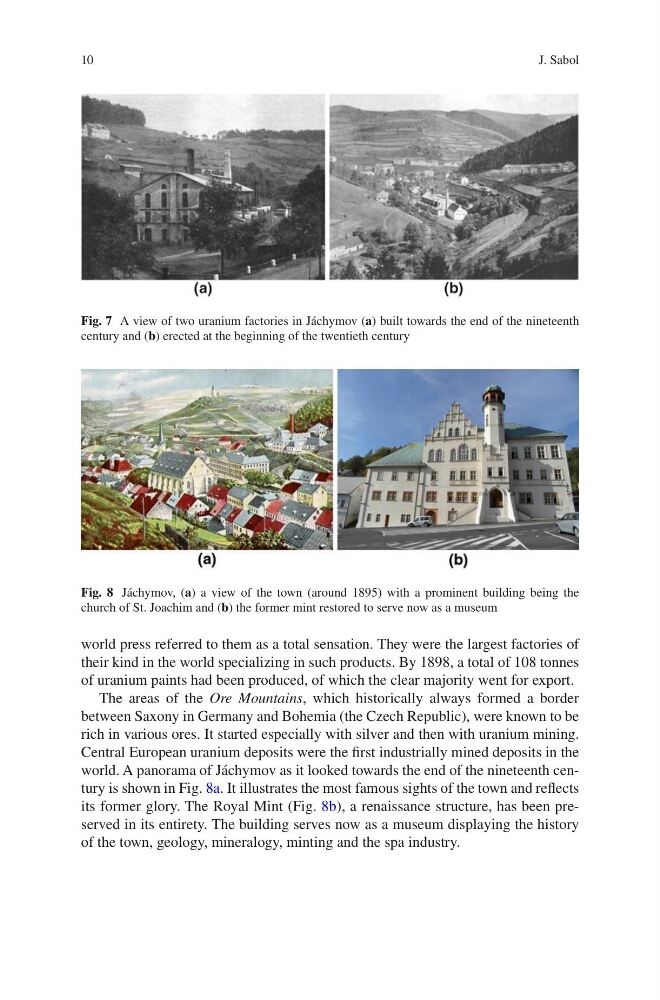
world. A panorama of Jáchymov as it looked towards the end of the nineteenth century is shown in Fig. 8a. It illustrates the most famous sights of the town and reflects
its former glory. The Royal Mint (Fig. 8b), a renaissance structure, has been preserved in its entirety. The building serves now as a museum displaying the history
of the town, geology, mineralogy, minting and the spa industry.
Fig. 7 A view of two uranium factories in Jáchymov (a) built towards the end of the nineteenth
century and (b) erected at the beginning of the twentieth century
Fig. 8 Jáchymov, (a) a view of the town (around 1895) with a prominent building being the
church of St. Joachim and (b) the former mint restored to serve now as a museum
J. Sabol
world press referred to them as a total sensation. They were the largest factories of
their kind in the world specializing in such products. By 1898, a total of 108 tonnes
of uranium paints had been produced, of which the clear majority went for export.
The areas of the Ore Mountains, which historically always formed a border
between Saxony in Germany and Bohemia (the Czech Republic), were known to be
rich in various ores. It started especially with silver and then with uranium mining.
Central European uranium deposits were the first industrially mined deposits in the
world. A panorama of Jáchymov as it looked towards the end of the nineteenth century is shown in Fig. 8a. It illustrates the most famous sights of the town and reflects
its former glory. The Royal Mint (Fig. 8b), a renaissance structure, has been preserved in its entirety. The building serves now as a museum displaying the history
of the town, geology, mineralogy, minting and the spa industry.
Fig. 7 A view of two uranium factories in Jáchymov (a) built towards the end of the nineteenth
century and (b) erected at the beginning of the twentieth century
Fig. 8 Jáchymov, (a) a view of the town (around 1895) with a prominent building being the
church of St. Joachim and (b) the former mint restored to serve now as a museum
J. Sabol