

221
(c) The amount of the contaminant circulated in the body by fluids
(d) The amount of the contaminant deposited in target tissues or organs
The annual effective ingestion dose, D a , due to uranium intake via drinking water
route is estimated by the following equation:
D A
a
c
WI DCF
= ×
×
(4)
Here, A c is the activity concentration of uranium in groundwater samples (Bq L
−1
),
WI is the annual water intake (L y
−1
) and DCF is the dose conversion factor
(Sv Bq
−1
). The assessment of annual ingestion dose must be done separately for different age groups considering the dissimilarities in tissue and organ sensitivity and
water consumption. Several factors, such as sex, weight, age and metabolism, determine daily water intake by an individual. The daily water intakes given by the
Institute of Medicine of the National Academies, Washington (Institute of Medicine
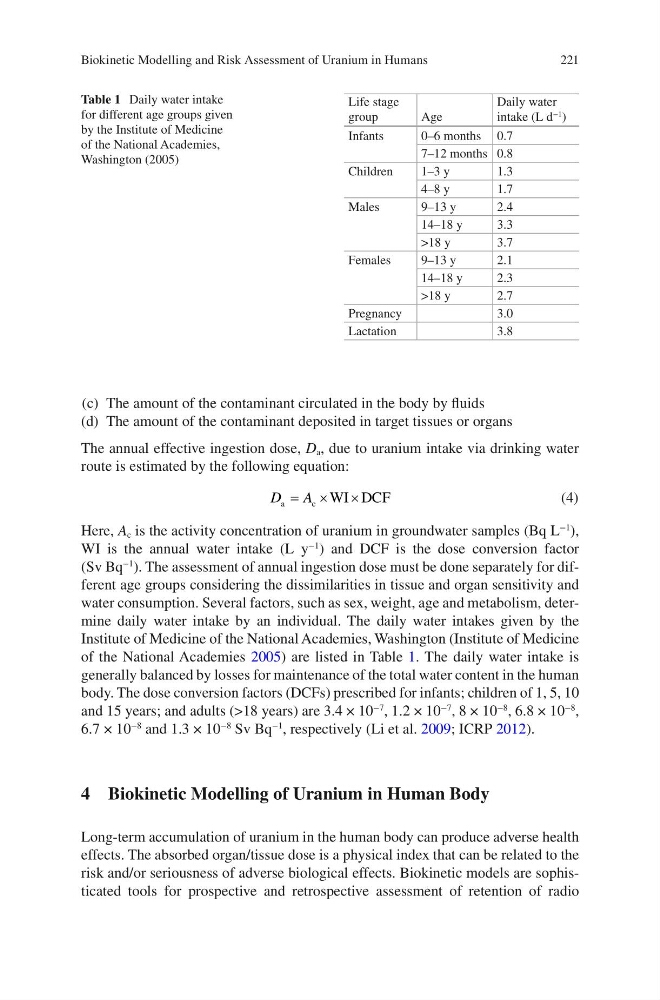
of the National Academies 2005) are listed in Table 1. The daily water intake is
generally balanced by losses for maintenance of the total water content in the human
body. The dose conversion factors (DCFs) prescribed for infants; children of 1, 5, 10
and 15 years; and adults (>18 years) are 3.4 × 10
−7
, 1.2 × 10
−7
, 8 × 10
−8
, 6.8 × 10
−8
,
6.7 × 10
−8
and 1.3 × 10
−8
Sv Bq
−1
, respectively (Li et al. 2009; ICRP 2012).
4 Biokinetic Modelling of Uranium in Human Body
Long-term accumulation of uranium in the human body can produce adverse health
effects. The absorbed organ/tissue dose is a physical index that can be related to the
risk and/or seriousness of adverse biological effects. Biokinetic models are sophisticated tools for prospective and retrospective assessment of retention of radio
Table 1 Daily water intake
for different age groups given
by the Institute of Medicine
of the National Academies,
Washington (2005)
Life stage
group
Age
Daily water
intake (L d
−1
)
Infants
0–6 months 0.7
7–12 months 0.8
Children
1–3 y
1.3
4–8 y
1.7
Males
9–13 y
2.4
14–18 y
3.3
>18 y
3.7
Females
9–13 y
2.1
14–18 y
2.3
>18 y
2.7
Pregnancy
3.0
Lactation
3.8
Biokinetic Modelling and Risk Assessment of Uranium in Humans
(c) The amount of the contaminant circulated in the body by fluids
(d) The amount of the contaminant deposited in target tissues or organs
The annual effective ingestion dose, D a , due to uranium intake via drinking water
route is estimated by the following equation:
D A
a
c
WI DCF
= ×
×
(4)
Here, A c is the activity concentration of uranium in groundwater samples (Bq L
−1
),
WI is the annual water intake (L y
−1
) and DCF is the dose conversion factor
(Sv Bq
−1
). The assessment of annual ingestion dose must be done separately for different age groups considering the dissimilarities in tissue and organ sensitivity and
water consumption. Several factors, such as sex, weight, age and metabolism, determine daily water intake by an individual. The daily water intakes given by the
Institute of Medicine of the National Academies, Washington (Institute of Medicine
of the National Academies 2005) are listed in Table 1. The daily water intake is
generally balanced by losses for maintenance of the total water content in the human
body. The dose conversion factors (DCFs) prescribed for infants; children of 1, 5, 10
and 15 years; and adults (>18 years) are 3.4 × 10
−7
, 1.2 × 10
−7
, 8 × 10
−8
, 6.8 × 10
−8
,
6.7 × 10
−8
and 1.3 × 10
−8
Sv Bq
−1
, respectively (Li et al. 2009; ICRP 2012).
4 Biokinetic Modelling of Uranium in Human Body
Long-term accumulation of uranium in the human body can produce adverse health
effects. The absorbed organ/tissue dose is a physical index that can be related to the
risk and/or seriousness of adverse biological effects. Biokinetic models are sophisticated tools for prospective and retrospective assessment of retention of radio
Table 1 Daily water intake
for different age groups given
by the Institute of Medicine
of the National Academies,
Washington (2005)
Life stage
group
Age
Daily water
intake (L d
−1
)
Infants
0–6 months 0.7
7–12 months 0.8
Children
1–3 y
1.3
4–8 y
1.7
Males
9–13 y
2.4
14–18 y
3.3
>18 y
3.7
Females
9–13 y
2.1
14–18 y
2.3
>18 y
2.7
Pregnancy
3.0
Lactation
3.8
Biokinetic Modelling and Risk Assessment of Uranium in Humans