

219
internal body tissues and organs after transport in various body fluids and blood.
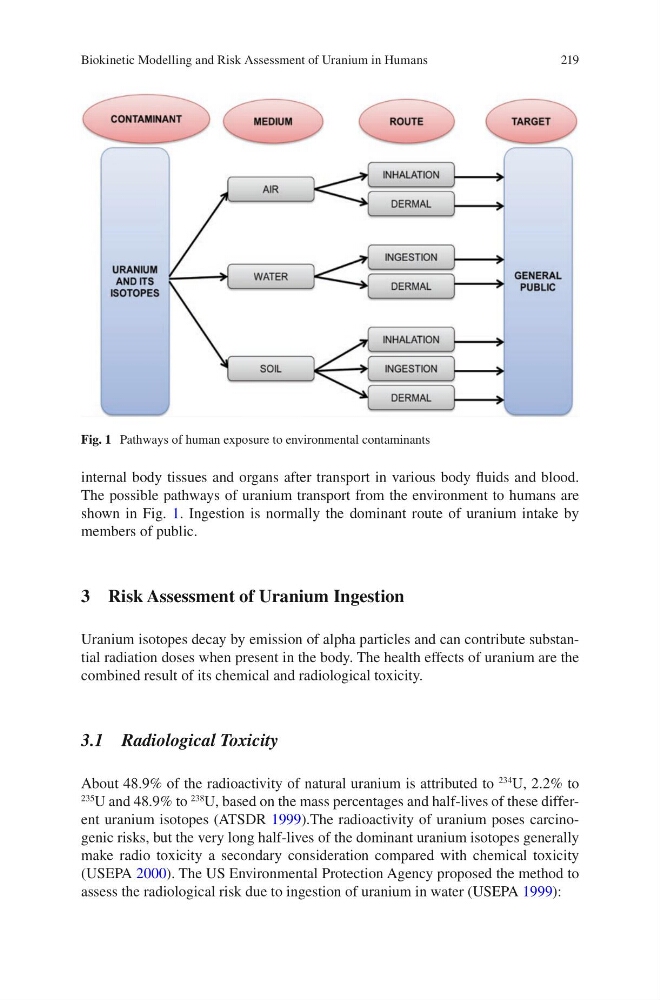
The possible pathways of uranium transport from the environment to humans are
shown in Fig. 1. Ingestion is normally the dominant route of uranium intake by
members of public.
3 Risk Assessment of Uranium Ingestion
Uranium isotopes decay by emission of alpha particles and can contribute substantial radiation doses when present in the body. The health effects of uranium are the
combined result of its chemical and radiological toxicity.
3.1 Radiological Toxicity
About 48.9% of the radioactivity of natural uranium is attributed to
234
U, 2.2% to
235
U and 48.9% to
238
U, based on the mass percentages and half-lives of these different uranium isotopes (ATSDR 1999).The radioactivity of uranium poses carcinogenic risks, but the very long half-lives of the dominant uranium isotopes generally
make radio toxicity a secondary consideration compared with chemical toxicity
(USEPA 2000). The US Environmental Protection Agency proposed the method to
assess the radiological risk due to ingestion of uranium in water (USEPA 1999):
Fig. 1 Pathways of human exposure to environmental contaminants
Biokinetic Modelling and Risk Assessment of Uranium in Humans
internal body tissues and organs after transport in various body fluids and blood.
The possible pathways of uranium transport from the environment to humans are
shown in Fig. 1. Ingestion is normally the dominant route of uranium intake by
members of public.
3 Risk Assessment of Uranium Ingestion
Uranium isotopes decay by emission of alpha particles and can contribute substantial radiation doses when present in the body. The health effects of uranium are the
combined result of its chemical and radiological toxicity.
3.1 Radiological Toxicity
About 48.9% of the radioactivity of natural uranium is attributed to
234
U, 2.2% to
235
U and 48.9% to
238
U, based on the mass percentages and half-lives of these different uranium isotopes (ATSDR 1999).The radioactivity of uranium poses carcinogenic risks, but the very long half-lives of the dominant uranium isotopes generally
make radio toxicity a secondary consideration compared with chemical toxicity
(USEPA 2000). The US Environmental Protection Agency proposed the method to
assess the radiological risk due to ingestion of uranium in water (USEPA 1999):
Fig. 1 Pathways of human exposure to environmental contaminants
Biokinetic Modelling and Risk Assessment of Uranium in Humans