

207
In the second approach, a limit is set based on the maximum acceptable kidney
concentration, and a biokinetic model is used to relate this maximum concentration
to an intake rate by ingestion or inhalation that would give rise to that concentration.
The maximum kidney concentration that is likely to be without an appreciable risk
of adverse non-cancer effects has been discussed by Leggett (1989), and an updated
evaluation is given by Wilson and Thorne (2015).
Animal studies during the 1940s suggested that up to 2–3 μg [U] g
−1
of the kidney might be accumulated without serious effects and in 1959 a limiting concentration of 3 μg [U] g
−1
of the kidney was adopted by the ICRP.
Subsequently, Stopps and Todd (1982) commented that although 2–3 μg [U] g
−1
of the kidney might be tolerated without the occurrence of serious tissue damage,
renal abnormalities and mild renal injuries could occur at concentrations of as low
as 0.1–0.4 μg [U] g
−1
of the kidney. Following on from this work, Leggett (1989)
concluded that the kidney may develop a kind of acquired tolerance to uranium after
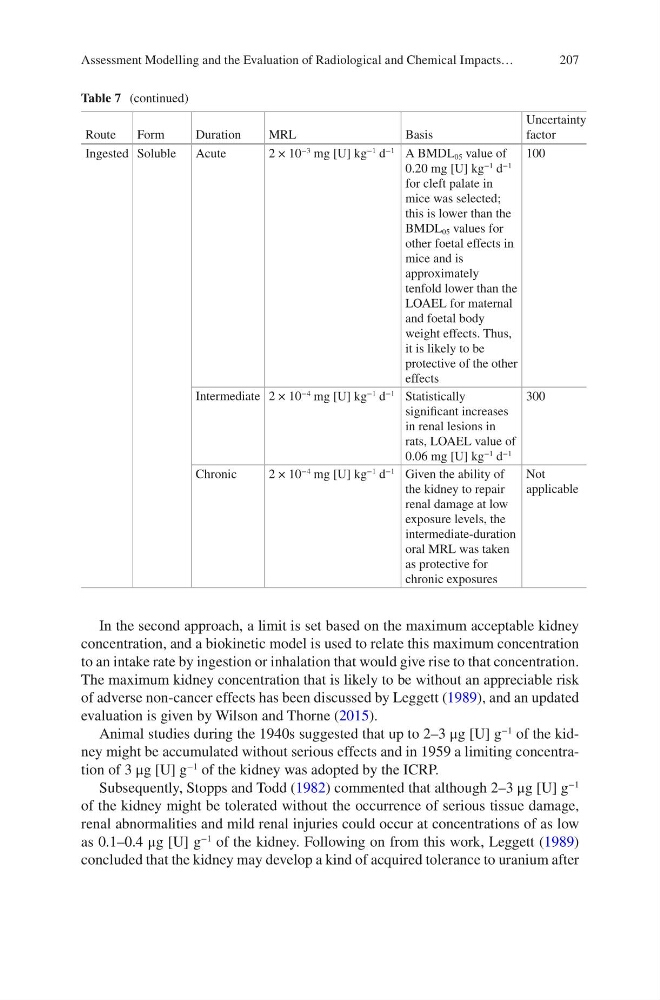
Table 7 (continued)
Route
Form
Duration
MRL
Basis
Uncertainty
factor
Ingested Soluble
Acute
2 × 10
−3
mg [U] kg
−1 d
−1 A BMDL 05 value of
0.20 mg [U] kg
−1 d
−1
for cleft palate in
mice was selected;
this is lower than the
BMDL 05 values for
other foetal effects in
mice and is
approximately
tenfold lower than the
LOAEL for maternal
and foetal body
weight effects. Thus,
it is likely to be
protective of the other
effects
100
Intermediate 2 × 10
−4
mg [U] kg
−1 d
−1 Statistically
significant increases
in renal lesions in
rats, LOAEL value of
0.06 mg [U] kg
−1 d
−1
300
Chronic
2 × 10
−4
mg [U] kg
−1 d
−1 Given the ability of
the kidney to repair
renal damage at low
exposure levels, the
intermediate-duration
oral MRL was taken
as protective for
chronic exposures
Not
applicable
Assessment Modelling and the Evaluation of Radiological and Chemical Impacts…
In the second approach, a limit is set based on the maximum acceptable kidney
concentration, and a biokinetic model is used to relate this maximum concentration
to an intake rate by ingestion or inhalation that would give rise to that concentration.
The maximum kidney concentration that is likely to be without an appreciable risk
of adverse non-cancer effects has been discussed by Leggett (1989), and an updated
evaluation is given by Wilson and Thorne (2015).
Animal studies during the 1940s suggested that up to 2–3 μg [U] g
−1
of the kidney might be accumulated without serious effects and in 1959 a limiting concentration of 3 μg [U] g
−1
of the kidney was adopted by the ICRP.
Subsequently, Stopps and Todd (1982) commented that although 2–3 μg [U] g
−1
of the kidney might be tolerated without the occurrence of serious tissue damage,
renal abnormalities and mild renal injuries could occur at concentrations of as low
as 0.1–0.4 μg [U] g
−1
of the kidney. Following on from this work, Leggett (1989)
concluded that the kidney may develop a kind of acquired tolerance to uranium after
Table 7 (continued)
Route
Form
Duration
MRL
Basis
Uncertainty
factor
Ingested Soluble
Acute
2 × 10
−3
mg [U] kg
−1 d
−1 A BMDL 05 value of
0.20 mg [U] kg
−1 d
−1
for cleft palate in
mice was selected;
this is lower than the
BMDL 05 values for
other foetal effects in
mice and is
approximately
tenfold lower than the
LOAEL for maternal
and foetal body
weight effects. Thus,
it is likely to be
protective of the other
effects
100
Intermediate 2 × 10
−4
mg [U] kg
−1 d
−1 Statistically
significant increases
in renal lesions in
rats, LOAEL value of
0.06 mg [U] kg
−1 d
−1
300
Chronic
2 × 10
−4
mg [U] kg
−1 d
−1 Given the ability of
the kidney to repair
renal damage at low
exposure levels, the
intermediate-duration
oral MRL was taken
as protective for
chronic exposures
Not
applicable
Assessment Modelling and the Evaluation of Radiological and Chemical Impacts…