

194
specifically to uranium, and the content of this chapter relies substantially on material included in that document.
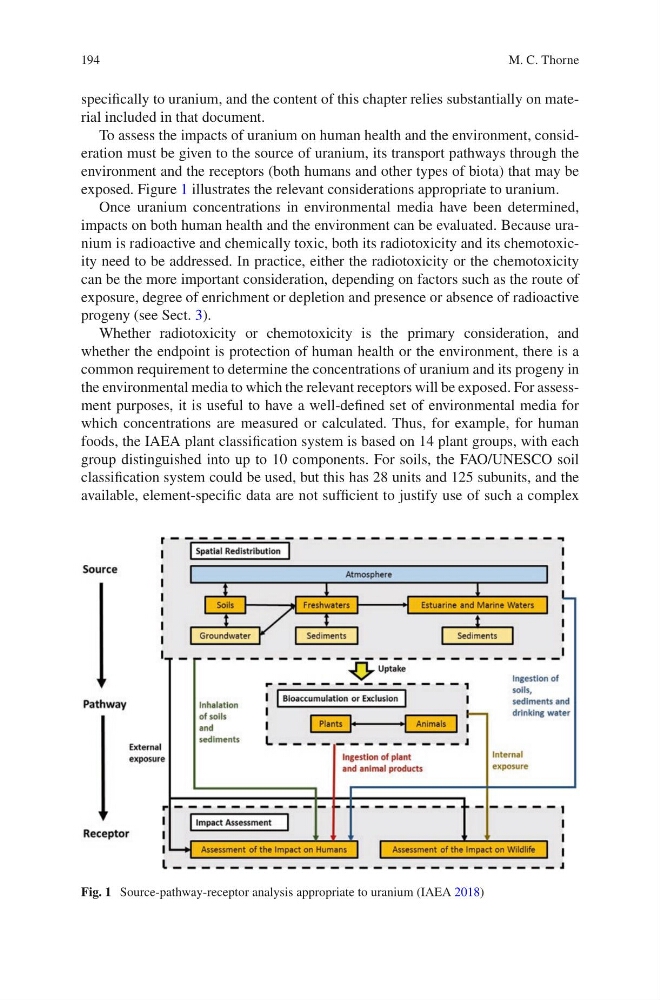
To assess the impacts of uranium on human health and the environment, consideration must be given to the source of uranium, its transport pathways through the
environment and the receptors (both humans and other types of biota) that may be
exposed. Figure 1 illustrates the relevant considerations appropriate to uranium.
Once uranium concentrations in environmental media have been determined,
impacts on both human health and the environment can be evaluated. Because uranium is radioactive and chemically toxic, both its radiotoxicity and its chemotoxicity need to be addressed. In practice, either the radiotoxicity or the chemotoxicity
can be the more important consideration, depending on factors such as the route of
exposure, degree of enrichment or depletion and presence or absence of radioactive
progeny (see Sect. 3).
Whether radiotoxicity or chemotoxicity is the primary consideration, and
whether the endpoint is protection of human health or the environment, there is a
common requirement to determine the concentrations of uranium and its progeny in
the environmental media to which the relevant receptors will be exposed. For assessment purposes, it is useful to have a well-defined set of environmental media for
which concentrations are measured or calculated. Thus, for example, for human
foods, the IAEA plant classification system is based on 14 plant groups, with each
group distinguished into up to 10 components. For soils, the FAO/UNESCO soil
classification system could be used, but this has 28 units and 125 subunits, and the
available, element-specific data are not sufficient to justify use of such a complex
Fig. 1 Source-pathway-receptor analysis appropriate to uranium (IAEA 2018)
M. C. Thorne
specifically to uranium, and the content of this chapter relies substantially on material included in that document.
To assess the impacts of uranium on human health and the environment, consideration must be given to the source of uranium, its transport pathways through the
environment and the receptors (both humans and other types of biota) that may be
exposed. Figure 1 illustrates the relevant considerations appropriate to uranium.
Once uranium concentrations in environmental media have been determined,
impacts on both human health and the environment can be evaluated. Because uranium is radioactive and chemically toxic, both its radiotoxicity and its chemotoxicity need to be addressed. In practice, either the radiotoxicity or the chemotoxicity
can be the more important consideration, depending on factors such as the route of
exposure, degree of enrichment or depletion and presence or absence of radioactive
progeny (see Sect. 3).
Whether radiotoxicity or chemotoxicity is the primary consideration, and
whether the endpoint is protection of human health or the environment, there is a
common requirement to determine the concentrations of uranium and its progeny in
the environmental media to which the relevant receptors will be exposed. For assessment purposes, it is useful to have a well-defined set of environmental media for
which concentrations are measured or calculated. Thus, for example, for human
foods, the IAEA plant classification system is based on 14 plant groups, with each
group distinguished into up to 10 components. For soils, the FAO/UNESCO soil
classification system could be used, but this has 28 units and 125 subunits, and the
available, element-specific data are not sufficient to justify use of such a complex
Fig. 1 Source-pathway-receptor analysis appropriate to uranium (IAEA 2018)
M. C. Thorne