

166
To estimate the ess U concentration in a soil sample, [ ess U], we used the following
equation:
ess
i nit
U
U
Th
U Th
[ ]= −
[ ]− −
[
]×
t
t
/
(1)
where [t − U] and [t − Th] are total concentrations of U and Th in the agricultural
soil sample and init U/Th is the initial U/Th ratio calculated from U and Th concentrations in nonagricultural field soil samples. Takeda et al. (2006) applied init U/
Th = 0.28 because that was the value found in deeper layers of their observation
field. Unfortunately, however, we cannot supply a suitable init U/Th for each soil
sample using a similar method to that of Takeda et al. (2006); therefore, a typical
value was derived for this study (see Sect. 2.1).
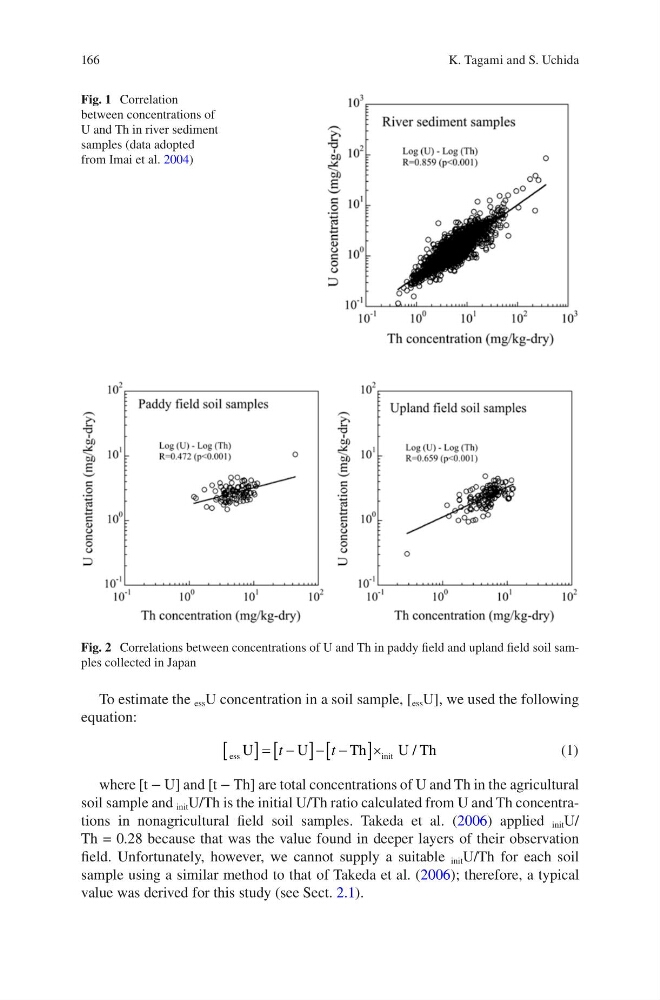
Fig. 1 Correlation
between concentrations of
U and Th in river sediment
samples (data adopted
from Imai et al. 2004)
Fig. 2 Correlations between concentrations of U and Th in paddy field and upland field soil samples collected in Japan
K. Tagami and S. Uchida
To estimate the ess U concentration in a soil sample, [ ess U], we used the following
equation:
ess
i nit
U
U
Th
U Th
[ ]= −
[ ]− −
[
]×
t
t
/
(1)
where [t − U] and [t − Th] are total concentrations of U and Th in the agricultural
soil sample and init U/Th is the initial U/Th ratio calculated from U and Th concentrations in nonagricultural field soil samples. Takeda et al. (2006) applied init U/
Th = 0.28 because that was the value found in deeper layers of their observation
field. Unfortunately, however, we cannot supply a suitable init U/Th for each soil
sample using a similar method to that of Takeda et al. (2006); therefore, a typical
value was derived for this study (see Sect. 2.1).
Fig. 1 Correlation
between concentrations of
U and Th in river sediment
samples (data adopted
from Imai et al. 2004)
Fig. 2 Correlations between concentrations of U and Th in paddy field and upland field soil samples collected in Japan
K. Tagami and S. Uchida