

119
The research of Ishchenko and Butnik (1990) conducted on different soil types
in Central Asia gives a comprehensive assessment of the effect of
238
U on the bioavailability, depending on the time of interaction of the radionuclide with the soil.
The transformation of the
238
U forms in time was studied on a typical sierozem.
Soil samples were taken from the plots, where cotton was grown in the first and
second years and in the third year—wheat. The concentration of
238
U was 53 mg kg
−1
of soil.
238
U from soil samples was successively extracted with distilled water, acetateammonium buffer solution (pH 4.8), a solution of citric acid (0.033 M), a mixture
of citric (0.033 M) and oxalic (0.5 M) acids and hydrochloric acid. The content of
the
238
U forms was calculated in %, assuming the initial value to be 100%.
It was found that uranium, introduced into the soil as a solution of
238
UO 2 (NO 3 ) 2 ,
comprises mainly exchangeable forms with soil components in desert-sandy soil
and light and typical sierozems, and in meadow soils, the uranium interaction with
soil components results in acid-soluble form. From such soils as desert-sandy, light
and typical sierozems, most of the
238
U passed into aqueous and acetate-ammonium
extracts (from 48.4 to 51.5%), into which readily soluble, exchangeable compounds
and organomineral complexes are displaced. There is an inverse relationship
between the physical and chemical soil properties and the amount of water-soluble
and exchangeable forms of
238
U, and with the number of fixed
238
U compounds, the
relationship is direct. Correlation coefficients between the amount of radionuclide
in water-soluble and exchangeable forms and all indicated soil parameters turned
out to be rather high (R = 0.73 − 0.88).
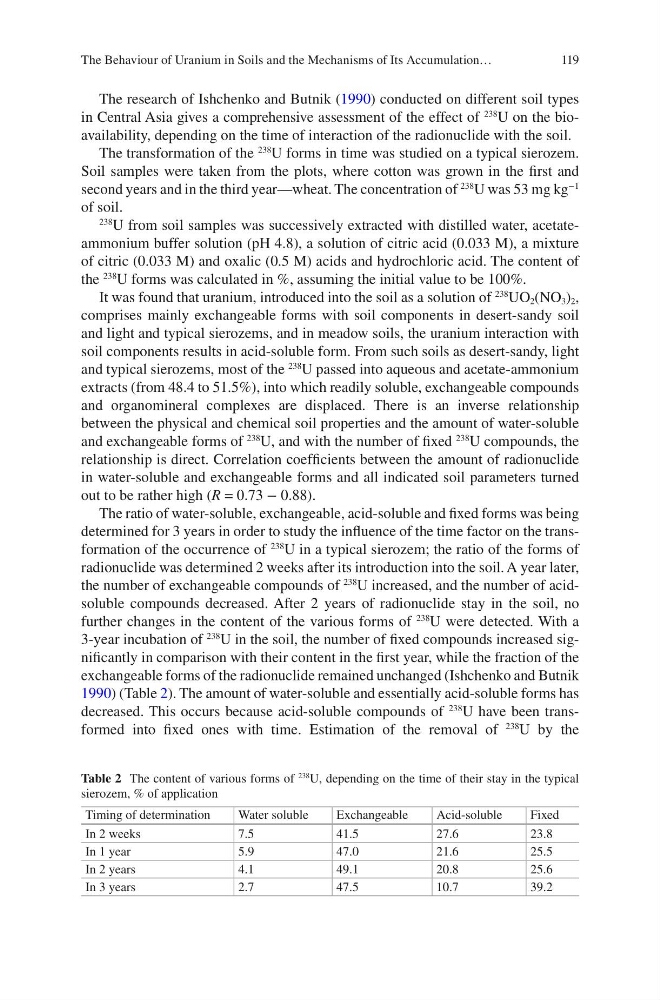
The ratio of water-soluble, exchangeable, acid-soluble and fixed forms was being
determined for 3 years in order to study the influence of the time factor on the transformation of the occurrence of
238
U in a typical sierozem; the ratio of the forms of
radionuclide was determined 2 weeks after its introduction into the soil. A year later,
the number of exchangeable compounds of
238
U increased, and the number of acidsoluble compounds decreased. After 2 years of radionuclide stay in the soil, no
further changes in the content of the various forms of
238
U were detected. With a
3-year incubation of
238
U in the soil, the number of fixed compounds increased significantly in comparison with their content in the first year, while the fraction of the
exchangeable forms of the radionuclide remained unchanged (Ishchenko and Butnik
1990) (Table 2). The amount of water-soluble and essentially acid-soluble forms has
decreased. This occurs because acid-soluble compounds of
238
U have been transformed into fixed ones with time. Estimation of the removal of
238
U by the
Table 2 The content of various forms of
238
U, depending on the time of their stay in the typical
sierozem, % of application
Timing of determination
Water soluble
Exchangeable
Acid-soluble
Fixed
In 2 weeks
7.5
41.5
27.6
23.8
In 1 year
5.9
47.0
21.6
25.5
In 2 years
4.1
49.1
20.8
25.6
In 3 years
2.7
47.5
10.7
39.2
The Behaviour of Uranium in Soils and the Mechanisms of Its Accumulation…
The research of Ishchenko and Butnik (1990) conducted on different soil types
in Central Asia gives a comprehensive assessment of the effect of
238
U on the bioavailability, depending on the time of interaction of the radionuclide with the soil.
The transformation of the
238
U forms in time was studied on a typical sierozem.
Soil samples were taken from the plots, where cotton was grown in the first and
second years and in the third year—wheat. The concentration of
238
U was 53 mg kg
−1
of soil.
238
U from soil samples was successively extracted with distilled water, acetateammonium buffer solution (pH 4.8), a solution of citric acid (0.033 M), a mixture
of citric (0.033 M) and oxalic (0.5 M) acids and hydrochloric acid. The content of
the
238
U forms was calculated in %, assuming the initial value to be 100%.
It was found that uranium, introduced into the soil as a solution of
238
UO 2 (NO 3 ) 2 ,
comprises mainly exchangeable forms with soil components in desert-sandy soil
and light and typical sierozems, and in meadow soils, the uranium interaction with
soil components results in acid-soluble form. From such soils as desert-sandy, light
and typical sierozems, most of the
238
U passed into aqueous and acetate-ammonium
extracts (from 48.4 to 51.5%), into which readily soluble, exchangeable compounds
and organomineral complexes are displaced. There is an inverse relationship
between the physical and chemical soil properties and the amount of water-soluble
and exchangeable forms of
238
U, and with the number of fixed
238
U compounds, the
relationship is direct. Correlation coefficients between the amount of radionuclide
in water-soluble and exchangeable forms and all indicated soil parameters turned
out to be rather high (R = 0.73 − 0.88).
The ratio of water-soluble, exchangeable, acid-soluble and fixed forms was being
determined for 3 years in order to study the influence of the time factor on the transformation of the occurrence of
238
U in a typical sierozem; the ratio of the forms of
radionuclide was determined 2 weeks after its introduction into the soil. A year later,
the number of exchangeable compounds of
238
U increased, and the number of acidsoluble compounds decreased. After 2 years of radionuclide stay in the soil, no
further changes in the content of the various forms of
238
U were detected. With a
3-year incubation of
238
U in the soil, the number of fixed compounds increased significantly in comparison with their content in the first year, while the fraction of the
exchangeable forms of the radionuclide remained unchanged (Ishchenko and Butnik
1990) (Table 2). The amount of water-soluble and essentially acid-soluble forms has
decreased. This occurs because acid-soluble compounds of
238
U have been transformed into fixed ones with time. Estimation of the removal of
238
U by the
Table 2 The content of various forms of
238
U, depending on the time of their stay in the typical
sierozem, % of application
Timing of determination
Water soluble
Exchangeable
Acid-soluble
Fixed
In 2 weeks
7.5
41.5
27.6
23.8
In 1 year
5.9
47.0
21.6
25.5
In 2 years
4.1
49.1
20.8
25.6
In 3 years
2.7
47.5
10.7
39.2
The Behaviour of Uranium in Soils and the Mechanisms of Its Accumulation…