

96
2.1 Toxicity and Uptake of U by Aquatic Organisms
Uranium is a naturally occurring element in the environment and normally is found
at very low concentrations in natural aquatic systems. Nevertheless, U exposure can
induce harmful effects in the living aquatic organisms including cytotoxic, genotoxic, and teratogenic effects (Lourenço et al. 2017). The U contamination is capable to affect the aquatic organisms at the biochemical, cellular, individual,
population, and community level (Franklin et al. 2000). Knowledge about environmental and bioavailable levels of U is important to the maintenance of the environmental health of aquatic ecosystems.
U occurs in natural surface waters at three oxidation states (U
4+
, UO
2+
, and
UO 2
2+
), depending on the physicochemical parameters of the environment (Markich
2002). The uranyl ion UO 2
2+
is the most stable U species in oxic conditions and the
most prevalent U species in the environment (Sheppard et al. 2005). Factors such as
pH, Eh, presence of chelating agents, concentration and type of organic and inorganic ligands, mixing rate and movement of the water, and reactions of adsorption,
desorption, complexation, and precipitation directly influence the U behavior and
consequently its speciation (Galhardi et al. 2017). In solutions, adsorption is an
important mechanism that controls U activity concentration (Prikryl et al. 2001).
The U presence in natural environments can induce biological effects via its
radiological and chemical pathway, representing a unique challenge for bioavailability and toxicity studies (Barillet et al. 2011). Although the radiological impact
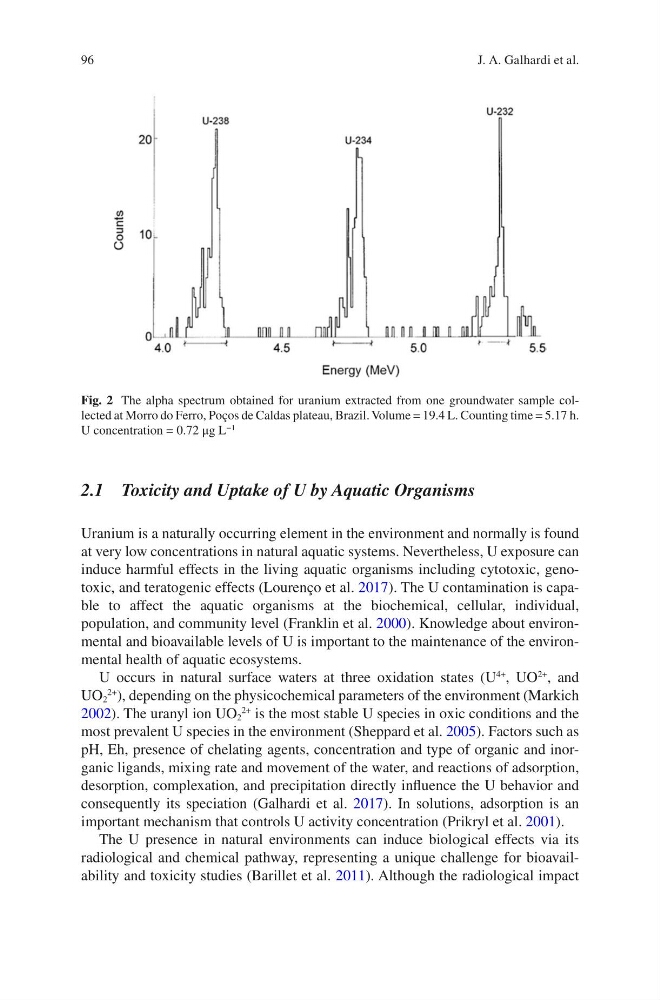
Fig. 2 The alpha spectrum obtained for uranium extracted from one groundwater sample collected at Morro do Ferro, Poços de Caldas plateau, Brazil. Volume = 19.4 L. Counting time = 5.17 h.
U concentration = 0.72 μg L
−1
J. A. Galhardi et al.
2.1 Toxicity and Uptake of U by Aquatic Organisms
Uranium is a naturally occurring element in the environment and normally is found
at very low concentrations in natural aquatic systems. Nevertheless, U exposure can
induce harmful effects in the living aquatic organisms including cytotoxic, genotoxic, and teratogenic effects (Lourenço et al. 2017). The U contamination is capable to affect the aquatic organisms at the biochemical, cellular, individual,
population, and community level (Franklin et al. 2000). Knowledge about environmental and bioavailable levels of U is important to the maintenance of the environmental health of aquatic ecosystems.
U occurs in natural surface waters at three oxidation states (U
4+
, UO
2+
, and
UO 2
2+
), depending on the physicochemical parameters of the environment (Markich
2002). The uranyl ion UO 2
2+
is the most stable U species in oxic conditions and the
most prevalent U species in the environment (Sheppard et al. 2005). Factors such as
pH, Eh, presence of chelating agents, concentration and type of organic and inorganic ligands, mixing rate and movement of the water, and reactions of adsorption,
desorption, complexation, and precipitation directly influence the U behavior and
consequently its speciation (Galhardi et al. 2017). In solutions, adsorption is an
important mechanism that controls U activity concentration (Prikryl et al. 2001).
The U presence in natural environments can induce biological effects via its
radiological and chemical pathway, representing a unique challenge for bioavailability and toxicity studies (Barillet et al. 2011). Although the radiological impact
Fig. 2 The alpha spectrum obtained for uranium extracted from one groundwater sample collected at Morro do Ferro, Poços de Caldas plateau, Brazil. Volume = 19.4 L. Counting time = 5.17 h.
U concentration = 0.72 μg L
−1
J. A. Galhardi et al.