

appear to have opposing starting points as explained by De
Wit and Meyer (2005) who argue that the former is an
‘outside in’ perspective while the latter is an ‘inside out’
perspective. Their recommendation is that a combination of
the two is the optimal way to pursue competitive advantage,
as there must be a fit between an organisation and its environment to build SCA.
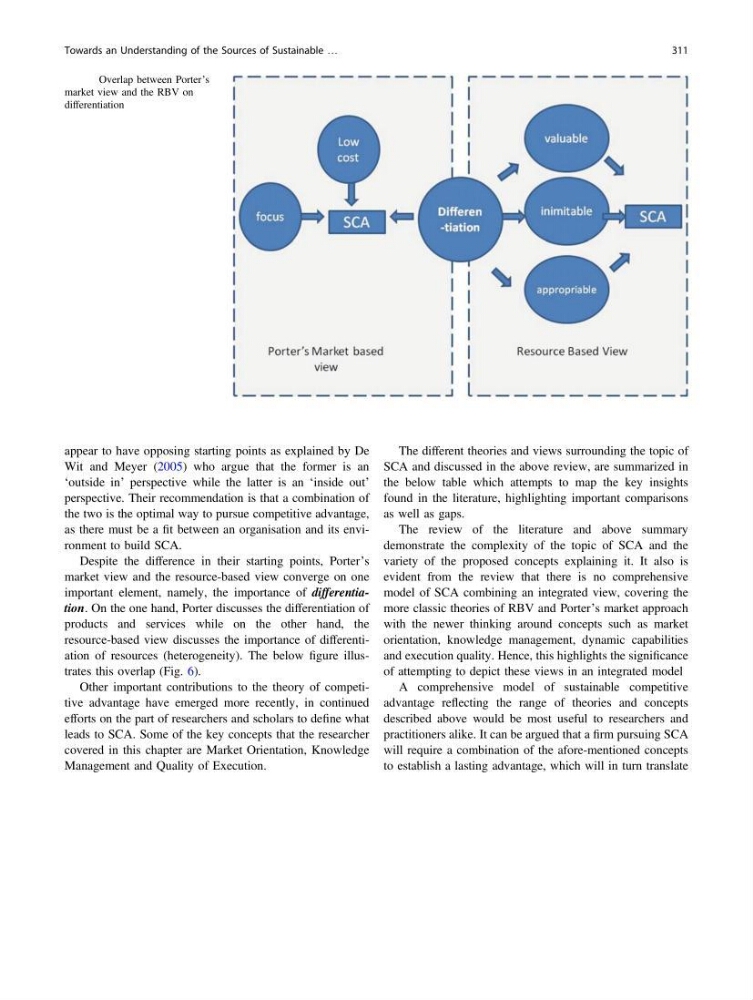
Despite the difference in their starting points, Porter’s
market view and the resource-based view converge on one
important element, namely, the importance of differentiation. On the one hand, Porter discusses the differentiation of
products and services while on the other hand, the
resource-based view discusses the importance of differentiation of resources (heterogeneity). The below figure illustrates this overlap (Fig. 6).
Other important contributions to the theory of competitive advantage have emerged more recently, in continued
efforts on the part of researchers and scholars to define what
leads to SCA. Some of the key concepts that the researcher
covered in this chapter are Market Orientation, Knowledge
Management and Quality of Execution.
The different theories and views surrounding the topic of
SCA and discussed in the above review, are summarized in
the below table which attempts to map the key insights
found in the literature, highlighting important comparisons
as well as gaps.
The review of the literature and above summary
demonstrate the complexity of the topic of SCA and the
variety of the proposed concepts explaining it. It also is
evident from the review that there is no comprehensive
model of SCA combining an integrated view, covering the
more classic theories of RBV and Porter’s market approach
with the newer thinking around concepts such as market
orientation, knowledge management, dynamic capabilities
and execution quality. Hence, this highlights the significance
of attempting to depict these views in an integrated model
A comprehensive model of sustainable competitive
advantage reflecting the range of theories and concepts
described above would be most useful to researchers and
practitioners alike. It can be argued that a firm pursuing SCA
will require a combination of the afore-mentioned concepts
to establish a lasting advantage, which will in turn translate
Fig. 6 Overlap between Porter’s
market view and the RBV on
differentiation
Towards an Understanding of the Sources of Sustainable …
311
Wit and Meyer (2005) who argue that the former is an
‘outside in’ perspective while the latter is an ‘inside out’
perspective. Their recommendation is that a combination of
the two is the optimal way to pursue competitive advantage,
as there must be a fit between an organisation and its environment to build SCA.
Despite the difference in their starting points, Porter’s
market view and the resource-based view converge on one
important element, namely, the importance of differentiation. On the one hand, Porter discusses the differentiation of
products and services while on the other hand, the
resource-based view discusses the importance of differentiation of resources (heterogeneity). The below figure illustrates this overlap (Fig. 6).
Other important contributions to the theory of competitive advantage have emerged more recently, in continued
efforts on the part of researchers and scholars to define what
leads to SCA. Some of the key concepts that the researcher
covered in this chapter are Market Orientation, Knowledge
Management and Quality of Execution.
The different theories and views surrounding the topic of
SCA and discussed in the above review, are summarized in
the below table which attempts to map the key insights
found in the literature, highlighting important comparisons
as well as gaps.
The review of the literature and above summary
demonstrate the complexity of the topic of SCA and the
variety of the proposed concepts explaining it. It also is
evident from the review that there is no comprehensive
model of SCA combining an integrated view, covering the
more classic theories of RBV and Porter’s market approach
with the newer thinking around concepts such as market
orientation, knowledge management, dynamic capabilities
and execution quality. Hence, this highlights the significance
of attempting to depict these views in an integrated model
A comprehensive model of sustainable competitive
advantage reflecting the range of theories and concepts
described above would be most useful to researchers and
practitioners alike. It can be argued that a firm pursuing SCA
will require a combination of the afore-mentioned concepts
to establish a lasting advantage, which will in turn translate
Fig. 6 Overlap between Porter’s
market view and the RBV on
differentiation
Towards an Understanding of the Sources of Sustainable …
311