

changes and difficult to replicate by the firm’s competitors
(Porter 1980). De Wit and Meyer (2005) associate two key
elements with sustainability, namely, defendability, which
can strongly be explained by the company’s strengths,
including the quality of its resources, and, environmental
consonance. The latter requires continuous adaptation of the
firm to the variations and demands of the market place and
the opportunities it presents. In order for a firm to be successful, it must ensure it adequately adapts to its environment, despite the seemingly opposite pressures these factors
present (De Wit and Meyer 2005).
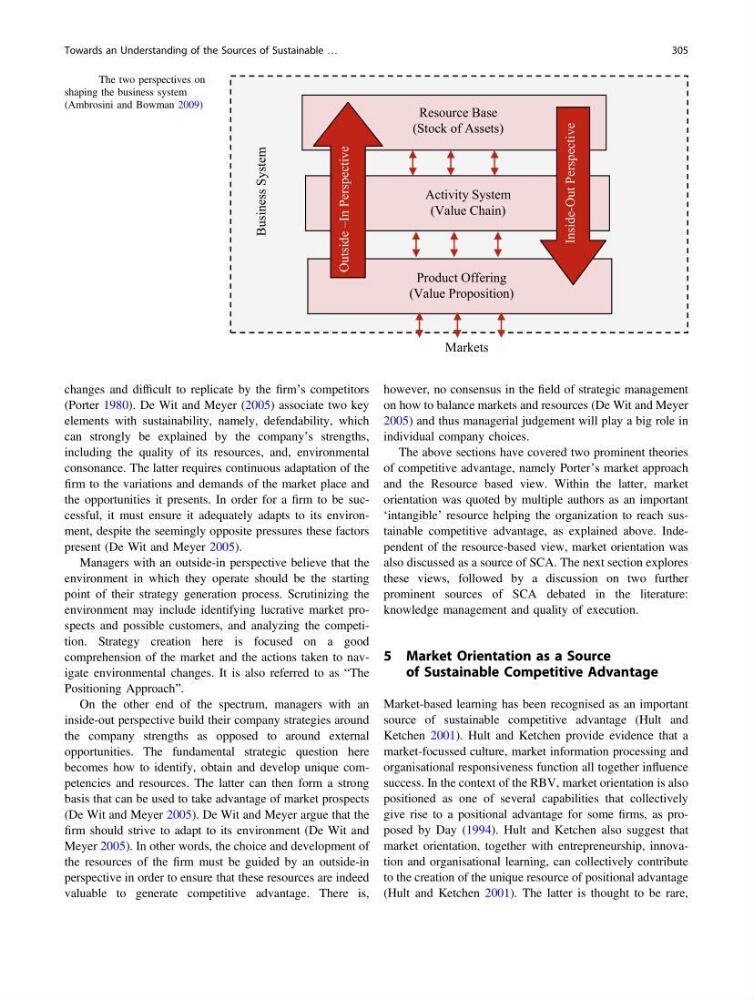
Managers with an outside-in perspective believe that the
environment in which they operate should be the starting
point of their strategy generation process. Scrutinizing the
environment may include identifying lucrative market prospects and possible customers, and analyzing the competition. Strategy creation here is focused on a good
comprehension of the market and the actions taken to navigate environmental changes. It is also referred to as “The
Positioning Approach”.
On the other end of the spectrum, managers with an
inside-out perspective build their company strategies around
the company strengths as opposed to around external
opportunities. The fundamental strategic question here
becomes how to identify, obtain and develop unique competencies and resources. The latter can then form a strong
basis that can be used to take advantage of market prospects
(De Wit and Meyer 2005). De Wit and Meyer argue that the
firm should strive to adapt to its environment (De Wit and
Meyer 2005). In other words, the choice and development of
the resources of the firm must be guided by an outside-in
perspective in order to ensure that these resources are indeed
valuable to generate competitive advantage. There is,
however, no consensus in the field of strategic management
on how to balance markets and resources (De Wit and Meyer
2005) and thus managerial judgement will play a big role in
individual company choices.
The above sections have covered two prominent theories
of competitive advantage, namely Porter’s market approach
and the Resource based view. Within the latter, market
orientation was quoted by multiple authors as an important
‘intangible’ resource helping the organization to reach sustainable competitive advantage, as explained above. Independent of the resource-based view, market orientation was
also discussed as a source of SCA. The next section explores
these views, followed by a discussion on two further
prominent sources of SCA debated in the literature:
knowledge management and quality of execution.
5 Market Orientation as a Source
of Sustainable Competitive Advantage
Market-based learning has been recognised as an important
source of sustainable competitive advantage (Hult and
Ketchen 2001). Hult and Ketchen provide evidence that a
market-focussed culture, market information processing and
organisational responsiveness function all together influence
success. In the context of the RBV, market orientation is also
positioned as one of several capabilities that collectively
give rise to a positional advantage for some firms, as proposed by Day (1994). Hult and Ketchen also suggest that
market orientation, together with entrepreneurship, innovation and organisational learning, can collectively contribute
to the creation of the unique resource of positional advantage
(Hult and Ketchen 2001). The latter is thought to be rare,
Resource Base
(Stock of Assets)
Activity System
(Value Chain)
Product Offering
(Value Proposition)
Markets
Inside-Out Perspective
Outside –In Perspective
Business System
Fig. 3 The two perspectives on
shaping the business system
(Ambrosini and Bowman 2009)
Towards an Understanding of the Sources of Sustainable …
305
(Porter 1980). De Wit and Meyer (2005) associate two key
elements with sustainability, namely, defendability, which
can strongly be explained by the company’s strengths,
including the quality of its resources, and, environmental
consonance. The latter requires continuous adaptation of the
firm to the variations and demands of the market place and
the opportunities it presents. In order for a firm to be successful, it must ensure it adequately adapts to its environment, despite the seemingly opposite pressures these factors
present (De Wit and Meyer 2005).
Managers with an outside-in perspective believe that the
environment in which they operate should be the starting
point of their strategy generation process. Scrutinizing the
environment may include identifying lucrative market prospects and possible customers, and analyzing the competition. Strategy creation here is focused on a good
comprehension of the market and the actions taken to navigate environmental changes. It is also referred to as “The
Positioning Approach”.
On the other end of the spectrum, managers with an
inside-out perspective build their company strategies around
the company strengths as opposed to around external
opportunities. The fundamental strategic question here
becomes how to identify, obtain and develop unique competencies and resources. The latter can then form a strong
basis that can be used to take advantage of market prospects
(De Wit and Meyer 2005). De Wit and Meyer argue that the
firm should strive to adapt to its environment (De Wit and
Meyer 2005). In other words, the choice and development of
the resources of the firm must be guided by an outside-in
perspective in order to ensure that these resources are indeed
valuable to generate competitive advantage. There is,
however, no consensus in the field of strategic management
on how to balance markets and resources (De Wit and Meyer
2005) and thus managerial judgement will play a big role in
individual company choices.
The above sections have covered two prominent theories
of competitive advantage, namely Porter’s market approach
and the Resource based view. Within the latter, market
orientation was quoted by multiple authors as an important
‘intangible’ resource helping the organization to reach sustainable competitive advantage, as explained above. Independent of the resource-based view, market orientation was
also discussed as a source of SCA. The next section explores
these views, followed by a discussion on two further
prominent sources of SCA debated in the literature:
knowledge management and quality of execution.
5 Market Orientation as a Source
of Sustainable Competitive Advantage
Market-based learning has been recognised as an important
source of sustainable competitive advantage (Hult and
Ketchen 2001). Hult and Ketchen provide evidence that a
market-focussed culture, market information processing and
organisational responsiveness function all together influence
success. In the context of the RBV, market orientation is also
positioned as one of several capabilities that collectively
give rise to a positional advantage for some firms, as proposed by Day (1994). Hult and Ketchen also suggest that
market orientation, together with entrepreneurship, innovation and organisational learning, can collectively contribute
to the creation of the unique resource of positional advantage
(Hult and Ketchen 2001). The latter is thought to be rare,
Resource Base
(Stock of Assets)
Activity System
(Value Chain)
Product Offering
(Value Proposition)
Markets
Inside-Out Perspective
Outside –In Perspective
Business System
Fig. 3 The two perspectives on
shaping the business system
(Ambrosini and Bowman 2009)
Towards an Understanding of the Sources of Sustainable …
305