

organization is unable to build a strong brand, it means that
its marketing efforts are flawed, and not accepted according
to the art of marketing. In an enterprise that will implement
MSM, the basis of market action is sustainable marketing
and brand identity is built on the basis of: responsible
products, safe and fair trade, fair dealing, responsible customer relationship management, corporate business responsibility, and profitability.
Last but not least, MSM also points to the need to promote sustainable consumption by using goods more efficiently and responsibly, suggesting a fair distribution of
resources between rich and poor, while taking into account
the needs of today’s and future generations of consumers.
By implementing MSM, we should promote sustainable
consumption as satisfying the needs justified by the
requirements of a decent human existence. Consumption
means the use of resources in order to directly meet human
needs.
Based on scientific reflection, more than twenty years of
marketing managerial experience, an analysis of literature, as
well as previously conducted own research, the authors
believe that leadership is the key pillar of the Sustainable
Marketing Model. Therefore, we have attempted to analyze
sustainable leadership from the perspective of a positive
psychology capital (PsyCap).
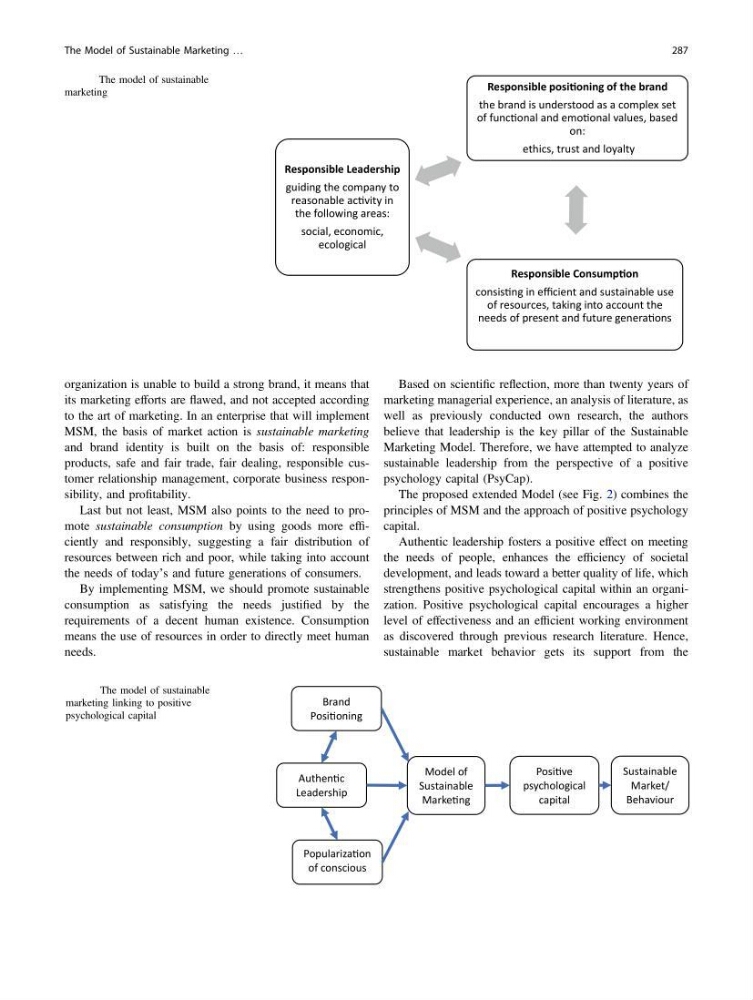
The proposed extended Model (see Fig. 2) combines the
principles of MSM and the approach of positive psychology
capital.
Authentic leadership fosters a positive effect on meeting
the needs of people, enhances the efficiency of societal
development, and leads toward a better quality of life, which
strengthens positive psychological capital within an organization. Positive psychological capital encourages a higher
level of effectiveness and an efficient working environment
as discovered through previous research literature. Hence,
sustainable market behavior gets its support from the
Responsible posiƟoning of the brand
the brand is understood as a complex set
of funconal and emoonal values, based
on:
ethics, trust and loyalty
Responsible ConsumpƟon
consisng in efficient and sustainable use
of resources, taking into account the
needs of present and future generaons
Responsible Leadership
guiding the company to
reasonable acvity in
the following areas:
social, economic,
ecological
Fig. 1 The model of sustainable
marketing
Sustainable
Market/
Behaviour
Brand
Posioning
Authenc
Leadership
Popularizaon
of conscious
Model of
Sustainable
Marke
Posive
psychological
capital
Fig. 2 The model of sustainable
marketing linking to positive
psychological capital
The Model of Sustainable Marketing …
287
its marketing efforts are flawed, and not accepted according
to the art of marketing. In an enterprise that will implement
MSM, the basis of market action is sustainable marketing
and brand identity is built on the basis of: responsible
products, safe and fair trade, fair dealing, responsible customer relationship management, corporate business responsibility, and profitability.
Last but not least, MSM also points to the need to promote sustainable consumption by using goods more efficiently and responsibly, suggesting a fair distribution of
resources between rich and poor, while taking into account
the needs of today’s and future generations of consumers.
By implementing MSM, we should promote sustainable
consumption as satisfying the needs justified by the
requirements of a decent human existence. Consumption
means the use of resources in order to directly meet human
needs.
Based on scientific reflection, more than twenty years of
marketing managerial experience, an analysis of literature, as
well as previously conducted own research, the authors
believe that leadership is the key pillar of the Sustainable
Marketing Model. Therefore, we have attempted to analyze
sustainable leadership from the perspective of a positive
psychology capital (PsyCap).
The proposed extended Model (see Fig. 2) combines the
principles of MSM and the approach of positive psychology
capital.
Authentic leadership fosters a positive effect on meeting
the needs of people, enhances the efficiency of societal
development, and leads toward a better quality of life, which
strengthens positive psychological capital within an organization. Positive psychological capital encourages a higher
level of effectiveness and an efficient working environment
as discovered through previous research literature. Hence,
sustainable market behavior gets its support from the
Responsible posiƟoning of the brand
the brand is understood as a complex set
of funconal and emoonal values, based
on:
ethics, trust and loyalty
Responsible ConsumpƟon
consisng in efficient and sustainable use
of resources, taking into account the
needs of present and future generaons
Responsible Leadership
guiding the company to
reasonable acvity in
the following areas:
social, economic,
ecological
Fig. 1 The model of sustainable
marketing
Sustainable
Market/
Behaviour
Brand
Posioning
Authenc
Leadership
Popularizaon
of conscious
Model of
Sustainable
Marke
Posive
psychological
capital
Fig. 2 The model of sustainable
marketing linking to positive
psychological capital
The Model of Sustainable Marketing …
287