

Simpson—ignoring the acquired knowledge, acting emotionally, unreasonably, short-run-motivated, and externallyoriented.
2 Review of Literature
Financial behavior is a component of overall human
behavior that can be defined as any human behavior that is
relevant to money management. There is still no generally
accepted definition of financial behavior, its components, or
the relevant measurement instrument. Proposed determinants
of financial behavior include various demographic factors
(such as age, gender, income, education, etc.), psychological
factors (such as self-efficacy, behavioral control, locus of
control, optimism, risk aversion, etc.), as well as financial
stressors, financial knowledge, and financial attitudes.
According to the conventional economic theory, efficient
financial behavior and better financial management practices
should be the result of an increased level of financial
knowledge and rational decision-making. Then again,
according to the behavioral economics approach, financial
behavior of individuals is largely determined by psychological factors, feelings and emotions, and therefore even
financially knowledgeable individuals might be incapable of
making rational decisions. Two types of cognitive processes
may explain the difference in these two approaches, for
which Stanovich and West (2000) introduced labels of
System 1 and System 2. Kahneman (2003) further developed
the architecture of cognition, exploring the functions of
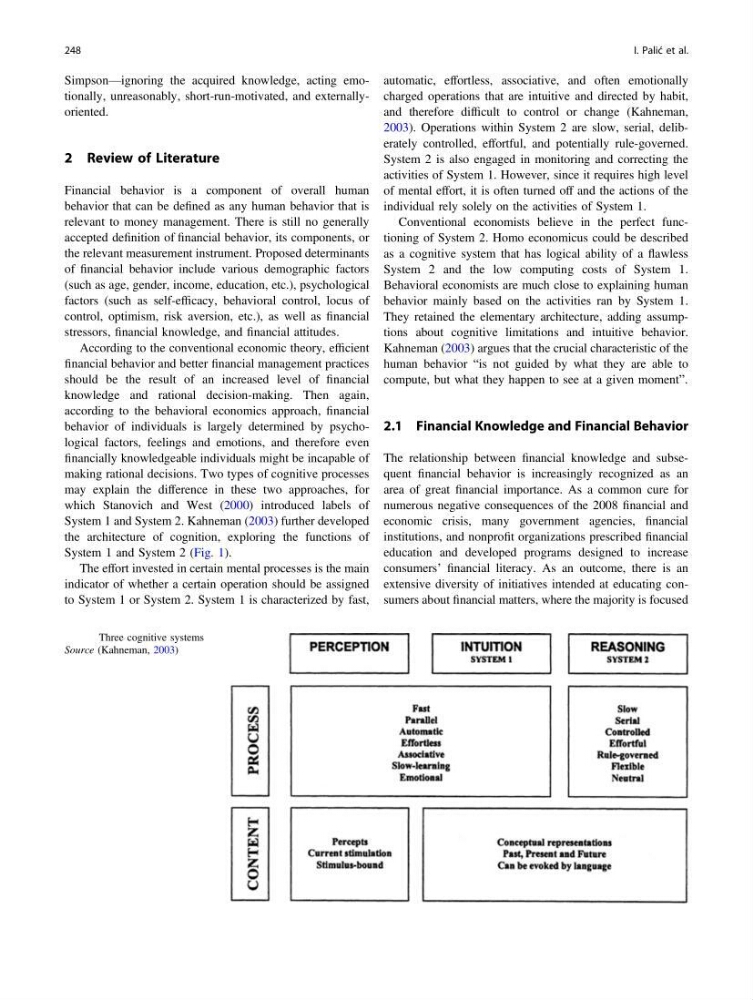
System 1 and System 2 (Fig. 1).
The effort invested in certain mental processes is the main
indicator of whether a certain operation should be assigned
to System 1 or System 2. System 1 is characterized by fast,
automatic, effortless, associative, and often emotionally
charged operations that are intuitive and directed by habit,
and therefore difficult to control or change (Kahneman,
2003). Operations within System 2 are slow, serial, deliberately controlled, effortful, and potentially rule-governed.
System 2 is also engaged in monitoring and correcting the
activities of System 1. However, since it requires high level
of mental effort, it is often turned off and the actions of the
individual rely solely on the activities of System 1.
Conventional economists believe in the perfect functioning of System 2. Homo economicus could be described
as a cognitive system that has logical ability of a flawless
System 2 and the low computing costs of System 1.
Behavioral economists are much close to explaining human
behavior mainly based on the activities ran by System 1.
They retained the elementary architecture, adding assumptions about cognitive limitations and intuitive behavior.
Kahneman (2003) argues that the crucial characteristic of the
human behavior “is not guided by what they are able to
compute, but what they happen to see at a given moment”.
2.1 Financial Knowledge and Financial Behavior
The relationship between financial knowledge and subsequent financial behavior is increasingly recognized as an
area of great financial importance. As a common cure for
numerous negative consequences of the 2008 financial and
economic crisis, many government agencies, financial
institutions, and nonprofit organizations prescribed financial
education and developed programs designed to increase
consumers’ financial literacy. As an outcome, there is an
extensive diversity of initiatives intended at educating consumers about financial matters, where the majority is focused
Fig. 1 Three cognitive systems
Source (Kahneman, 2003)
248
I. Palić et al.
2 Review of Literature
Financial behavior is a component of overall human
behavior that can be defined as any human behavior that is
relevant to money management. There is still no generally
accepted definition of financial behavior, its components, or
the relevant measurement instrument. Proposed determinants
of financial behavior include various demographic factors
(such as age, gender, income, education, etc.), psychological
factors (such as self-efficacy, behavioral control, locus of
control, optimism, risk aversion, etc.), as well as financial
stressors, financial knowledge, and financial attitudes.
According to the conventional economic theory, efficient
financial behavior and better financial management practices
should be the result of an increased level of financial
knowledge and rational decision-making. Then again,
according to the behavioral economics approach, financial
behavior of individuals is largely determined by psychological factors, feelings and emotions, and therefore even
financially knowledgeable individuals might be incapable of
making rational decisions. Two types of cognitive processes
may explain the difference in these two approaches, for
which Stanovich and West (2000) introduced labels of
System 1 and System 2. Kahneman (2003) further developed
the architecture of cognition, exploring the functions of
System 1 and System 2 (Fig. 1).
The effort invested in certain mental processes is the main
indicator of whether a certain operation should be assigned
to System 1 or System 2. System 1 is characterized by fast,
automatic, effortless, associative, and often emotionally
charged operations that are intuitive and directed by habit,
and therefore difficult to control or change (Kahneman,
2003). Operations within System 2 are slow, serial, deliberately controlled, effortful, and potentially rule-governed.
System 2 is also engaged in monitoring and correcting the
activities of System 1. However, since it requires high level
of mental effort, it is often turned off and the actions of the
individual rely solely on the activities of System 1.
Conventional economists believe in the perfect functioning of System 2. Homo economicus could be described
as a cognitive system that has logical ability of a flawless
System 2 and the low computing costs of System 1.
Behavioral economists are much close to explaining human
behavior mainly based on the activities ran by System 1.
They retained the elementary architecture, adding assumptions about cognitive limitations and intuitive behavior.
Kahneman (2003) argues that the crucial characteristic of the
human behavior “is not guided by what they are able to
compute, but what they happen to see at a given moment”.
2.1 Financial Knowledge and Financial Behavior
The relationship between financial knowledge and subsequent financial behavior is increasingly recognized as an
area of great financial importance. As a common cure for
numerous negative consequences of the 2008 financial and
economic crisis, many government agencies, financial
institutions, and nonprofit organizations prescribed financial
education and developed programs designed to increase
consumers’ financial literacy. As an outcome, there is an
extensive diversity of initiatives intended at educating consumers about financial matters, where the majority is focused
Fig. 1 Three cognitive systems
Source (Kahneman, 2003)
248
I. Palić et al.