

5 Conclusion
Although several studies are quoted on researching positive
aspects of sustainable behavior, it is still possible to find the
correlation of positive variables to positive behavior. The
psychology of sustainability and sustainable development
brings awareness to the concept of organizational well-being
from a unique perspective. This involves promoting organizational development and well-being from the direction of
enhancing constructive relationship and positive environment in everyday workplace life.
Positive psychology is a new branch studying human
behavior and experience. It contributes to the understanding
of what instigates the behavior we act and shows a direction
toward inspiring human well-being and the growth of human
potential needed for healthy atmosphere. It aims at improving
the quality of life of people and the environment. Through the
concept of gainful employment of positive psychology,
Henry (2004) cited by Snyder, Lopez, and Pedrotti (2011,
p. 424), described, “The centrality of work to well-being is
not surprising when you think of the number of benefits it
offers, notably: an identity, opportunities for social interaction
and support, purpose, time filling, engaging challenges, and
possibilities for status apart from the provision of income”.
The positive consequences of intrinsic and extrinsic motivation have been derived from this concept of the benefits of
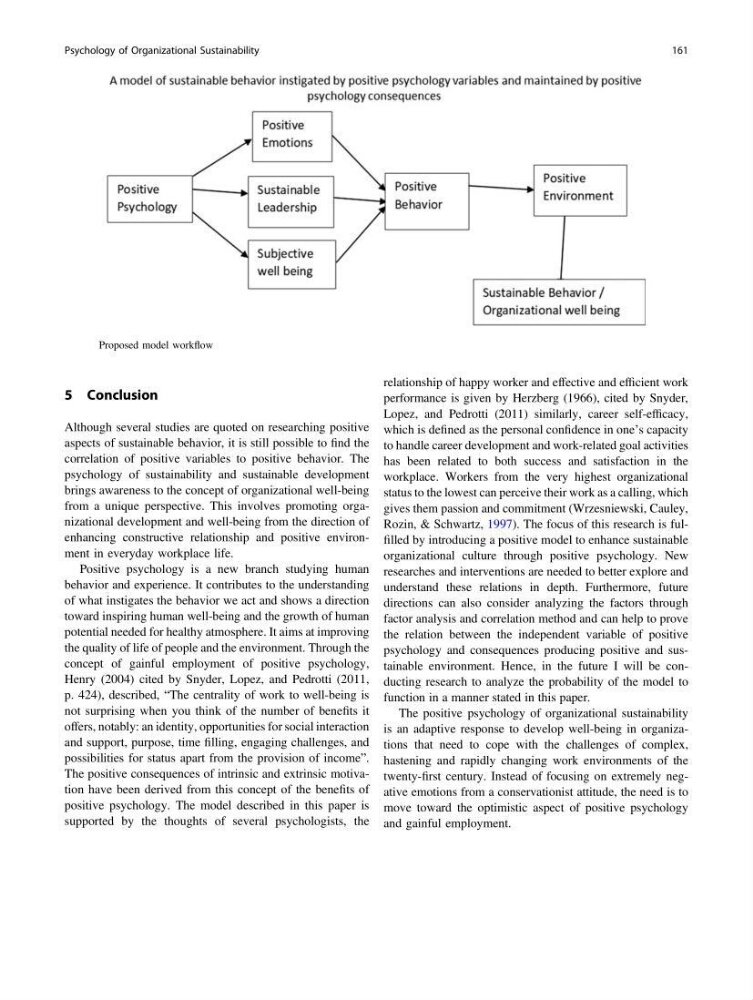
positive psychology. The model described in this paper is
supported by the thoughts of several psychologists, the
relationship of happy worker and effective and efficient work
performance is given by Herzberg (1966), cited by Snyder,
Lopez, and Pedrotti (2011) similarly, career self-efficacy,
which is defined as the personal confidence in one’s capacity
to handle career development and work-related goal activities
has been related to both success and satisfaction in the
workplace. Workers from the very highest organizational
status to the lowest can perceive their work as a calling, which
gives them passion and commitment (Wrzesniewski, Cauley,
Rozin, & Schwartz, 1997). The focus of this research is fulfilled by introducing a positive model to enhance sustainable
organizational culture through positive psychology. New
researches and interventions are needed to better explore and
understand these relations in depth. Furthermore, future
directions can also consider analyzing the factors through
factor analysis and correlation method and can help to prove
the relation between the independent variable of positive
psychology and consequences producing positive and sustainable environment. Hence, in the future I will be conducting research to analyze the probability of the model to
function in a manner stated in this paper.
The positive psychology of organizational sustainability
is an adaptive response to develop well-being in organizations that need to cope with the challenges of complex,
hastening and rapidly changing work environments of the
twenty-first century. Instead of focusing on extremely negative emotions from a conservationist attitude, the need is to
move toward the optimistic aspect of positive psychology
and gainful employment.
Fig. 1 Proposed model workflow
Psychology of Organizational Sustainability
161
Although several studies are quoted on researching positive
aspects of sustainable behavior, it is still possible to find the
correlation of positive variables to positive behavior. The
psychology of sustainability and sustainable development
brings awareness to the concept of organizational well-being
from a unique perspective. This involves promoting organizational development and well-being from the direction of
enhancing constructive relationship and positive environment in everyday workplace life.
Positive psychology is a new branch studying human
behavior and experience. It contributes to the understanding
of what instigates the behavior we act and shows a direction
toward inspiring human well-being and the growth of human
potential needed for healthy atmosphere. It aims at improving
the quality of life of people and the environment. Through the
concept of gainful employment of positive psychology,
Henry (2004) cited by Snyder, Lopez, and Pedrotti (2011,
p. 424), described, “The centrality of work to well-being is
not surprising when you think of the number of benefits it
offers, notably: an identity, opportunities for social interaction
and support, purpose, time filling, engaging challenges, and
possibilities for status apart from the provision of income”.
The positive consequences of intrinsic and extrinsic motivation have been derived from this concept of the benefits of
positive psychology. The model described in this paper is
supported by the thoughts of several psychologists, the
relationship of happy worker and effective and efficient work
performance is given by Herzberg (1966), cited by Snyder,
Lopez, and Pedrotti (2011) similarly, career self-efficacy,
which is defined as the personal confidence in one’s capacity
to handle career development and work-related goal activities
has been related to both success and satisfaction in the
workplace. Workers from the very highest organizational
status to the lowest can perceive their work as a calling, which
gives them passion and commitment (Wrzesniewski, Cauley,
Rozin, & Schwartz, 1997). The focus of this research is fulfilled by introducing a positive model to enhance sustainable
organizational culture through positive psychology. New
researches and interventions are needed to better explore and
understand these relations in depth. Furthermore, future
directions can also consider analyzing the factors through
factor analysis and correlation method and can help to prove
the relation between the independent variable of positive
psychology and consequences producing positive and sustainable environment. Hence, in the future I will be conducting research to analyze the probability of the model to
function in a manner stated in this paper.
The positive psychology of organizational sustainability
is an adaptive response to develop well-being in organizations that need to cope with the challenges of complex,
hastening and rapidly changing work environments of the
twenty-first century. Instead of focusing on extremely negative emotions from a conservationist attitude, the need is to
move toward the optimistic aspect of positive psychology
and gainful employment.
Fig. 1 Proposed model workflow
Psychology of Organizational Sustainability
161