

4.1.4 The Effect
This project exemplified the emphasis of two main aspects:
the integral process and the spatial aesthetics. The way in
which decisions were made held greater importance than the
design outcome itself. The participatory approach that was
adopted in this pilot project focused on engaging different
parties and considering their requirements and desires and
incorporate their recommendation in a simple generic
scheme.
Accordingly, the passage was transformed at the end into
a cultural microcosm in the middle of Downtown. It became
an inviting park equipped with fixed concrete benches, trees
for shading, soft lighting and the facades along both its sides
were renovated. Its activities vary according to the time of
day and day of the week, this new public space can be
considered a cultural park hosting different intellectual
events and accommodating several art exhibits, screenings,
book fairs and performances, and for every season the street
changes its decorations to embrace the occasion.
As a hybrid equilibrium of urban design and art manifestation in the northern part of Downtown Cairo, it highlights the existing and emerging initiatives in a way that
would help activate other underutilized public spaces in the
area.
4.2 Al-Alfi Street, State Intervention
Location: Al-Alfi Street off Emad ElDin, downtown Cairo.
Installed: Mid 1990s–ongoing.
Designed by: Cairo Governorate, General Organization for
Physical Planning GOPP then National organization of
urban harmony NOUH.
Sponsored and funded by: Cairo Governorate, union of
many banks, and Al-Alfi Street Tenants Association.
Area: 2868 m
2 (Width: 19.5 m, Length: 147.05 m).
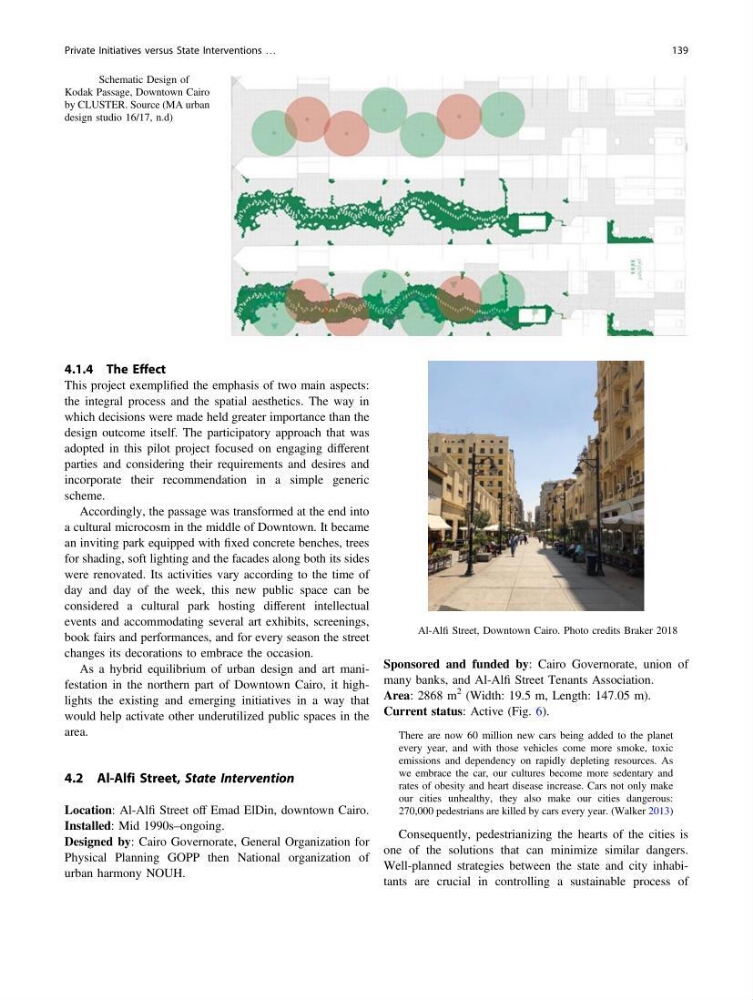
Current status: Active (Fig. 6).
There are now 60 million new cars being added to the planet
every year, and with those vehicles come more smoke, toxic
emissions and dependency on rapidly depleting resources. As
we embrace the car, our cultures become more sedentary and
rates of obesity and heart disease increase. Cars not only make
our cities unhealthy, they also make our cities dangerous:
270,000 pedestrians are killed by cars every year. (Walker 2013)
Consequently, pedestrianizing the hearts of the cities is
one of the solutions that can minimize similar dangers.
Well-planned strategies between the state and city inhabitants are crucial in controlling a sustainable process of
Fig. 5 Schematic Design of
Kodak Passage, Downtown Cairo
by CLUSTER. Source (MA urban
design studio 16/17, n.d)
Fig. 6 Al-Alfi Street, Downtown Cairo. Photo credits Braker 2018
Private Initiatives versus State Interventions …
139
This project exemplified the emphasis of two main aspects:
the integral process and the spatial aesthetics. The way in
which decisions were made held greater importance than the
design outcome itself. The participatory approach that was
adopted in this pilot project focused on engaging different
parties and considering their requirements and desires and
incorporate their recommendation in a simple generic
scheme.
Accordingly, the passage was transformed at the end into
a cultural microcosm in the middle of Downtown. It became
an inviting park equipped with fixed concrete benches, trees
for shading, soft lighting and the facades along both its sides
were renovated. Its activities vary according to the time of
day and day of the week, this new public space can be
considered a cultural park hosting different intellectual
events and accommodating several art exhibits, screenings,
book fairs and performances, and for every season the street
changes its decorations to embrace the occasion.
As a hybrid equilibrium of urban design and art manifestation in the northern part of Downtown Cairo, it highlights the existing and emerging initiatives in a way that
would help activate other underutilized public spaces in the
area.
4.2 Al-Alfi Street, State Intervention
Location: Al-Alfi Street off Emad ElDin, downtown Cairo.
Installed: Mid 1990s–ongoing.
Designed by: Cairo Governorate, General Organization for
Physical Planning GOPP then National organization of
urban harmony NOUH.
Sponsored and funded by: Cairo Governorate, union of
many banks, and Al-Alfi Street Tenants Association.
Area: 2868 m
2 (Width: 19.5 m, Length: 147.05 m).
Current status: Active (Fig. 6).
There are now 60 million new cars being added to the planet
every year, and with those vehicles come more smoke, toxic
emissions and dependency on rapidly depleting resources. As
we embrace the car, our cultures become more sedentary and
rates of obesity and heart disease increase. Cars not only make
our cities unhealthy, they also make our cities dangerous:
270,000 pedestrians are killed by cars every year. (Walker 2013)
Consequently, pedestrianizing the hearts of the cities is
one of the solutions that can minimize similar dangers.
Well-planned strategies between the state and city inhabitants are crucial in controlling a sustainable process of
Fig. 5 Schematic Design of
Kodak Passage, Downtown Cairo
by CLUSTER. Source (MA urban
design studio 16/17, n.d)
Fig. 6 Al-Alfi Street, Downtown Cairo. Photo credits Braker 2018
Private Initiatives versus State Interventions …
139