

straight line comes into play. The visibility and span of the
extending boulevards of Paris helped in facilitating control
over the city, something that could not be achieved through
the old narrow streets (Attia et al. 2012).
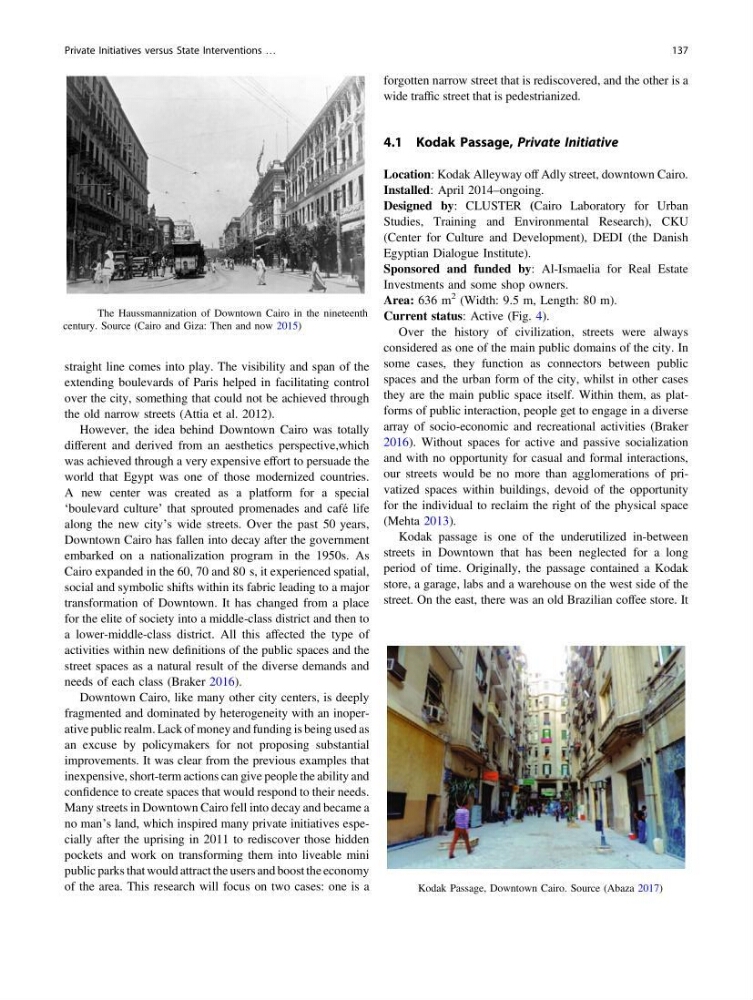
However, the idea behind Downtown Cairo was totally
different and derived from an aesthetics perspective,which
was achieved through a very expensive effort to persuade the
world that Egypt was one of those modernized countries.
A new center was created as a platform for a special
‘boulevard culture’ that sprouted promenades and café life
along the new city’s wide streets. Over the past 50 years,
Downtown Cairo has fallen into decay after the government
embarked on a nationalization program in the 1950s. As
Cairo expanded in the 60, 70 and 80 s, it experienced spatial,
social and symbolic shifts within its fabric leading to a major
transformation of Downtown. It has changed from a place
for the elite of society into a middle-class district and then to
a lower-middle-class district. All this affected the type of
activities within new definitions of the public spaces and the
street spaces as a natural result of the diverse demands and
needs of each class (Braker 2016).
Downtown Cairo, like many other city centers, is deeply
fragmented and dominated by heterogeneity with an inoperative public realm. Lack of money and funding is being used as
an excuse by policymakers for not proposing substantial
improvements. It was clear from the previous examples that
inexpensive, short-term actions can give people the ability and
confidence to create spaces that would respond to their needs.
Many streets in Downtown Cairo fell into decay and became a
no man’s land, which inspired many private initiatives especially after the uprising in 2011 to rediscover those hidden
pockets and work on transforming them into liveable mini
public parks that would attract the users and boost the economy
of the area. This research will focus on two cases: one is a
forgotten narrow street that is rediscovered, and the other is a
wide traffic street that is pedestrianized.
4.1 Kodak Passage, Private Initiative
Location: Kodak Alleyway off Adly street, downtown Cairo.
Installed: April 2014–ongoing.
Designed by: CLUSTER (Cairo Laboratory for Urban
Studies, Training and Environmental Research), CKU
(Center for Culture and Development), DEDI (the Danish
Egyptian Dialogue Institute).
Sponsored and funded by: Al-Ismaelia for Real Estate
Investments and some shop owners.
Area: 636 m
2 (Width: 9.5 m, Length: 80 m).
Current status: Active (Fig. 4).
Over the history of civilization, streets were always
considered as one of the main public domains of the city. In
some cases, they function as connectors between public
spaces and the urban form of the city, whilst in other cases
they are the main public space itself. Within them, as platforms of public interaction, people get to engage in a diverse
array of socio-economic and recreational activities (Braker
2016). Without spaces for active and passive socialization
and with no opportunity for casual and formal interactions,
our streets would be no more than agglomerations of privatized spaces within buildings, devoid of the opportunity
for the individual to reclaim the right of the physical space
(Mehta 2013).
Kodak passage is one of the underutilized in-between
streets in Downtown that has been neglected for a long
period of time. Originally, the passage contained a Kodak
store, a garage, labs and a warehouse on the west side of the
street. On the east, there was an old Brazilian coffee store. It
Fig. 3 The Haussmannization of Downtown Cairo in the nineteenth
century. Source (Cairo and Giza: Then and now 2015)
Fig. 4 Kodak Passage, Downtown Cairo. Source (Abaza 2017)
Private Initiatives versus State Interventions …
137
extending boulevards of Paris helped in facilitating control
over the city, something that could not be achieved through
the old narrow streets (Attia et al. 2012).
However, the idea behind Downtown Cairo was totally
different and derived from an aesthetics perspective,which
was achieved through a very expensive effort to persuade the
world that Egypt was one of those modernized countries.
A new center was created as a platform for a special
‘boulevard culture’ that sprouted promenades and café life
along the new city’s wide streets. Over the past 50 years,
Downtown Cairo has fallen into decay after the government
embarked on a nationalization program in the 1950s. As
Cairo expanded in the 60, 70 and 80 s, it experienced spatial,
social and symbolic shifts within its fabric leading to a major
transformation of Downtown. It has changed from a place
for the elite of society into a middle-class district and then to
a lower-middle-class district. All this affected the type of
activities within new definitions of the public spaces and the
street spaces as a natural result of the diverse demands and
needs of each class (Braker 2016).
Downtown Cairo, like many other city centers, is deeply
fragmented and dominated by heterogeneity with an inoperative public realm. Lack of money and funding is being used as
an excuse by policymakers for not proposing substantial
improvements. It was clear from the previous examples that
inexpensive, short-term actions can give people the ability and
confidence to create spaces that would respond to their needs.
Many streets in Downtown Cairo fell into decay and became a
no man’s land, which inspired many private initiatives especially after the uprising in 2011 to rediscover those hidden
pockets and work on transforming them into liveable mini
public parks that would attract the users and boost the economy
of the area. This research will focus on two cases: one is a
forgotten narrow street that is rediscovered, and the other is a
wide traffic street that is pedestrianized.
4.1 Kodak Passage, Private Initiative
Location: Kodak Alleyway off Adly street, downtown Cairo.
Installed: April 2014–ongoing.
Designed by: CLUSTER (Cairo Laboratory for Urban
Studies, Training and Environmental Research), CKU
(Center for Culture and Development), DEDI (the Danish
Egyptian Dialogue Institute).
Sponsored and funded by: Al-Ismaelia for Real Estate
Investments and some shop owners.
Area: 636 m
2 (Width: 9.5 m, Length: 80 m).
Current status: Active (Fig. 4).
Over the history of civilization, streets were always
considered as one of the main public domains of the city. In
some cases, they function as connectors between public
spaces and the urban form of the city, whilst in other cases
they are the main public space itself. Within them, as platforms of public interaction, people get to engage in a diverse
array of socio-economic and recreational activities (Braker
2016). Without spaces for active and passive socialization
and with no opportunity for casual and formal interactions,
our streets would be no more than agglomerations of privatized spaces within buildings, devoid of the opportunity
for the individual to reclaim the right of the physical space
(Mehta 2013).
Kodak passage is one of the underutilized in-between
streets in Downtown that has been neglected for a long
period of time. Originally, the passage contained a Kodak
store, a garage, labs and a warehouse on the west side of the
street. On the east, there was an old Brazilian coffee store. It
Fig. 3 The Haussmannization of Downtown Cairo in the nineteenth
century. Source (Cairo and Giza: Then and now 2015)
Fig. 4 Kodak Passage, Downtown Cairo. Source (Abaza 2017)
Private Initiatives versus State Interventions …
137