

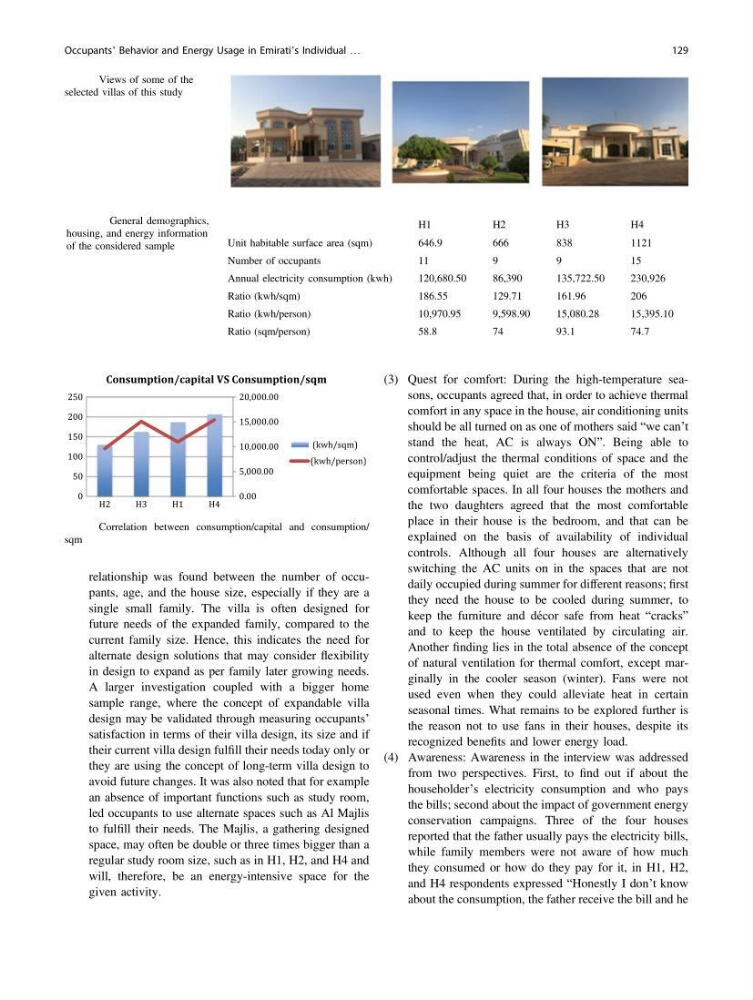
relationship was found between the number of occupants, age, and the house size, especially if they are a
single small family. The villa is often designed for
future needs of the expanded family, compared to the
current family size. Hence, this indicates the need for
alternate design solutions that may consider flexibility
in design to expand as per family later growing needs.
A larger investigation coupled with a bigger home
sample range, where the concept of expandable villa
design may be validated through measuring occupants’
satisfaction in terms of their villa design, its size and if
their current villa design fulfill their needs today only or
they are using the concept of long-term villa design to
avoid future changes. It was also noted that for example
an absence of important functions such as study room,
led occupants to use alternate spaces such as Al Majlis
to fulfill their needs. The Majlis, a gathering designed
space, may often be double or three times bigger than a
regular study room size, such as in H1, H2, and H4 and
will, therefore, be an energy-intensive space for the
given activity.
(3) Quest for comfort: During the high-temperature seasons, occupants agreed that, in order to achieve thermal
comfort in any space in the house, air conditioning units
should be all turned on as one of mothers said “we can’t
stand the heat, AC is always ON”. Being able to
control/adjust the thermal conditions of space and the
equipment being quiet are the criteria of the most
comfortable spaces. In all four houses the mothers and
the two daughters agreed that the most comfortable
place in their house is the bedroom, and that can be
explained on the basis of availability of individual
controls. Although all four houses are alternatively
switching the AC units on in the spaces that are not
daily occupied during summer for different reasons; first
they need the house to be cooled during summer, to
keep the furniture and décor safe from heat “cracks”
and to keep the house ventilated by circulating air.
Another finding lies in the total absence of the concept
of natural ventilation for thermal comfort, except marginally in the cooler season (winter). Fans were not
used even when they could alleviate heat in certain
seasonal times. What remains to be explored further is
the reason not to use fans in their houses, despite its
recognized benefits and lower energy load.
(4) Awareness: Awareness in the interview was addressed
from two perspectives. First, to find out if about the
householder’s electricity consumption and who pays
the bills; second about the impact of government energy
conservation campaigns. Three of the four houses
reported that the father usually pays the electricity bills,
while family members were not aware of how much
they consumed or how do they pay for it, in H1, H2,
and H4 respondents expressed “Honestly I don’t know
about the consumption, the father receive the bill and he
Fig. 5 Views of some of the
selected villas of this study
Table 1 General demographics,
housing, and energy information
of the considered sample
H1
H2
H3
H4
Unit habitable surface area (sqm)
646.9
666
838
1121
Number of occupants
11
9
9
15
Annual electricity consumption (kwh)
120,680.50
86,390
135,722.50
230,926
Ratio (kwh/sqm)
186.55
129.71
161.96
206
Ratio (kwh/person)
10,970.95
9,598.90
15,080.28
15,395.10
Ratio (sqm/person)
58.8
74
93.1
74.7
Fig. 6 Correlation between consumption/capital and consumption/
sqm
Occupants’ Behavior and Energy Usage in Emirati’s Individual …
129
single small family. The villa is often designed for
future needs of the expanded family, compared to the
current family size. Hence, this indicates the need for
alternate design solutions that may consider flexibility
in design to expand as per family later growing needs.
A larger investigation coupled with a bigger home
sample range, where the concept of expandable villa
design may be validated through measuring occupants’
satisfaction in terms of their villa design, its size and if
their current villa design fulfill their needs today only or
they are using the concept of long-term villa design to
avoid future changes. It was also noted that for example
an absence of important functions such as study room,
led occupants to use alternate spaces such as Al Majlis
to fulfill their needs. The Majlis, a gathering designed
space, may often be double or three times bigger than a
regular study room size, such as in H1, H2, and H4 and
will, therefore, be an energy-intensive space for the
given activity.
(3) Quest for comfort: During the high-temperature seasons, occupants agreed that, in order to achieve thermal
comfort in any space in the house, air conditioning units
should be all turned on as one of mothers said “we can’t
stand the heat, AC is always ON”. Being able to
control/adjust the thermal conditions of space and the
equipment being quiet are the criteria of the most
comfortable spaces. In all four houses the mothers and
the two daughters agreed that the most comfortable
place in their house is the bedroom, and that can be
explained on the basis of availability of individual
controls. Although all four houses are alternatively
switching the AC units on in the spaces that are not
daily occupied during summer for different reasons; first
they need the house to be cooled during summer, to
keep the furniture and décor safe from heat “cracks”
and to keep the house ventilated by circulating air.
Another finding lies in the total absence of the concept
of natural ventilation for thermal comfort, except marginally in the cooler season (winter). Fans were not
used even when they could alleviate heat in certain
seasonal times. What remains to be explored further is
the reason not to use fans in their houses, despite its
recognized benefits and lower energy load.
(4) Awareness: Awareness in the interview was addressed
from two perspectives. First, to find out if about the
householder’s electricity consumption and who pays
the bills; second about the impact of government energy
conservation campaigns. Three of the four houses
reported that the father usually pays the electricity bills,
while family members were not aware of how much
they consumed or how do they pay for it, in H1, H2,
and H4 respondents expressed “Honestly I don’t know
about the consumption, the father receive the bill and he
Fig. 5 Views of some of the
selected villas of this study
Table 1 General demographics,
housing, and energy information
of the considered sample
H1
H2
H3
H4
Unit habitable surface area (sqm)
646.9
666
838
1121
Number of occupants
11
9
9
15
Annual electricity consumption (kwh)
120,680.50
86,390
135,722.50
230,926
Ratio (kwh/sqm)
186.55
129.71
161.96
206
Ratio (kwh/person)
10,970.95
9,598.90
15,080.28
15,395.10
Ratio (sqm/person)
58.8
74
93.1
74.7
Fig. 6 Correlation between consumption/capital and consumption/
sqm
Occupants’ Behavior and Energy Usage in Emirati’s Individual …
129