

challenges. The project takes a holistic approach, unifying
research, education, and practice to stimulate students to
identify solutions based on market trends and sustainability.
The conventional steps of fashion design practice were
challenged and reinvented during this project. The usual
flow starting with trend and concept research, and going on
to concept/theme selection, color selection, designing of
outfits/technical drawings, fabric research and sourcing,
patternmaking/draping, sewing and finishing, was followed
in a different order, as the students started with trend
research along with identifying and sourcing used and/or
end-of-roll fabrics. This was the most critical step as the
fabric would serve as inspiration for the designs, thereby
deploying “new ways” of designing to meet creativity as
well as sustainability goals. Further research was then
conducted to create designs that would align with the
sustainable principles of zero-waste, upcycling and
reconstruction.
After participating in the project, the students reported
learnings that were multidimensional. There was a substantial increase in their knowledge and skills, and they felt
enabled, empowered, and inspired to implement sustainable
design strategies. They also experienced improvement in
critical thinking skills and problem-solving due to the
complexities arising because of limited fabric resources. Due
to the social and community nature of the project, feelings of
empathy and social responsibility were heightened (Grose
2017). The teachers took on the role of facilitators during the
student-centered project (Welsh and Murray 2003). As cited
by Agarwal and proposed by Jeffrey and Craft, this “learner
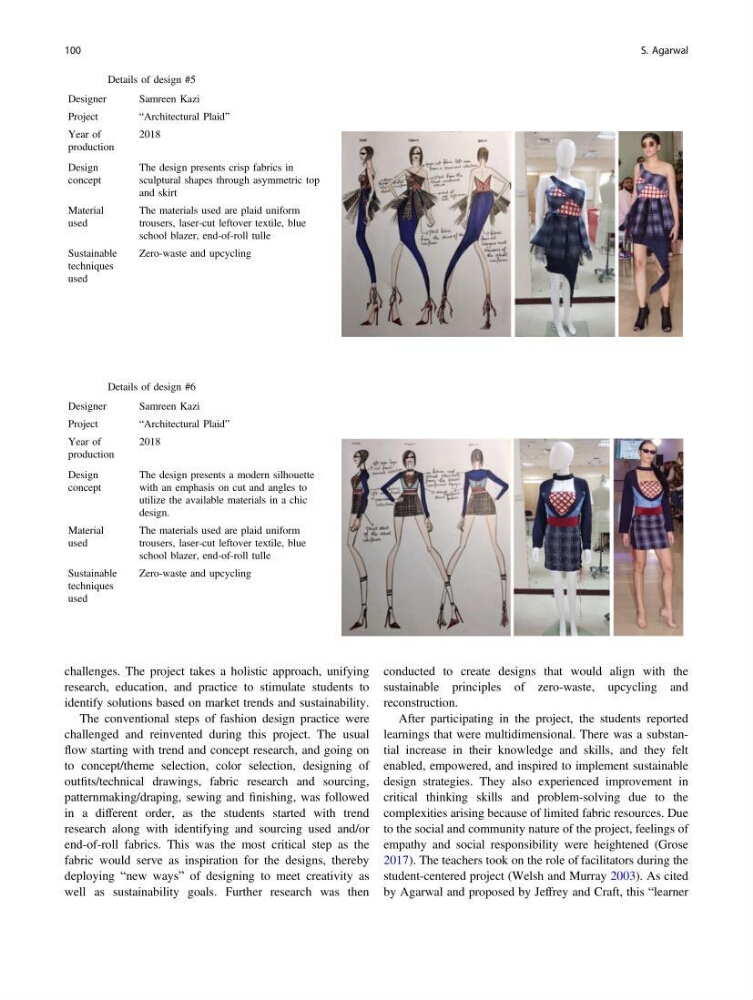
Table 5 Details of design #5
Designer
Samreen Kazi
Project
“Architectural Plaid”
Year of
production
2018
Design
concept
The design presents crisp fabrics in
sculptural shapes through asymmetric top
and skirt
Material
used
The materials used are plaid uniform
trousers, laser-cut leftover textile, blue
school blazer, end-of-roll tulle
Sustainable
techniques
used
Zero-waste and upcycling
Table 6 Details of design #6
Designer
Samreen Kazi
Project
“Architectural Plaid”
Year of
production
2018
Design
concept
The design presents a modern silhouette
with an emphasis on cut and angles to
utilize the available materials in a chic
design.
Material
used
The materials used are plaid uniform
trousers, laser-cut leftover textile, blue
school blazer, end-of-roll tulle
Sustainable
techniques
used
Zero-waste and upcycling
100
S. Agarwal
research, education, and practice to stimulate students to
identify solutions based on market trends and sustainability.
The conventional steps of fashion design practice were
challenged and reinvented during this project. The usual
flow starting with trend and concept research, and going on
to concept/theme selection, color selection, designing of
outfits/technical drawings, fabric research and sourcing,
patternmaking/draping, sewing and finishing, was followed
in a different order, as the students started with trend
research along with identifying and sourcing used and/or
end-of-roll fabrics. This was the most critical step as the
fabric would serve as inspiration for the designs, thereby
deploying “new ways” of designing to meet creativity as
well as sustainability goals. Further research was then
conducted to create designs that would align with the
sustainable principles of zero-waste, upcycling and
reconstruction.
After participating in the project, the students reported
learnings that were multidimensional. There was a substantial increase in their knowledge and skills, and they felt
enabled, empowered, and inspired to implement sustainable
design strategies. They also experienced improvement in
critical thinking skills and problem-solving due to the
complexities arising because of limited fabric resources. Due
to the social and community nature of the project, feelings of
empathy and social responsibility were heightened (Grose
2017). The teachers took on the role of facilitators during the
student-centered project (Welsh and Murray 2003). As cited
by Agarwal and proposed by Jeffrey and Craft, this “learner
Table 5 Details of design #5
Designer
Samreen Kazi
Project
“Architectural Plaid”
Year of
production
2018
Design
concept
The design presents crisp fabrics in
sculptural shapes through asymmetric top
and skirt
Material
used
The materials used are plaid uniform
trousers, laser-cut leftover textile, blue
school blazer, end-of-roll tulle
Sustainable
techniques
used
Zero-waste and upcycling
Table 6 Details of design #6
Designer
Samreen Kazi
Project
“Architectural Plaid”
Year of
production
2018
Design
concept
The design presents a modern silhouette
with an emphasis on cut and angles to
utilize the available materials in a chic
design.
Material
used
The materials used are plaid uniform
trousers, laser-cut leftover textile, blue
school blazer, end-of-roll tulle
Sustainable
techniques
used
Zero-waste and upcycling
100
S. Agarwal